



Scores bolster case for Shanghai math









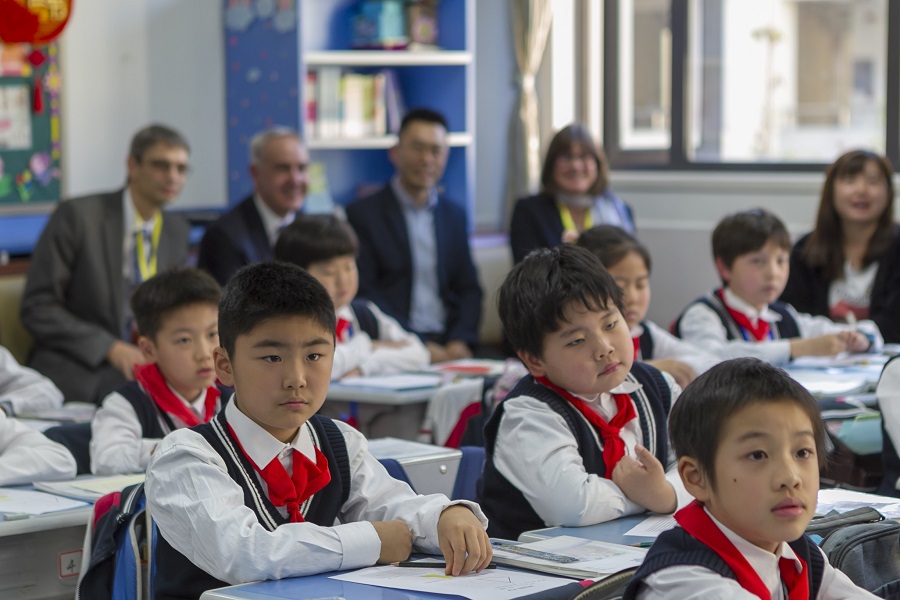
Top scores produced by Chinese teenagers in a recent global academic test indicate the British government made a positive move in importing the Shanghai-style math teaching method into UK schools over the past five years, observers said.
In the latest Program for International Student Assessment, run by the Organization for Economic Cooperation and Development, 15-year-old students from Beijing and Shanghai, as well as Jiangsu and Zhejiang provinces, outperformed their peers in all of the other 78 participating education systems in mathematics and science by a wide margin. In reading comprehension scores, only Singapore came close.
In fact, the 10 percent most disadvantaged students in these four regions of China-which have a combined population of about 180 million-showed better reading skills than those of the average student in all OECD countries, and they performed on a par with the 10 percent most advantaged students in some of them.
Chinese mainland students first took part in the tests in 2009, when students from Shanghai ranked on top, and the city also claimed the top spot again in the 2012 PISA test, when students from the United Kingdom ranked 26th in math.
The PISA rankings triggered global interest in Chinese methods, and as a result Britain increased exchanges with Chinese teachers and schools to find out how to improve quality.
Nearly 600 teachers from England and China, mainly from primary schools, have engaged in the exchange since 2014, and around 5,000 of Britain's 16,000 primary schools have adopted the Shanghai math teaching method.
Experts have said Shanghai's continuous good results in math have underlined the value of understanding what lies behind China's success and seeing what is applicable in other contexts.
David Johnson, an academic of comparative and international education at the University of Oxford, said, "Any example of success, good performance elsewhere, is something any country should look seriously at.
"It is a justifiable reason to look at China very seriously in terms of how it performs in mathematics, and that was the absolute right thing to do," Johnson said.
Mark Boylan, a professor of education at Sheffield Hallam University, said: "Chinese success in PISA 2009 and 2012 led the English Department for Education to develop a teacher exchange program to learn from and adopt mathematics teaching methods from Shanghai.
"The ongoing success in PISA 2018 is likely to encourage policymakers in England to continue and enhance the links with China," said Boylan, who led the evaluation of the Mathematics Teacher Exchange. "This approach has now spread beyond mathematics to literacy. Chinese success in the PISA reading tests may further encourage these developments."
The assessment is carried out every three years and involves more than 500,000 students around the world taking two-hour tests.
In the 2018 PISA test, the latest, students from four regions in China scored an average of 591 points in math-more than 100 points higher than the OECD average. British students had an average score of 502, jumping from 27th place three years ago to 18th in the international ranking for math.
While welcoming the PISA result, the National Centre for Excellence in the Teaching of Mathematics said: "It is too early to draw any direct link between the results and the changes to math teaching in English schools."
The exchange program focused mainly on English primary school classrooms, and then more recently was extended to some secondary schools. Pupils taking part in the most recent PISA tests were between the ages of 15 and 16 in autumn 2018.
This means they had left primary school by summer 2014, before the new teaching initiative had gained momentum.
Johnson, the Oxford academic, said that although a strong correlation cannot be drawn between the Shanghai exchange program and the improved performance of the English students, "it does look like, at least on the face of it, that the teachers who have participated are reasonably comfortable and happy to continue to use the methods".
Philip Avery, director of education for the Bohunt Education Trust, said: "We've benefited from working with Chinese partners due to the very high quality of sequencing, lesson planning and teaching for memorization in China. Our Chinese partners have benefited from our approach to the development of character, focus on innovation and application of knowledge."
However, education experts pointed out that China still has a long way to go to improve in other areas.
Zhang Xuanmin, former president of Shanghai Normal University and the person in charge of the PISA project in Shanghai, said that while Chinese students' results in the latest PISA test are welcome news, the four regions do not reflect China as a whole.
"Math, science and reading-these are all the important subjects in basic education. But there is still more to it, and Chinese students need to improve their social and emotional competencies," Zhang said.
"It is also worth noting that basic education is not the whole education (process)," he added. "In the list of the top 100 universities in the world, the United States accounts for 45 to 50, more than 30 are in Europe, a dozen in the Asia-Pacific, and (only) about two or three are in China, so there is still a long way ahead."






- China's Global Governance Initiative receives positive feedback at forum
- China's Xizang sees steady tourism growth in 2025
- First-of-its-kind pearl auction held utilizing Hainan FTP
- Agarwood exhibition steeps Shanghai museum in fragrance
- The Fujian Coast Guard conducts regular law enforcement patrol in the waters near Jinmen
- IP protection for new fields to improve














