



Pinduoduo disrupts China's e-commerce









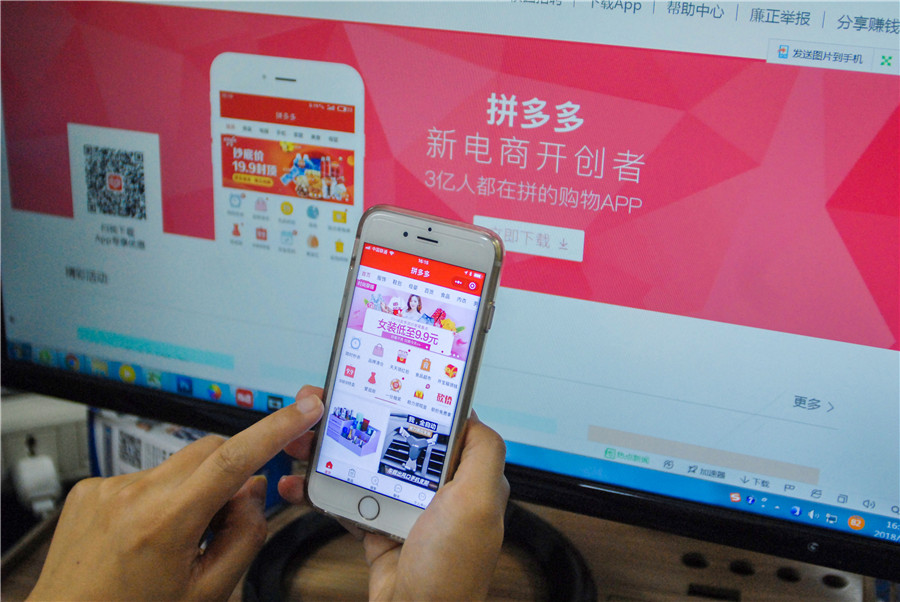
Deeper discounts on generic products stoke group-buying, boost e-shopping
Wu Weidong was never much of an online shopper.
The 47-year-old resident of Yanzhou, a small town in China's eastern Shandong province, typically bought groceries from local stores.
But messages from friends asking him to join their group purchases of fruits at bargain prices on the website Pinduoduo finally persuaded him to open an account there.
"It's mainly because my friends said the items there are cheap," he said. "So I've started using Pinduoduo more to buy fruits and snacks."
Started four years ago by a former Google engineer, Pinduoduo has become one of China's biggest retail disruptors, breaking the dominance of Alibaba and JD by persuading users like Wu, who live in China's smaller cities, to start shopping online.
Alibaba and JD have for years tried to unleash rural China's spending power, teaching residents how to use their online platforms and using drones for deliveries to remote spots, with mixed results.
But the success of Pinduoduo's model, which offers users deeper discounts on mostly generic products if they buy in groups, and encourages them to share purchases through messaging app WeChat, is driving Alibaba and JD to make a fresh push into China's lower-tier cities.
Pinduoduo did not reveal its Singles Day (Nov 11 or 11-11) sales data this year, but big data provider Syntun said Pinduoduo was ranked as the third-largest online sales platform during the shopping festival.
Syntun noted Alibaba's Singles Day sales grew 26 percent year-on-year to 268.4 billion yuan ($38 billion) this year. That tremendous figure made Alibaba the largest online platforms during the festival, followed by JD and Pinduoduo, Syntun data showed.
Pinduoduo said the company considered Singles Day as just an ordinary busy day.
"Compared with the numbers, we care more about whether the consumers have enjoyed real benefits and fun," the company said in a public letter.
According to the letter, more than 1,000 cars were sold on the platform in just over 16 minutes of the Nov 11 event this year, mainly from the third-, fourth-and fifth-tier cities.
Pinduoduo noted in the letter that agricultural products from less-developed areas reported 220-percent growth in Singles Day sales, mainly purchased by consumers from the first-and second-tier cities.
Actually, residents of lower-tier cities and towns are becoming the new driving force behind the online sales growth. Mobile developer-service provider Jiguang showed that consumers from the third-tier cities or below accounted for 55.5 percent of the total Singles Day consumers last year.
Pinduoduo has already seen the big potential in the spending power of lower-tier city folk and townspeople, with its unique business strategy that aimed at capturing the large number of deal-seeking users via team purchasing. And it has already made a name.
Pinduoduo reported 483.2 million active buyers at the end of June, versus Alibaba's 674 million. JD has 321.3 million annual active customer accounts.
"China's e-commerce has been a duopoly market for years. Against everyone's expectation, there came Pinduoduo, emerging with a completely different set of practices to engage with users," said Keso Hong, an independent internet commentator in China.
Analysts say Pinduoduo gained a foothold in the market thanks to the shortcomings in some of Alibaba and JD's models.
The two e-commerce giants built their businesses on the country's burgeoning middle-income group, competing intensely to woo big international brands like Burberry or Valentino to set up online stores. But it was hard to persuade residents in lower-tier cities that they needed to shop for luxury goods online.
Pinduoduo's model encourages users to recommend products to friends and family to gain discounts, and heavily leverages WeChat, China's dominant messaging service, which is owned by Pinduoduo-backer Tencent Holdings.
A slowing economy has hurt Alibaba's purchasing power and JD's big-city core consumer base. Residents in lower-tier cities are starting to have higher disposable incomes compared with their first-tier city compatriots, whose living costs are higher, economists say.
To be sure, Pinduoduo's user base remains much smaller than market leader Alibaba's, and its rise has not been without challenges.
Local media reports last month cited Pinduoduo's founder Huang Zheng as saying in an internal meeting that its gross merchandise volume, the value of goods sold on its website and app within a certain time period, had surpassed that of JD. The remarks drew a sharp response from the latter.
"Based on our internal analysis, we believe there is a significant gap between Pinduoduo and JD in terms of GMV (by any imaginable measures), basket size, return rate, and so on," a JD spokesman said.
Pinduoduo also remains dogged by accusations that its site hosts counterfeits. The company says it is cracking down on fakes.
Meanwhile, Alibaba and JD are trying to get a foothold in rural areas. JD in September upgraded its group-buying platform, renaming it Jingxi, and is looking to improve logistics for users, saying that it wants to eventually fulfill deliveries to smaller cities within 24 hours.
Alibaba has announced a fresh focus on expanding in less-developed areas. Last year, it launched a mobile app called Taobao Tejia, or Taobao Discounts, which offers rock bottom bargain deals.
In August, Alibaba Vice-Chairman Joe Tsai predicted that retail consumption from the lower-tier cities and townships would triple from $2.3 trillion to nearly $7 trillion by 2030, equivalent to compounded annual growth of 10 percent.
An Alibaba spokesman said that although 85 percent of Chinese residents in developed areas have used Alibaba's retail marketplace, the penetration was only 40 percent in less-developed places. That presents a "tremendous opportunity", he said.
Xinhua contributed to the story.



















