


Chinese science fiction wins growing universal approval









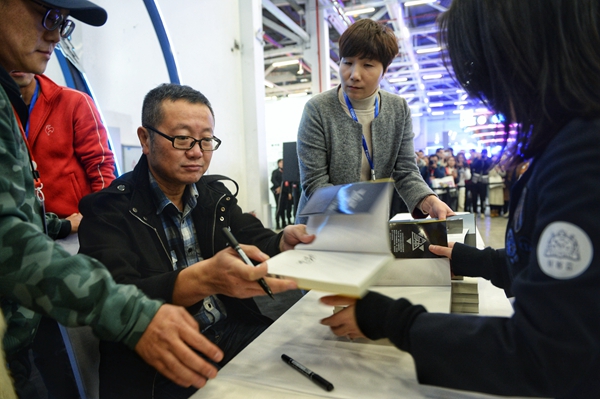
The Japanese version of The Three-Body Problem, the first book in Chinese author Liu Cixin's The Three-Body trilogy, has proved to be a hit since it was launched in July.
The Hugo Award-winning novelist's work has sold over 130,000 copies and become Japan's best-selling science-fiction novel in 2019, says Marie Umeda, editor of Hayakawa Publishing Corp, the book's publisher, during an international sci-fi conference in Chengdu, Southwest China.
Chengdu, perhaps best known for being home to many of the nation's pandas, is making an effort to establish itself as China's leading sci-fi hub and has entered a formal bid to host the 81st World Science Fiction Convention in 2023.
So far, The Three-Body trilogy has been published in 20 foreign languages, most recently in Serbian. Celebrity fans of the books include former US president Barack Obama and Facebook founder Mark Zuckerberg.
Chinese sci-fi has begun attracting global attention and is contributing its unique outlook, as well as its interpretation of Eastern philosophy, to the world of literature.
"There is often a 'lone hero' in Western sci-fi, but Chinese sci-fi seldom highlights an individual. Although each story has a protagonist, we focus more on the collective wisdom of a team or a group behind the protagonist," says Han Song, a Chinese sci-fi writer.
He says the difference has cultural roots. Modern science and sci-fi came from the West. While accepting external influences, Chinese sci-fi also retains its own traditions.
For nearly two centuries, Chinese authors were absent in global sci-fi literature which had long been dominated by European and American writers.
China's first sci-fi boom started in the early 20th century when the then impoverished, war-torn country looked to the sciences for national rejuvenation. The reform and opening-up policy introduced in the late 1970s kicked off another boom in sci-fi appetite.
In recent years, China has witnessed renewed public enthusiasm for sci-fi, coming at a time when the country is pushing for technological innovation. Liu Cixin and the other Chinese writer, Hao Jingfang, both winning the Hugo Award has helped bring the once marginalized literary genre into the mainstream.
Gong Ge'er, the producer of Chinese sci-fi blockbuster The Wandering Earth, started reading sci-fi magazines in 1991 when he was 10 years old. In the same year, the annual convention of the World Science Fiction Society was held in China for the first time.
Gong says Chinese sci-fi integrates Chinese philosophy into stories, which is distinctive enough to attract more global fans because the works represent Chinese people's views on the world and themselves.
"The more we open up and look at science fiction from around the world from different cultures, the richer it makes all of our science fiction," says Suzanne Palmer, an American sci-fi writer who won the Hugo Award in 2018 with The Secret Life of Bots.
Kaori Uehara, a visiting research fellow at Tokyo Metropolitan University, began to follow and study Chinese sci-fi about 20 years ago. She says Chinese science fiction reflects how Chinese people imagine the future, which is exactly what the international community is most concerned about at present, making it increasingly popular around the world.
Her idea was echoed by Robert J.Sawyer, a Canadian sci-fi author and winner of both the Hugo and Nebula awards.
"China has been a country of bold experimentation. Things are being tested here. Sometimes they work, sometimes they don't, but there is a belief that the future that lies ahead of us is better than the past. It's central to the Chinese perspective," he says.
"I think if there is a future for science fiction, it will probably be here (in China)," he says.