



Macao achieves leapfrog development since returning to China









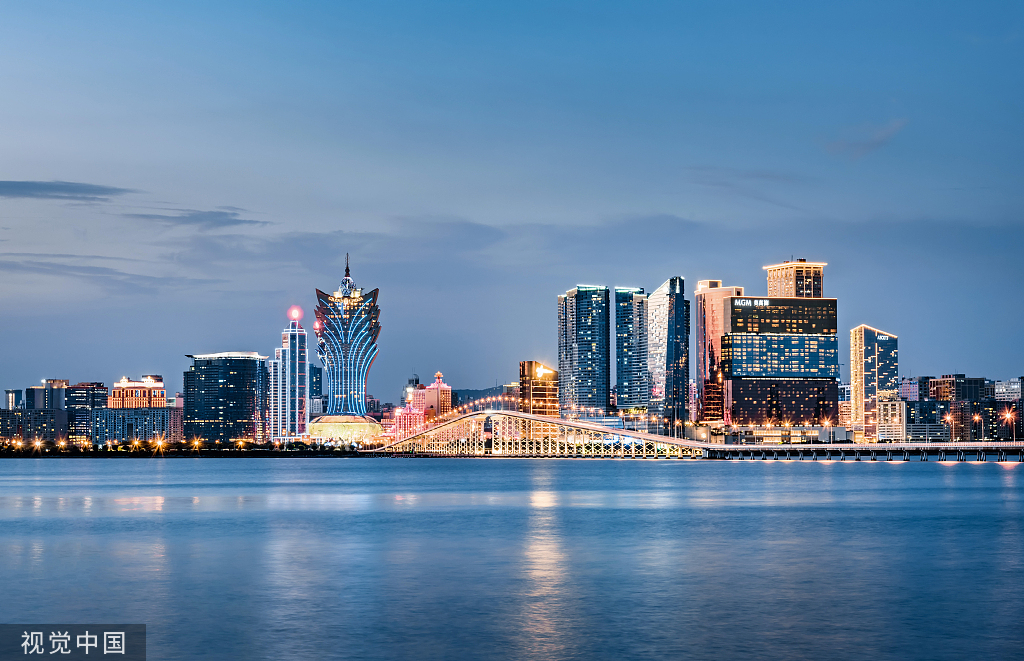
Macao has achieved remarkable progress since it returned to China 20 years ago, and the changes it experienced are obvious to all.
It has grown into one of the world’s fastest-growing regions, enjoying top-notch per capita GDP.
Macao’s GDP made leapfrog development, growing from 51.9 billion mop ($6.48 billion) in 1999 to 444.7 billion mop last year, and its per capita GDP also increased to 670,000 mop from 120,000 mop during the same period.
It’s a hard-won achievement for Macao, as the past 20 years was not plain sailing. It had been impacted by the SARS virus, hit by the financial crisis and traumatized by Typhoon Hato.
In 2002, the government of the Macao Special Administrative Region (SAR) freed up its gambling sector. The decision brought a quick pickup of the region’s economy, but also posed a threat that the industry might be made into an only prospering sector of the Macao society.
A year later, the Macao SAR government proposed to appropriately diversify its economy and vowed to build Macao into a world-class tourism and leisure center in 2007. Guaranteeing the healthy development of tourism, Macao is making huge efforts to advance emerging sectors such as convention and exhibition, traditional Chinese medicine, specialized financial services and cultural and creative industries.
“Macao has always stuck to its advantages - tourism and resort industries,” said Matthew Liu, professor with the University of Macau.
Liu believes that the 20 years of economic growth of Macao came from the successful implementation of the “One country, Two systems” principle and the strong support offered by the central government, as well as the joint efforts made by the diligent and plain Macao residents, and the correct positioning of the Macao SAR government.
Fo Kion is a third-generation settler in Macao who has served as a policeman and been engaged in leather business. Now he is thriving in food trade.
The 60-year-old man has witnessed the changes that the city went through, saying the country has offered many favorable policies during the past 20 years, and that’s what guaranteed the sound development of Macao. “My experience is the best proof,” he noted.
In 2003, the Closer Economic Partnership Arrangement (CEPA) was inked by the mainland and Macao, promoting the economic growth of the SAR together with the continuously deepening cooperation in the pan-Pearl River Delta.
To develop into a world-class tourism and leisure center and to build a commerce and trade cooperation service platform between China and Lusophone countries were included in China’s Twelfth and Thirteenth Fiver-Year Plans to appropriately diversify the region’s economy.
As a micro economy, Macao has long suffered from its economic size. In 2009, the State Council formally approved Hengqin, Zhuhai as a demonstration zone to explore new models of cooperation among Guangdong, Hong Kong and Macao under the framework of the “One country, two system” framework, and Hengqin substantially expanded the development space for Macao.
In the past 20 years, Macao’s position has been more and more clear, and its advantages well complement the demand of the country.
Due to historical reasons, Macao has an extensive connection with Lusophone countries that have a combined population of 250 million. In 2003, the Forum for Economic and Trade Co-operation between China and Portuguese-speaking Countries was established.
Two years ago, the China-Portuguese-speaking Countries Co-operation and Development Fund was found in Macao. The $1-billion fund will mainly invest in agriculture, manufacture, and energy industries of Mozambique, Angola, and Brazil, offering financial services for the construction of the Belt and Road Initiative.
Macao’s position becomes even clearer as the Outline Development Plan for the Guangdong-Hong Kong-Macao Greater Bay Area was issued Feb. this year. The plan aims to develop Macao into a base for exchange and cooperation where Chinese culture is the mainstream and diverse cultures coexist.
The Greater Bay Area covering Hong Kong, Macao and nine cities in Guangdong creates huge possibilities for Macao.
Macao, with its small piece of land and population, can only give full play to its advantages and avoid its shortages by cooperating with surrounding cities, Liu remarked.
“The Greater Bay Area, with a population of nearly 67 million, enjoys rich human resources and market, and is able to attract more capital. Macao can even promote its business models to the entire mainland market through the Area,” Liu said.
He took beef noodle as an example, saying that the noodle can be sold to only 600,000 people in Macao, but in the future, it will be sold to the entire mainland, including Xi’an, Nanning and Chongqing.
During the past 20 years, major development strategies such as the CEPA, the pan-Pearl River Delta cooperation, the Belt and Road construction, and the development of the Guangdong-Hong Kong-Macao Greater Bay Area have created opportunities for Macao again and again. Macao is not closely connected with the mainland, with frequent exchanges of personnel and economic cooperation.
Joining hands and supporting each other, the mainland and Macao will jointly create a better future.





