



Macao proof of 'one country, two systems' success









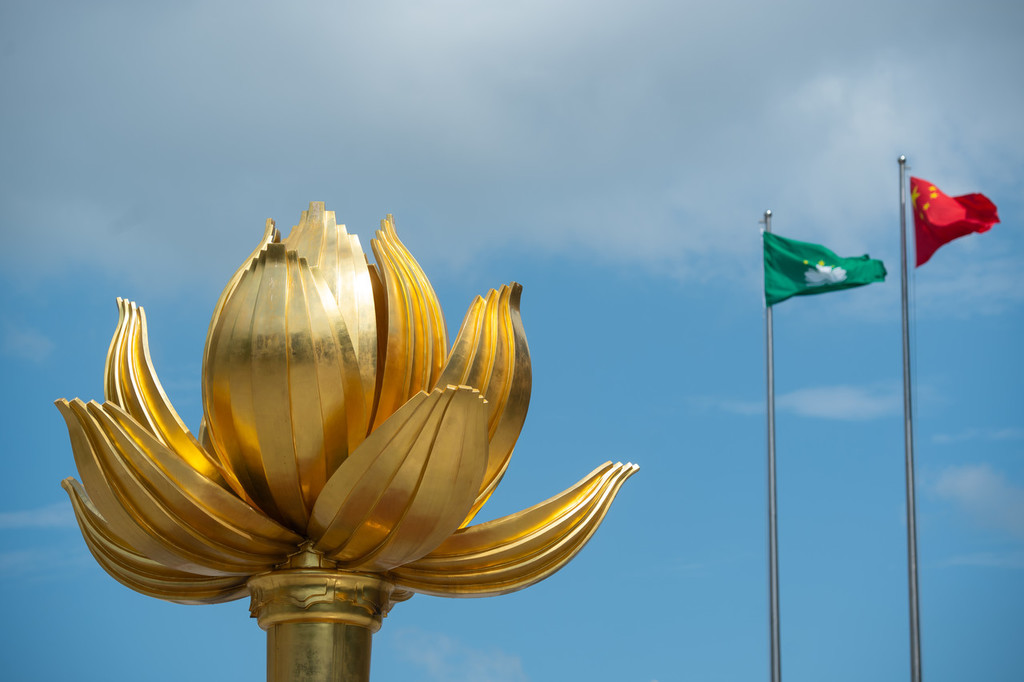
President Xi Jinping's trip to Macao last week to commemorate the 20th anniversary of Macao's return to the motherland reminded me not only of my visit there in May 2013, but also of its rich history and how far and fast the Macao Special Administrative Region has progressed under the "one country, two systems" model crafted in the early 1980s by Deng Xiaoping.
On my visit, I remember the exotic mixture of Portuguese and Chinese cultures. They not only existed side by side but actually were inextricably intertwined by the threads of history.
We all know that China was Asia's maritime colossus with Admiral Zheng He's massive fleet in the late Ming dynasty. But, from Europe, both Spain and Portugal ruled the sea around that time as well. Macao was one of the key ports of the Maritime Silk Road facilitating this trade when the Portuguese took control of it in 1557 and for a century thereafter. China in fact was Europe's leading supplier of luxury goods such as blue and white porcelain, tea and silk until the early 19th century. Around that time the British and Dutch wrestled control of most East Asian trading routes and after the first Opium War, Macao became a sleepy shadow of its former self and remained that way for more than a century.
At the time of my visit in 2013, some casinos and other buildings and infrastructure had been built but many others were works in various stages of construction, and reminded me of Beijing pre-2008 Olympics. My favorite was The Venetian. It, like many others, was busy enough but it was certainly cleaner and infinitely more pleasurable than fighting the crowds in St. Mark's Square. From the TV coverage on CGTN, I could see that Macao has now become full of tall buildings and quickly matured.
What I never thought about then though was just how rich Macao was. "One country, two systems" has been a boon for Macao. The numbers speak for themselves. In 1999, the year of its return to China, its GDP rose from 51.87 billion Macao patacas, the local currency (US$6.43 billion), to 444.7 billion patacas last year. Macao's GDP per capita by purchasing power parity is one of the highest in the world and was unsurpassed by any other country in 2014 according to the World Bank. And according to the International Monetary Fund, 2020 will find Macao as having the world's highest per capita income.
In this era of governments drowning in red ink globally, Macao's surplus last year was 505.6 billion yuan, a 193-fold increase over 1999. Coupled with that in the same period, unemployment decreased from 6.3 percent to a rock bottom 1.8 percent.
And it's never wise to put all your eggs in one basket, although in this case it's chips, as Macao relies on the gaming industry for 80 percent of its revenue. Moreover, Macao, whose residents enjoy generous government benefits, still face challenges of income inequality.
But despite these challenges, Macao's residents are happy as clams.
As a further dividend of "one country two systems", Macao is destined to further regain its once important status, this time as an element of the monumental Greater Bay Area development around the Pearl River Delta.
And yet another dividend of the "one country, two systems" model is relief from the fact that Macao has no room to grow within its miniscule 31 kilometers, making the Special Administrative Region with a population of 670,000 one of the Earth's most densely populated areas. Macao will be allocated additional land on the mainland island of Hengqin for the development of sectors such as healthcare and education.
Macao has grown by leaps and bounds in the five years since I visited there. It's living proof that "one country, two systems" works well and is poised to pay rich future dividends.
Harvey Dzodin is a senior fellow at the think tank Center for China and Globalization, and a former legal adviser in the Carter administration.
The opinions expressed here are those of the writer and do not represent the views of China Daily and China Daily website.





