Ancient yoga provides exercise in prosperity









Incubator
Being relatively new to Tibetan yoga, Tsering and her colleagues try to hone their skills every day.
For the past few months, they have been studying the ancient art with Yadrang Yudruk Tsering, a recognized master of Tibetan yoga who acts as a counselor at the studio.
He is hired and paid by the Tibetan Medicine Mass Creation Zone, an incubator-like outfit that aims to foster businesses that will help preserve Tibet's time-tested traditional healing techniques.
The zone was established in May last year by Gonpo Dorje, a master of traditional Tibetan medicine who is also head of the Association for the Conservation of Tibetan Medicine in Nagqu city, and his friend Karma Lhundrup.
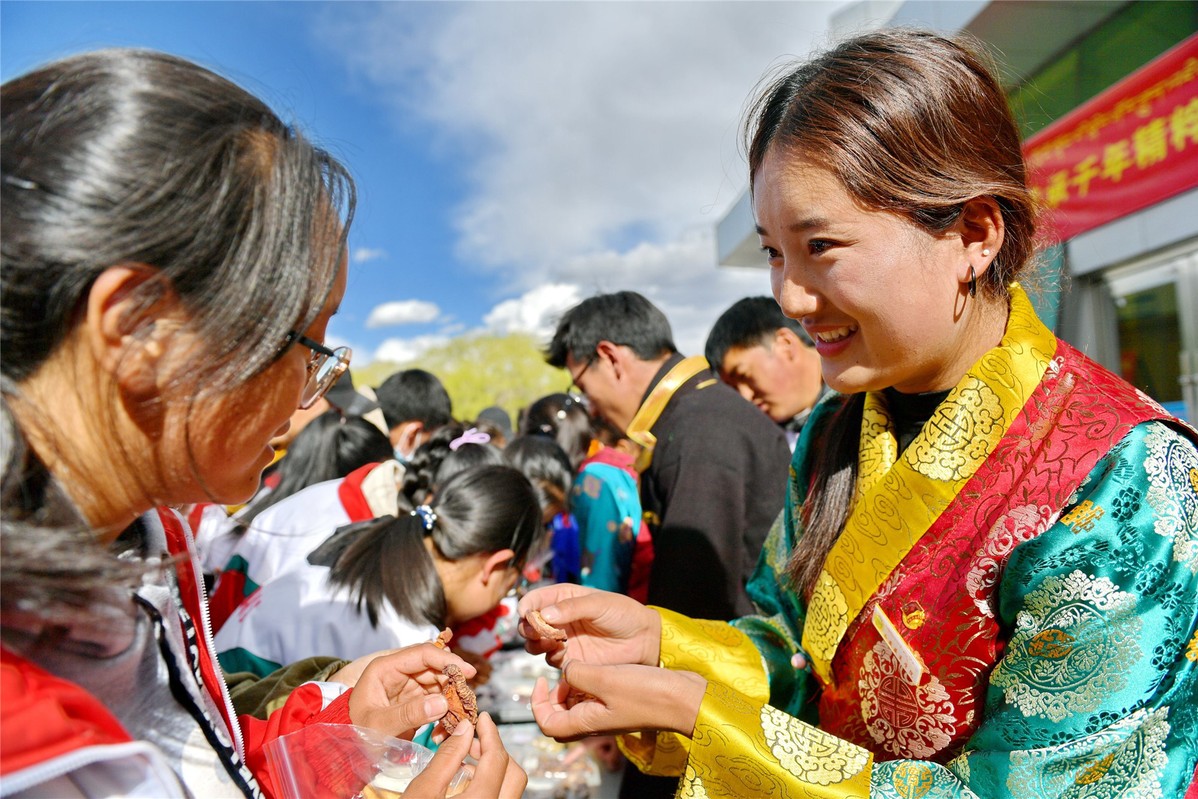
By providing funds and rent-free offices to college graduates and startups, and hiring counselors with medical and business expertise, the zone has managed to conserve a string of health-preserving practices that originated in traditional Tibetan medicine or culture. They include medicated baths, moxibustion and medicinal diets.
It has also helped college graduates from rural Tibet start micro-businesses, a move the central government has been promoting via a nationwide campaign to bolster the entrepreneurial spirit to sustain jobs and economic growth.
"Many college graduates in traditional Tibetan medicine come from the rural areas. In most cases, they lack the funds and experience to start a business using what they learned on campus," said Gonpo, who like many Tibetans only uses one part of his given name.
In Tsering Palmo's case, that business is Tibetan yoga, which dates back 3,800 years. However, despite being born and raised in rural Shigatse city, she never heard of yoga-Indian or Tibetan-as a child.
She regarded the gaokao-the national college entrance examination-as the most practical way to start a life away from the snowcapped plateau, so she quit vocational school after two years of nursing studies and enrolled at a high school.
In 2016, she was admitted to a college in the eastern province of Jiangsu to study law. Having combed through myriad student societies, she decided to join a yoga club, where she became captivated by the stress-relieving effects of traditional Indian yoga.
Her passion for the art gradually outgrew her academic interests, and by the time she graduated this year she had decided to find a job that could serve her new interest.
This summer, she returned to Lhasa to look for a job, but, to her dismay, she found few yoga studios. It was a sharp contrast to the situation in Jiangsu, one of China's most-active yoga markets.
In recent decades, Tibet has seen rapid urbanization. However, a growing number of new urban dwellers are struggling to adapt to fast-paced city lifestyles.
By the end of last year, Tibet's urban population had reached 1.07 million, almost four times the 287,000 recorded in 1980, according to regional government figures.
But the growth of studios devoted to yoga-a fashionable pastime intended to reduce the stress felt by office workers and help them lose weight-lagged in the region.
Figures from a 2017 industry report show that the region, which is home to more than 3 million Tibetans, had just one yoga studio, the lowest number among the 31 provinces and regions surveyed that year. By contrast, neighboring Qinghai province had 16, despite being last but one on the list.
The survey, conducted by the Chinese Academy of Social Sciences' Food and Drug Development and Supervision Center, found that the number of studios in Guangdong province surpassed 1,300, the most that year, followed by Shandong (1,067) and Jiangsu provinces (922).

- US defense policy act fuels Taiwan tensions
- New Year holiday to bring peak in travel
- China's top 10 sci-tech news events unveiled
- Over 700 generative AI large model products complete filing in China
- Beijing accuses Lai of 'kowtowing' to US
- Hong Kong's global standing boosted with increasing presence of intl organizations: justice secretary