


As one of the most visited museums in the world, the Metropolitan Museum of Art, also called the Met, has "a very big commitment" to giving people "a real sense of the glories of Chinese art", according to a senior curator of the museum.
"We have more space devoted to Chinese art than any other museum outside of China," says Maxwell K. Hearn, Douglas Dillon Chairman of the Department of Asian Art at the Met.
The museum hopes to make visitors from China, which tops its list of international visitors, feel proud of their history and culture through the way the exhibits are displayed, he adds.
The Met began collecting Chinese art in 1879 by purchasing around 1,000 Chinese works of ceramics, as many Americans collecting European art then wanted to have Qing ceramics alongside their old master paintings to decorate their homes with, says Hearn, 69, who joined the Met in 1971.
After a century of development, especially after a substantial expansion of the Asian Art Department in the 1970s, today's Chinese art collection at the Met is composed of more than 14,000 jade, bronze, lacquer, textile and ceramic pieces, and works in other media, dating back from the third millennium BC to the present day.
"This was possible because of the generosity of New York patrons and collectors," says Hearn, who witnessed this growth, adding that 80 to 90 percent of the Met's collections came as gifts.
One of the major patrons of Hearn's department is Brooke Astor, a member of New York's prominent Astor family, who spent much of her childhood in China. A donation of $9.6 million from her family foundation led to one of the most attractive spots in the museum-the Astor Court, which was modeled after a 17 century Suzhou courtyard-which opened to the public in 1981.
Since 1980, the Met started to hold special exhibitions featuring Chinese art, and over 100 pieces of bronze dating back over 3,000 years were borrowed from museums across China to form the Great Bronze Age of China exhibition that year, which turned out to be a sensation.
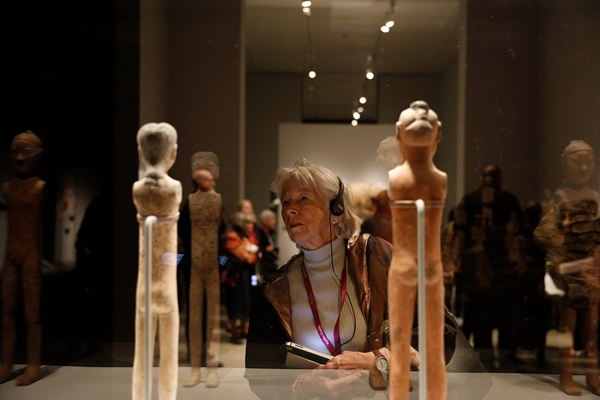
In the past decades, bilateral exchanges have facilitated a number of successful exhibitions on both sides. In 2017, the Age of Empires: Chinese Art of the Qin and Han Dynasties (221 BC-AD 220) featuring Terracotta Warriors and other types of rare objects from 32 museums in China welcomed over 355,000 visitors in 100 days, according to the Met.
"I think it was the 18th exhibition that we've done with China, and we are very proud of the fact that we have this long tradition of working with Chinese museums," says the department head. "Our colleagues in Chinese museums are very supportive of what we try to do."
In recent years, the museum has also tried creative approaches in curating China-themed exhibitions. China: Through the Looking Glasses, a 2015 cross-department exhibition featuring 140 pieces of haute couture and avant-garde ready-to-wear clothes exhibited alongside Chinese art, explored the impact of traditional Chinese aesthetics on Western fashion instead of directly showing Chinese art.
"It was to showcase how China as an idea, and bits and pieces of Chinese culture have had a profound impact on (Western) cinema, costume and culture," he adds.
For example, a dress designed by Yves Saint Laurent was put next to an Eastern Zhou vessel with similar details "to show that here's a modern artist looking at something that's 2,500 years old but still making something new with it," Hearn says.
The show has attracted over 810,000 visitors, making it one of the most visited exhibitions in Met's history, according to the museum.
"People come to art with an open mind. I think if they're fascinated by a work of art, then they want to learn more about the artist. They want to understand the context in which the artist lived. They want to learn about China.
"For us, to be able to show Chinese art from Neolithic times down to the present day is a way of introducing people to the longest surviving culture in the world," Hearn says.
He hopes that Chinese visitors will come to the museum "with a critical eye" and believes that the Met is showing their culture in a responsible way, so that people of non-Chinese origin can understand the significance of Chinese culture through the exhibits.








