Poverty poses a 'hundred problems'









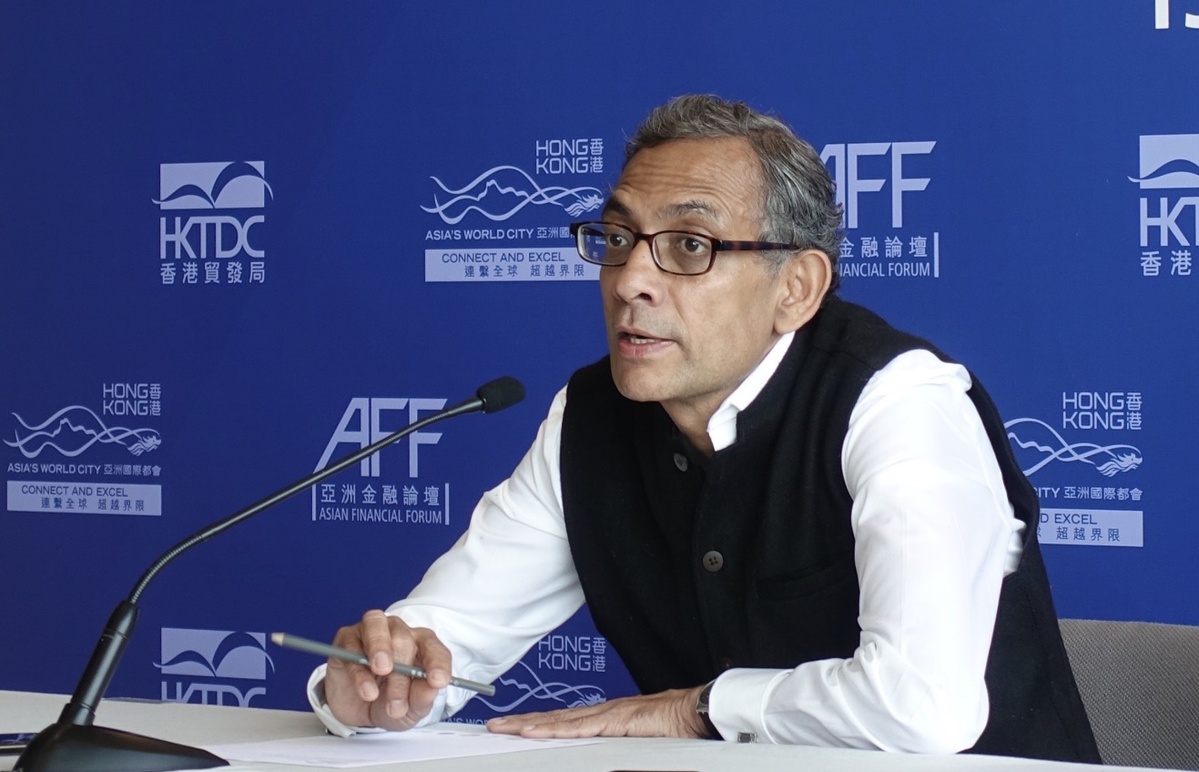
Noble Laureate Banerjee calls China 'remarkably successful'
Designing policies that fit the specific needs of a local community is more effective than seeking a grand solution for the global poverty problem, according to an award-winning economist.
Nobel Laureate Abhijit Vinayak Banerjee said that one of the most important insights he gained from his experimental approach to poverty reduction is that "poverty is not one problem".
Poverty is "a hundred problems and each of those problems has a different solution," Banerjee said at a press briefing on Jan 14.
Banerjee was in Hong Kong to give a keynote speech at the 13th Asian Financial Forum. The Hong Kong Special Administrative Region government and the Hong Kong Trade Development Council jointly organized the two-day event.
Banerjee is the Ford Foundation International Professor of Economics at the Massachusetts Institute of Technology (MIT) in the United States. He and his colleagues, MIT Professor Esther Duflo and Harvard University Professor Michael Kremer, won the 2019 Nobel Prize for economics for pioneering the use of randomized controlled trials, or RCTs, to tackle global poverty.
RCTs involve the use of carefully-designed field experiments to test the effectiveness of one specific project on a local community.
"I don't know how one can be an economist and not be interested in poverty alleviation," he said.
Banerjee said that one of the key insights that he gained from conducting many of these experiments is that the solution is "much less global than what we hoped for".
"There's no global answer. One of the things that we insisted on is that the answer is often specific to the problem," he said.
Banerjee said China "has been remarkably successful in reducing poverty". But he said this success also means that China now has to address the rising aspirations of its people.
China is the first developing country to attain the United Nations Millennium Development Goal for poverty reduction. The country has lifted more than 439 million people out of poverty between 1990 and 2011.
In his keynote speech delivered after the press briefing, Banerjee discussed micro financing and how it failed to raise the income of poor communities.
By using RCTs in various developing countries like India, the Philippines, Peru and Mexico, Banerjee and his colleagues learned that microfinance encourages people to be borrowers and not become entrepreneurs.
He said most of the people merely get loans so that they can buy some things like a refrigerator, and then set up a small business just to repay the loan. Once the loan is fully paid, they close shop.
Banerjee said institutes that introduce microfinance tend to have an "extremely structured" payment system, with borrowers required to pay a fixed amount at a certain time. This is in contrast to the informal money lenders who usually allow more flexible payment terms.
He said microfinance is "a relatively ineffective way" of encouraging entrepreneurship. This is because a fixed payment schedule does not fit the needs of entrepreneurs who have to deal with the many uncertainties involved in growing a business.
"Loan products need to be redesigned for a particular group of people," Banerjee said.
He added that there are a few borrowers who succeeded and managed to grow their business through microfinance. But these people were already starting small businesses even before microfinance came to their community.






- China moves to set national standards for pre-made dishes
- Chinese company unveils plans for commercial space flights
- Latest addition to Shiziyang Bridge constructions brings main tower above 300 meters
- Hebei's 'ancient pressure cooker' setting internet ablaze
- Major urban renovation restores Xi'an's ancient moat
- China launches nationwide employment assistance program