



History and humanity: Two lessons for WSJ









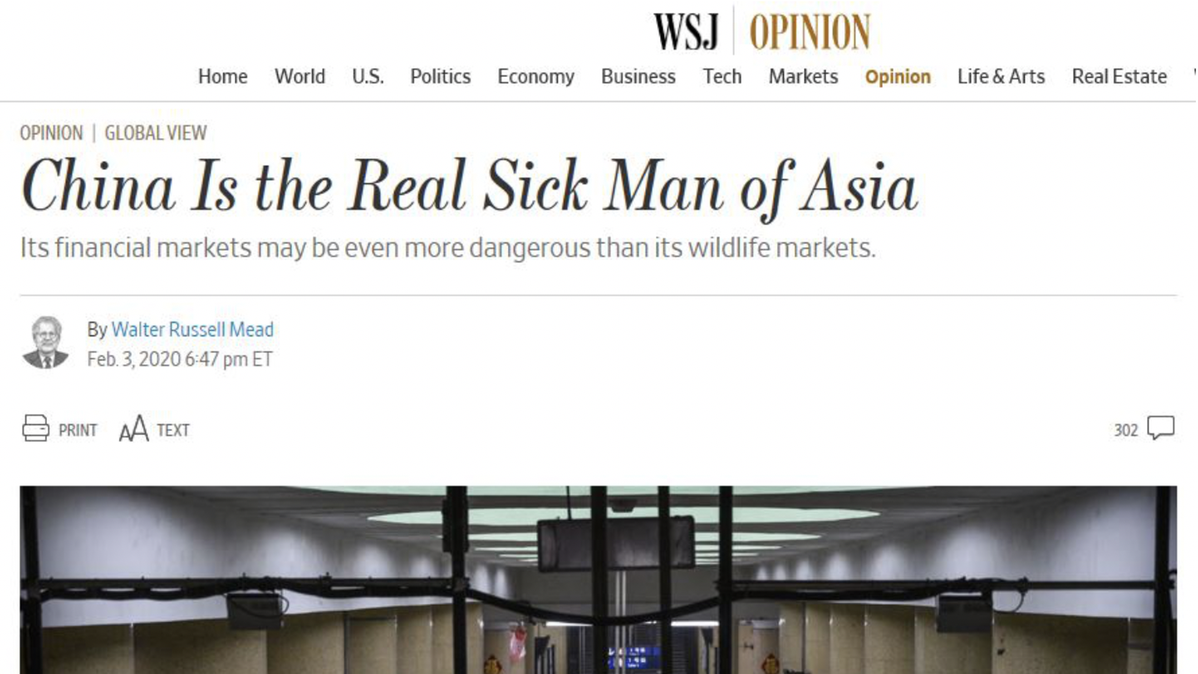
The Wall Street Journal has been called out again, this time by its own staff.
More than 50 reporters and editors working for the media outlet in China signed a letter to its executives criticizing the newspaper's response to the fallout from its commentary, "China Is the Real Sick Man of Asia," and urging management to apologize. The paper has claimed the commentary aimed to highlight the problems faced by China's government in its handling of the COVID-19 outbreak.
In a separate editorial published by the WSJ, its editorial board played down the significance of the headline, describing Beijing's decision to expel the WSJ's three journalists in China as an attempt to deflect from the country's coronavirus woes. The editorial maintains that the author of the commentary, Walter Russell Mead, didn't write the headline. That means one of the newspaper's editors came up with the idea. At best, they demonstrated a lack of understanding or sensitivity about history. At worst, they used offensive clickbait to lure traffic. This kind of tabloid tactic seriously tarnishes the reputation of the WSJ editorial board.
If the editor indeed mistakenly used the phrase, ignorant about the story behind it, then here is a brief lesson on Chinese history.
The phrase "sick man of Asia" or "sick man of East Asia" was first used in the late 19 century by a British writer whose mother country repeatedly bullied, abused and humiliated China, which was ruled by the Qing Dynasty at that time, by launching a slew of invasions, including two wars waged to force China to open its doors to British opium. The expression, unlike its original form, "sick man of Europe," that was mainly associated with the Ottoman Empire's economic situation, is considered by Chinese people to be a derogatory reference closely linked to the 100 years of national humiliation brought about by European and Japan colonialism.
Take a look at the 1972 Bruce Lee movie, "The Fist of Fury," in which the kung fu star became a national hero by destroying a plaque bearing the Chinese characters "sick man of East Asia" after defeating a violent gang of Japanese opponents. "Chinese people are not sick men," he yelled as he smashed the plaque.
This is not a matter of free speech. It's simply racist and offensive. As the WSJ's China-based crew noted in their letter, "This is not about editorial independence or the sanctity of the divide between news and opinion. It is not about the content of Dr. Mead's article. It is about the mistaken choice of a headline that was deeply offensive to many people, not just in China."
If the WSJ chose the headline by mistake, then it certainly should consider correcting the headline and apologizing to its "readers, sources, colleagues and anyone else who was offended by it," as requested by its 50-plus team in China. As the Greek philosopher Sophocles wrote, "All men make mistakes, but only a good man yields when he knows his course is wrong, and repairs the evil. The only crime is pride."
That said, if the WSJ published that headline fully aware of its historical background, consider the words of Anthony Ocampo, a sociologist and associate professor at Cal Poly Pomona, who was quoted by NBC News as saying, "Countless other lives – families, people being quarantined – are changed forever… so my initial reaction to this piece is, where is the concern for their humanity?"
This concern is shared by award-winning author Catherine Ceniza Choy, a professor of ethnic studies at the University of California, Berkeley, who said, "The consequences of publishing an opinion like this by mainstream media include stoking more fear and anxiety, and increasing hostility against Chinese and other Asians throughout the world. This is extremely harmful and wrong."
Tu Yun is an editor with China Plus. The article reflects the author's opinions and not necessarily the views of CGTN.





