Lives of iron forged in tribulation









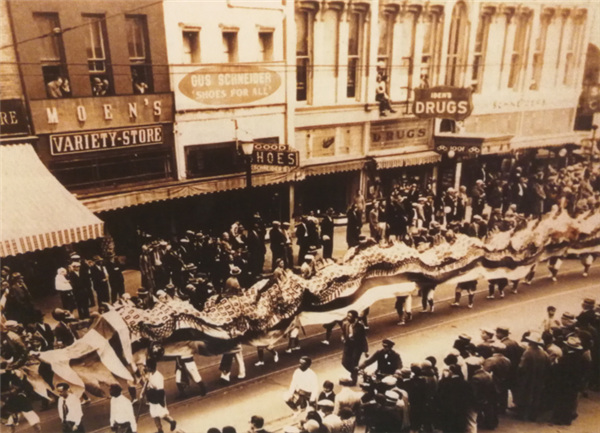
From a railroad construction site in the Sierra Nevada to the sun-kissed citrus gardens of Florida, Chinese who made the perilous voyage across the Pacific Ocean to start a new life helped build a nation.
One morning in fall 2016, Michael Perrone, president of the Belleville Historical Society in Belleville, New Jersey, was inspecting a church cemetery he had been helping restore for the past 20 years.
"Suddenly, I saw a tip sticking out of the ground, by an inch and a half," he said. "It looked like the bow of a ship. We dug it up and it was an iron, the same type of iron that laundry workers would have used."
Last October, Perrone was at the Museum of Chinese in America (MOCA) in New York telling his story to attendees at the opening of the exhibition Gathering-Collecting& Documenting Chinese American History.
"For 20 years we cleaned that cemetery and probed every square foot with probes and metal detectors," an emotional Perrone said. "For 20 years we never found a thing. Then came this iron, announcing its existence to us on the very morning after we dedicated a monument to early Chinese immigrants who first came in 1870, brought by a retired sea captain, James Hervey, to work at what was then the country's largest commercial laundry."
That was little more than one year after the completion of the Transcontinental Railroad linking the American east and west, on whose construction 23,000 Chinese immigrant laborers were employed, and more than 20 years after the discovery of gold in California brought the first wave of Chinese immigrants to the US.
However, in the collection of works featured in this exhibition, the museum president, Nancy Yao Maasbach, sees a history that goes back even further, one that "has been created not in the past 100 years, not in the past 150 years, but in the past 200 years".
One organization present to tell this early story is the Hawaii Chinese Cultural Center founded in 1970. According to the wall text, Chinese, often prompted by civil unrest and famine, began migrating to the Hawaiian islands nearly 230 years ago, first as traders, then as sojourners to begin small sugar plantations.
Later they were brought to the United States to teach those in the budding sugar industry how to cultivate the plant and mill it into sugar, and they eventually served as a source of labor themselves.
The story is one of the many being told by the exhibition, which draws on the strength of 28 cultural institutions across the US(there is also one from Canada), all dedicated to ensuring that the history of Chinese America expands and endures.
With each organization contributing an exhibit, the iron being an example, the exhibition seeks to offer revealing and often evocative glimpses into a history whose depiction is at its best "generic and fuzzy", as Herb Tam, the exhibition curator, puts it.
In a distortion of history, the California Gold Rush-in which about 300,000 people arrived on the West Coast in the two and a half years or so before California became the 31st state of the union in 1850-is still attributed by many as the beginning of that story.
On view at the exhibition is a set of fortune sticks found in a temple built around 1854 by Chinese settlers who arrived around that time in Mendocino, 150 miles (250 kilometers) north of San Francisco, by sampan, a small, flat-bottomed wooden boat with a shelter.
The oral history that has been passed down for four generations is that seven sampans sailed to California, those on board hoping to find gold, but only two survived the 6,000-mile (10,000-kilometer) journey. As planned, one landed at Monterey, 90 miles (150 kilometers) south of San Francisco, as planned, and the other at Caspar Beach, 4 miles (7 kilometers) north of Mendocino.
Intertwined in almost every story of the early Chinese immigrants are episodes of fortune and misfortune, of hope and sorrow-those who desperately wanted a fresh start in a distant land, constantly feeling the pull of the loved ones they left behind.
Antagonism toward the Chinese started to arise near the end of the Gold Rush in the mid 1850s, when gold became scarcer and competition fiercer. By that time, San Francisco, which grew from a small settlement with a population of just a few hundred in 1846 to a boomtown of about 36,000 by 1852, had witnessed the birth of the first Chinatown in the US.
In 1863, the construction of the Transcontinental Railroad began, with two concerns, the Central Pacific and the Union Pacific Railroad companies, racing toward each other from Sacramento, California, at one end, to Omaha, Nebraska, at the other, struggling against great risk before they met at Promontory, Utah, completing the line of 1,900 miles (3,077 kilometers) on May 10, 1869.
Working for the Central Pacific, the 23,000 Chinese laborers-some arrived earlier, and others were recruited by the company from Guangdong-had to battle the toughest terrain and severest weather, with 44 storms recorded in 1866 alone.