Mutual reinforcement









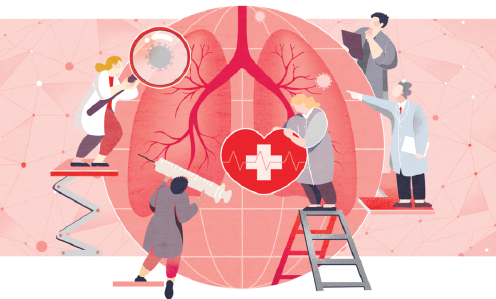
In China, the peak of the novel coronavirus pandemic has passed, with the number of new cases, most of them imported ones, continuing to decline. The world however is facing a pandemic. The novel coronavirus has already spread to more than 190 countries and regions. The situation in some areas is very serious and is likely to get out of control. This requires countries under the leadership of the United Nations, the World Health Organization and other international bodies, to strengthen communication and cooperation to jointly fight against the pandemic.
On Feb 10, the advance team of the novel coronavirus international expert group led by the WHO arrived in China. The group set up a joint investigation team of 25 Chinese and foreign experts, whose purpose was to quickly gain information on the outbreak in China and guide its further response to the pandemic, and to make suggestions on how countries and regions not yet affected by the virus could prepare for it.
On Feb 24, the joint inspection report was officially released. This document summarized the main findings regarding the pandemic in terms of six aspects (virus, outbreak, dynamics of transmission, progress and severity of the disease, China's response measures and knowledge limitations); provided a pandemic assessment (response measures and next steps for China and the world), and put forward specific suggestions on five aspects. This is the first scientific, professional and authoritative investigation report on the epidemic situation, and it provides an invaluable guide for decision-makers facing a range of different situations.
In the current situation of a global pandemic, the WHO faces a critical problem, that is, fund-raising. On Feb 21, the director-general of the WHO called on donor countries to provide timely funds to combat the spread of the novel coronavirus. To this end, the organization asked for an initial amount of $61.5 million for global prevention and control efforts to be paid before April. However, by early March only $1.2 million had actually been received into the WHO account, accounting for only 2 percent of the total funds required.
In response to this shortfall, on March 7 the Chinese government decided to donate $20 million to the WHO to support international cooperation in the fight against COVID-19. This is equivalent to 32.5 percent of the total funds, a significant contribution.
At a critical period when countries around the world must work together to fight the pandemic, the US government will increase its military spending to a record high of $740.5 billion, while slashing funding for the WHO and global health projects by 53 percent and 35 percent respectively. This shows that at a critical time in the global fight against the pandemic, China has taken the lead, increasing its funding of the WHO, while the United States has taken the lead in prioritizing its own concerns.
On Jan 15, China released the "Diagnosis and Treatment Plan for Novel Coronavirus Pneumonia (Trial Version 1)". To date, it has released seven versions of the diagnosis and treatment plan and six versions of the prevention and control plan. These plans have been translated into multiple languages and shared with many countries. Furthermore, China has shared many technical documents, including its epidemic prevention and treatment plans, with more than 100 countries and more than 10 international organizations. Maria van Kielkhofer, technical lead of the WHO health emergency project, has stated that China's rich experience can be used as a reference for other countries.
In addition, China has held video conferences with the European Union, Association of Southeast Asian Nations, Africa Union, Caribbean Community and Common Market, Shanghai Cooperation Organization, South Pacific, Turkmenistan, Azerbaijan, Moldova, Georgia, and other countries to share experiences in epidemic prevention and control.
So far, the Chinese Red Cross has sent teams of experts to Iran, Iraq and Italy to work intensively in the fight against the virus. These teams have been well received by local people and health departments. China is also preparing to send teams of medical experts to other countries and regions, to support local epidemic prevention efforts and share its epidemic control experiences. The Chinese Centre for Disease Control and Prevention has appointed a senior technical consultant to the African Centres for Disease Control and Prevention, to work closely with local professionals to strengthen epidemic prevention and control in Africa.
In response to the requests of relevant countries, China has donated anti-epidemic materials such as masks, medicines, protective clothing and other urgently needed medical materials and equipment. Chinese local governments, such as those of Beijing and Shanghai, and Shandong, Zhejiang, Jiangxi, Jilin, Anhui, Jiangsu and Henan provinces, have provided epidemic prevention supplies to their sister cities, and Chinese private institutions have also participated in these efforts.
In the context of globalization, people share a common future in an interconnected world, which includes public health. Like all viruses, the novel coronavirus has no nationality and no passport, and respects no national borders. It is a common enemy facing humankind. Therefore, we all need to work together to combat the pandemic.
This time, China is at the forefront of the global fight. As early as Feb 24, United Nations Secretary-General António Guterres said during a visit to WHO headquarters that the Chinese people have made huge sacrifices for the prevention and control of the epidemic. In doing so, China won at least one and a half months for the world to combat this virus. China has also provided the world with valuable practical experience, ensuring that fewer wasteful detours are taken, thus maximizing the efficiency of the response to the epidemic. China is also providing donations to the WHO to fully support its global leadership in this matter.
The author is the dean of the Institute of Contemporary China Studies at Tsinghua University. The author contributed this article to China Watch, a think tank powered by China Daily. The views do not necessarily reflect those of China Daily.