Signs of the times ahead









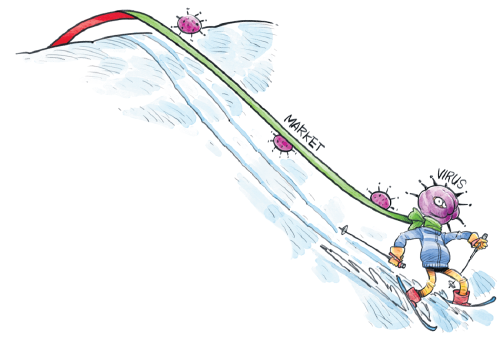
While the novel coronavirus outbreak has sent shock waves through the Chinese economy, and the slowdown in the first quarter will inevitably be drastic, I believe that the loss in the first quarter will be partially, if not mostly, offset as the economy recovers. And, that viewed against a longer time horizon, the cost will be even less significant, because despite the enormous economic costs in the short term, China has been able to get the virus quickly under control and flatten the growth curve for infections by applying short-term shock therapy. For Western countries, which have been slower to act, the pandemic may take a bigger toll on their economies in the long run.
A case in point is the stock markets. A-shares have recorded fewer declines than all their global peers. With the virus a global pandemic, as of March 24, the CSI-300, a key index of Chinese stocks, fell more than 13 percent from peak to trough this year, whereas the Hong Kong Stock Exchange fell by 22 percent, US stocks declined by over 29 percent and European stock exchanges plummeted by around 29 percent. The Republic of Korea saw its stock market contract by 27 percent whereas Japan saw its share prices shrink by around 25 percent.
Assuming most declines in stock value to be indicators of the present value of long-term economic losses, we may reasonably surmise that European and US markets may be yet to bottom out, while the turning point has already been reached in China. In this sense, investors seem to believe that China's actions will be the most effective and least economically costly in the long run.
Most asset classes had been recording normal performance in the recent past. The evolution of the pandemic has triggered market panic, with safe-haven assets appreciating and risky assets depreciating. Having said that, the market went into a tailspin after the week of March 9, with both safe-haven and risky assets plummeting unexpectedly. Gold and US treasury bonds fell in tandem with share prices while the US dollar rallied. These market movements indicate a severe liquidity crunch, with great repercussions for global markets.
It is notable that as of March 9, before the liquidity crunch began, the 10-Year US Treasury Bond Yield had been sliding at record rates to historical lows. The downward movement has dwarfed the yield crash in the aftermath of the 2008 financial crisis even though pandemics are a short-term shock going by historical experiences. My reading of the decline in US bond yield is that markets believe that the US economy may fall into chronic stagnation after an acute depression, which will push Federal Fund rates to stay zero for a long time. Simply put, the United States is taking a page out of Japan and Europe's economic and monetary policy playbook.
Oil prices have also crashed. One milestone event in the oil market during the past decade was the rise of US shale oil, which catapulted the US past all other major oil producers and greatly reshaped the oil market as we knew it.
When the global economy slowed down in 2014, Saudi Arabia became acutely aware of the risks of booming shale industry in the US, and pushed down oil prices to squeeze out its US competitor. While the strategy was correct for Saudi Arabia, its faltering implementation nevertheless gave the US an opportunity to grow its shale industry. Russia also managed to expand its share in the oil market.
This led to two problems. One, unprepared for low oil prices, both Saudi Arabia and Russia faced enormous fiscal pressure and had to back down. Additionally, after a short adjustment period, US shale oil became highly competitive thanks to rapid progress in the technology.
History seems to be repeating itself, with the only difference being that the US now sits on a much larger and technologically sophisticated shale oil industry, while Russia and Saudi Arabia are better prepared for low oil prices. This means that even though a short-term ceasefire is likely, the oil price war is probably here to stay. While this is good news for importing countries, it certainly bodes ill for the US economy and its financial market.
Previously, most people believed that there were bubbles in the high-yield US corporate bond market, where shale oil companies are big issuers. The bubbles may already be bursting due to the oil price war and the pandemic. As a result, it is only a matter of time for impacts on the economy to emerge.
But if the history of infectious diseases over the past century has taught us anything, it is that this pandemic too shall pass. While it may take a few quarters before the disease is put under control and the economy bounces back, no disease outbreaks in the past century have had significant lasting impacts on long-term growth, more so if the cash flow of the private sector is well maintained by forceful policy actions.
Europe is a case in point. European stocks have fallen by 30 percent to date. Assuming that pre-outbreak prices were reasonable, the market should go back to normal levels in a few quarters as the pandemic blows over. In other words, European stocks will rise by 50 percent from their current levels. Despite numerous uncertainties, a 50 percent increase in share prices should be enough to compensate for uncertainties and opportunity costs given the near-zero risk-free interest rate.
Even though the outbreak is a one-off, short-term shock, the recession it has triggered will dampen business confidence and expectations. Companies will cut back on investments and economies will suffer knock-on impacts. Additionally, central banks in developed countries have little policy space to respond. Europe and Japan have long had negative interest rates, while the US does not have much room left for downward adjustment. Hence, their economies might stagnate for years to come after an acute downturn once the pandemic is over. This is partly what the market has been worrying about all along.
The author is chief economist at Essence Securities Co, Ltd. The author contributed this article to China Watch, a think tank powered by China Daily. The views do not necessarily reflect those of China Daily.