



China stepping up efforts to provide test kits









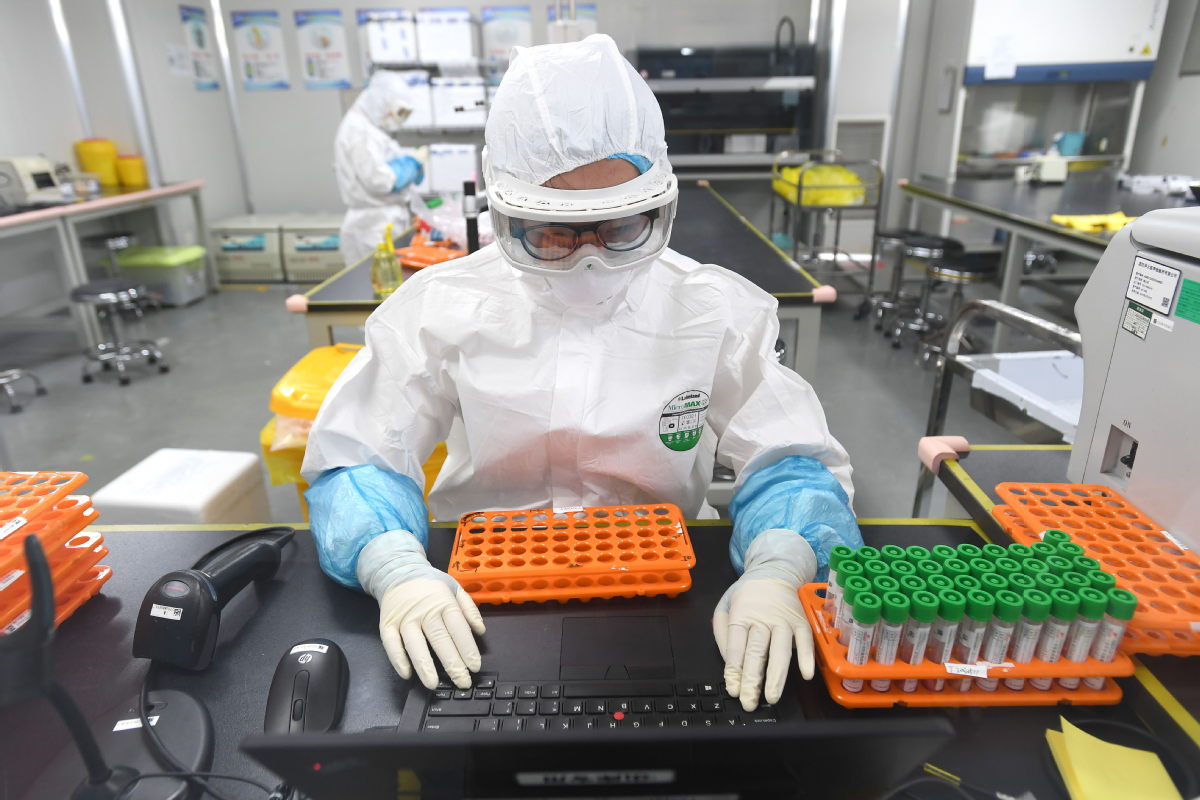
Local producers ramp up production and exports as the pandemic fight outside the nation faces shortages of key materials
As COVID-19 spreads around the world, it is of paramount importance to test people in a timely manner to detect infections and formulate responses.
Thanks to much-improved research and development capabilities, Chinese companies were able to develop nucleic acid test kits quickly in January, soon after Chinese scientists published the genomic sequence of the virus, and then developed antibody tests later in February. They were also able to produce test kits in large volumes to help the country deal with the disease properly due to solid manufacturing capacity, industry experts said.
While the contagion's spread in China has already been effectively contained, a lack of test kits is becoming an issue in many other countries. Chinese test kit producers have ramped up production and exports, eyeing increasing overseas demand.
Xu Shan, secretary-general of the China Association for Medical Devices Industry, estimated that more than 100 Chinese companies have obtained CE marking by the European Union for their novel coronavirus test kits, or the permits for the products' commercial launch in the EU and other markets recognizing the designation.
By March 19, more than 64 Chinese in vitro diagnostic device producers had obtained the designation, which is also widely recognized in Southeast Asia, Central Asia and Africa, according to the Professional Community of Experimental Medicine, a national industry organization under the National Association of Health Industry and Enterprise Management.
The virus test kits of several Chinese companies-including BGI Group and Hunan province-based Sansure Biotech Inc-have also become commercially available in the United States, with updated guidance from the United States Food and Drug Administration issued on March 16. The new policy allows eligible use of qualified products in clinical testing for the novel coronavirus before they have been officially approved or granted emergency use authorization by the FDA.
Previously, some Chinese companies submitted requests to the FDA for such authorization, which permits use of unapproved medical products or unapproved uses of approved medical products in a declared emergency to diagnose, treat or prevent serious or life-threatening diseases or conditions.
Shi Lichen, founder of Beijing Dingchen Consultancy, said it's very impressive that Chinese companies successfully developed an array of virus test kits in a very short time following the outbreak, and they are well-prepared to meet domestic and overseas demand.
Xu said recent messages from foreign trade associations and institutions seeking to purchase test kits often accumulate in a few hours as infections spike overseas. A WeChat group has been set up by the association to help link Chinese test kit providers with overseas buyers.
"Chinese companies didn't hesitate to develop test kits when the outbreak occurred, and they have made tremendous contributions to COVID-19 prevention and control in China. It makes sense that foreign countries with soaring testing demand are now seeking imports from China," she said.
Multinational companies took relatively more time to make decisions and produce products due to the large size of their organizations, and perhaps also because the outbreak first occurred in China, she added.
Wang Sizhen, co-founder and CEO of Genetron Holdings Ltd-a Beijing-based precision oncology company-said he is very impressed with the capability Chinese companies have demonstrated during the COVID-19 struggle.
Wang cited one example. By Feb 2, nearly 130 Chinese companies had joined a campaign initiated a day earlier to suspend some ongoing businesses and scientific research programs so that resources-including laboratories, devices, capital and personnel-could be used to accelerate infection detection and control of the COVID-19 outbreak.
"Chinese companies acted quickly based on their experience and capacity accumulated over the past two decades, especially in the IVD sector-an area that features interdisciplinary R&D, manufacturing and laboratory applications involving biology, physics, chemistry, materials, optoelectronics and genetics," he added.
The National Medical Products Administration said it had approved 11 nucleic acid test kits and eight antibody test kits as of March 17.
BGI Group developed two of the first four diagnostic tests that received emergency approval from the NMPA on Jan 26 for the novel coronavirus.
A subsidiary of BGI Group, BGI Genomics produced real-time fluorescent RT-PCR kits for specific testing of novel coronavirus. The kits received CE-IVD marking on Feb 26. The company announced on March 27 that it had received the FDA's formal EUA.
The PMseq metagenomics sequencing kits using BGI Group's combinatorial probe-anchor synthesis sequencing technology can rapidly detect viral sequences to identify and diagnose novel and other coronaviruses.
In addition, another subsidiary of BGI Group, MGI's ultra-high-throughput DNBSEQ-T7 sequencing system and analysis software, also received NMPA certification as Class III medical device to support future epidemic prevention and control efforts.
The genetic system can complete the entire novel coronavirus detection process-from sample extraction to diagnosis-within 20 hours.
More importantly, it can process 50 to 200 samples per run and deliver 100 megabytes of data per sample, ensuring extremely high virus detection accuracy as well as information on viral mutations, which is of great use in current and future clinical and epidemiological research in battling COVID-19.
BGI Group has also rapidly scaled up manufacturing following the COVID-19 outbreak.
By March 22, its total output of real-time fluorescent RT-PCR kits was capable of testing 4.72 million samples, and the test kits had been distributed to more than 70 countries and regions around the world, with international orders for more than 1 million tests.
In China, BGI had performed over 560,000 tests in its laboratories as of March 22, including 310,000 in Shenzhen, Guangdong province.
Sansure Biotech, one of the first six companies China approved to sell detection kits for the coronavirus, is operating at full capacity.
With a daily production capacity of 500,000 test kits, the company has distributed its products to more than 40 countries and regions to help curb the contagion, including donations to countries such as Ethiopia, Kenya, Sweden and Sierra Leone.
Wang's company, which has expertise in genetic solutions for cancer treatment, has a detection kit for novel coronavirus using PCR-fluorescence probing that received CE marking in late March.
It has also developed a new lower respiratory tract aerosol particle sampler that is pending approval. It will help alleviate two common problems of nucleic acid tests-low viral load in throat swab samples and high risk of exposing medical staff to infection.
The company has donated a Genetron S5 sequencer and supporting instruments to a hospital in Wuhan, Hubei province. It can perform accurate molecular tests of clinical samples to yield comprehensive genomic data to help monitor mutations of the coronavirus, formulate preventive measures and develop related diagnostic kits, vaccines and drug treatment.
Chinese biotech and IVD companies invested heavily into the development and production of new test kits and genetic devices for rapid pathogen detection, even when a lack of testing resources hindered prevention and control of COVID-19 in China. It is great that their products can help other countries fight the contagion, Wang said.
However, Shi said it is important for Chinese companies to establish efficient overseas sales networks to better distribute products, especially because many of them lack experience in overseas markets as the domestic market has traditionally been their priority.



















