Listed companies should learn a lesson from Luckin Coffee's experience









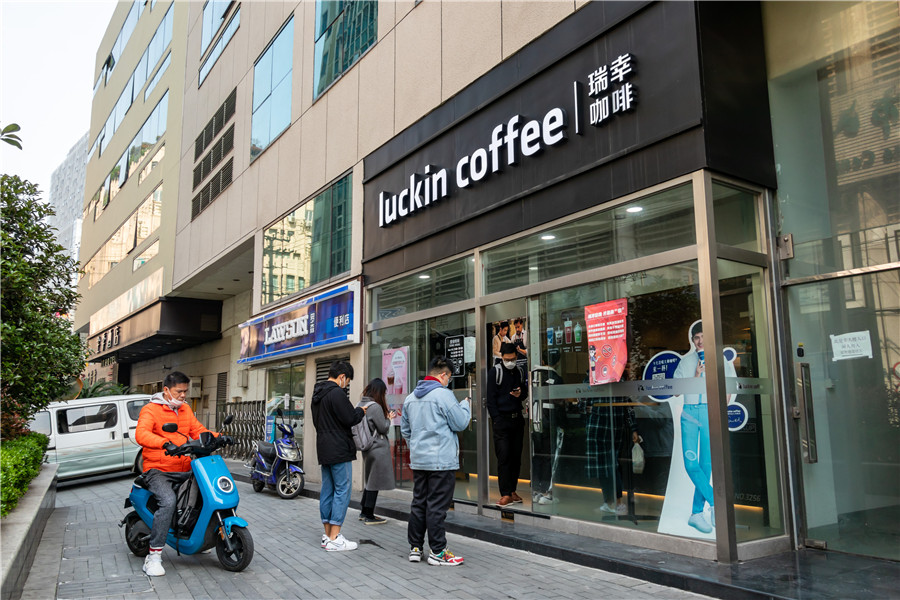
Luckin Coffee Inc, the Chinese chain in deep crisis for fabricating sales data, disclosed on April 2 that its 2019 revenue was inflated by about 2.2 billion yuan ($310 million), thus admitting to short seller Muddy Water's earlier allegation.
The Nasdaq-listed company thereafter saw its shares plunge 83 percent until a trading halt on April 7, thus exposing its investors to huge losses.
Awaiting the two-year-old company are class action suits-filed by law firms on behalf of affected investors-and perhaps investigations from the Securities and Exchange Commission, the regulatory body in the United States.
Besides a considerable amount of compensation and administrative punishment, individuals in charge may even face criminal sanctions, enforced via extradition arrangements.
The incident has also brought the financial integrity of Chinese firms listed in the US under increased scrutiny.
Nasdaq-listed online video platform iQIYI Inc faced a short seller accusation of overstating revenue less than a week after Luckin admitted to issuing falsified statements. Meanwhile, NYSE-listed tutoring service provider TAL Education Group reported inflated sales, albeit minor.
The spillovers have led to concerns that Chinese firms could face difficulty selling their shares and may have to discount future IPOs in the US market as trust in Chinese firms takes a hit.
The phenomenon has a history.
Between 2010 and 2011, Wall Street short sellers initiated a series of accusations against Chinese firms' financial integrity, many of which proved to be true. This caused an interruption to Chinese companies' going public in the US market between 2012 and 2013 as investor confidence soured.
Some Chinese firms listed in the US have recklessly chosen to take advantage of loopholes in the firewall system against financial fraud in that country's capital markets. The firewall is composed of four tiers: regulators, investors, auditors and class action lawsuits.
When the scandals of US-listed Chinese firms' financial reporting fabrications peaked nearly a decade ago, there were gaps in securities supervision between the two countries, which caused loopholes in the tiers of regulators and external auditors.
Notably, US supervisory bodies such as the Public Company Accounting Oversight Board cannot inspect Chinese auditing firms registered with them and their auditing performed in China, meaning that the SEC is unable to clearly assess the accuracy of external auditors.
The Chinese and US governments have stepped up efforts to fix the problem beginning in 2012. Chinese regulators began to allow representatives of US regulators to observe their inspections of related Chinese auditing firms, and the two parties signed a memorandum of understanding in 2013.
Now, upon the request of the PCAOB on a case-by-case basis, Chinese regulators including the China Securities Regulatory Commission and the Ministry of Finance have granted access to working papers of Chinese auditing firms.
Since then, regulators and external auditors have exerted their functions more effectively and helped improve Wall Street investors' confidence in Chinese firms. IPOs of Chinese firms like Alibaba and JD were welcomed by the US market.
Financial reporting quality of Chinese firms has also improved, as none in the 57 Chinese firms that went public in the US market from 2013 to 2017 received punishment from the SEC, versus 15 in the 269 predecessors that listed during the 1999-2011 period.
But there are still loopholes in the firewall, as some gaps in regulatory cooperation remain, especially when it comes to enforcing court judgments for class action suits filed against Chinese firms.
Our research tracing the 326 Chinese firms that went public in the US from 1999 to 2017 has showed that US courts sometimes face difficulties in fully carrying out punishments of Chinese firms engaged in misconduct.
This is because many of the companies do not have assets in the US, which means their assets cannot be frozen by the court to enforce compensation for investors.
Some US-listed Chinese firms have taken a chance on the loopholes and resorted to malpractice. Yet, the case of Luckin proves that the four-tier firewall, despite its weak links, still plays a key role.
Particularly, the force of external investors, especially short sellers, has once again proven to be strong. In a market where 80 percent of investors are institutional investors, listed firms' misconduct will ultimately be detected and priced in.
Taking a lesson from Luckin, Chinese firms must achieve a higher standard of compliance.
They must stay true to the bottom line of financial integrity, and at the same time strengthen information disclosure to live up to investor expectations.
Compliance, in a broad sense, means not only satisfying requirements of laws and regulations, but meeting investor expectations over information disclosure as well. The latter could be more important but has been overlooked by many Chinese firms.
Chinese companies should be fully aware that stock price slumps due to information disclosure that falls short of investor requirements will probably induce class action suits and economic compensation for shareholders.
For Chinese firms directly facing allegations of false financial reporting, rebuttals based on facts and details will work. For instance, New Oriental Education and Technology Group Inc saw its stock price soon recover from a plummet in 2012.
The Beijing-based educational services provider proactively disclosed more information to the SEC as well as investors, and carried out timely communication, helping investors rebuild confidence in the company.
All in all, for a listed company, transparent information disclosure and open communication are always the most sound practice. Otherwise, betting on good luck to mask malpractice will only result in punishment from the market.
The writer is an associate professor of accounting and deputy director of the accounting department at Peking University's Guanghua School of Management.