Don’t throw away the apple because its core is bad









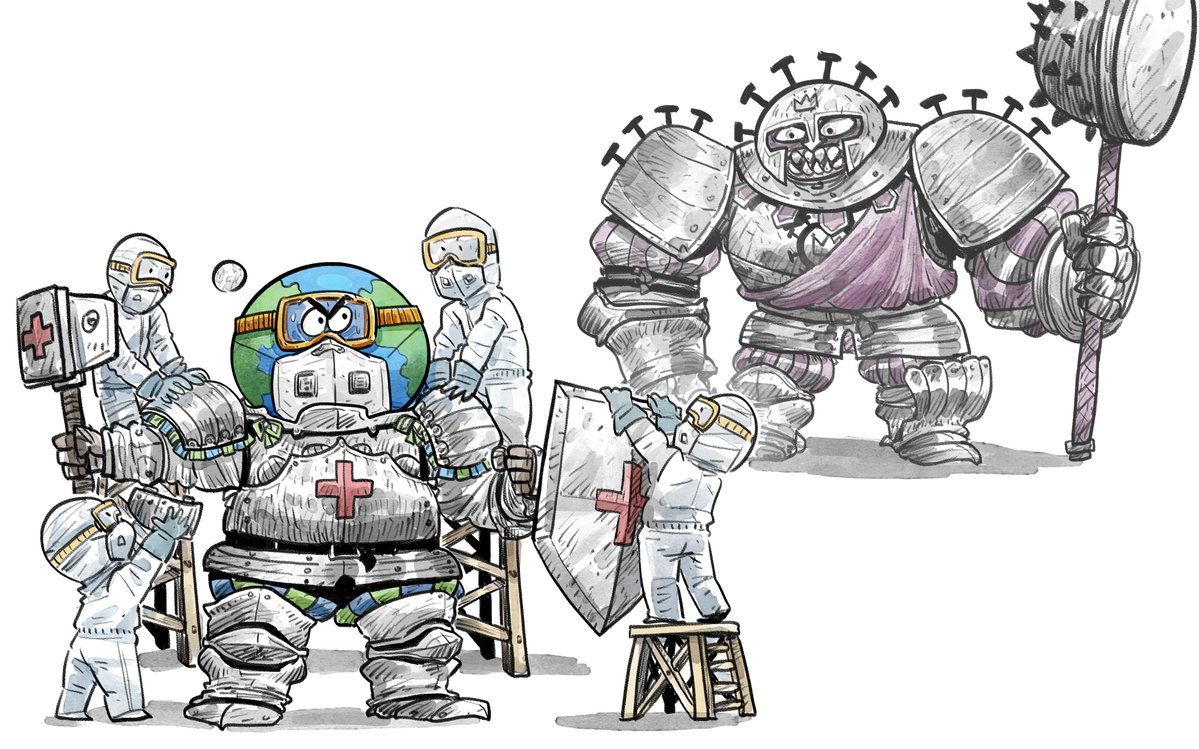
The COVID-19 pandemic has not only shocked the world, but has also changed the thinking of corporates and individuals around the globe. A consensus seems to be that the world will never be the same again.
In this regard, entrepreneurs, scholars, and politicians have put forward various ideas. Some argue that the pandemic will accelerate the remaking of globalization and the “decoupling” between China and the United States. Some are worrying about the fragility of the global supply chain, and believe that the Just-In-Time approach in pursuit of zero inventory should be changed to increase the necessary redundancy at the expense of efficiency. It has also been observed that countries such as China, South Korea and Singapore are quite successful in fighting the coronavirus outbreak by employing big data for contact tracing and smart medical treatment. A prediction is made that tech giants will continue to play an important role after the pandemic, as privacy protection issues will be of greater concern.
Liu He, Chinese vice-premier, once said in his research on the Great Depression and 2008 global financial crisis that “In the face of severe crises, major countries always make the same mistakes. When openness and international cooperation are needed, protectionist policies are often adopted....These obvious blunders may seem ridiculous afterwards, but it is an arduous task to implement the correct policy at that time.” The current global economic governance may not be as perfect as everyone hoped, however, just as an ancient Chinese idiom puts it, don’t throw away the apple because of its core.
First, the world will not get better because of de-globalization. The modern economy is a flow composed of flow of people, goods, capital and data. People expect the pandemic could be brought under control as soon as possible, and social distancing could be lifted, allowing the global economy to flow again. De-globalization will force all economies to go back to “social distancing”, which will inevitably pose a huge challenge to supply, demand, and financing. People who have just recovered from a serious illness need to strengthen their health rather than hurt their muscles and bones. Similarly, when the pandemic ebbs, all countries in the world need to implement higher-level global cooperation to cushion the blow made by the dire interruption, rather than deny globalization because of its imperfections.
Second, sacrificing the efficiency of the supply chain is not the only solution. Some politicians believe that it is unreasonable to depend on others for food supply and medical security, thus exerting political pressure on multinational corporations and requiring them to increase the stability of the supply chain at the cost of profit margins. Frankly speaking, chasing profitability at lower cost is the instinct of enterprises. While requiring corporates to fulfill their social responsibilities, authorities should do their own part. For strategic resources related to national interests and people’s livelihood, authorities should improve the reserve system in case of emergency. Singaporean Prime Minister Lee Hsien Loong believes that China, as a huge manufacturing base, has drastically reduced manufacturing costs for the world. How can you criticize companies for being too efficient when you are enjoying their fine products at low prices?
Third, uncertainty should be reduced. The plunge in the US and the European financial markets in March conformed to the characteristics described by economist Frank Knight (1921), namely, risk can be priced, but uncertainty is hard to be priced. Facing a novel virus that is highly contagious, with a high lethal rate and worldwide impact, and that human beings have no vaccine or effective drugs for the time being, financial markets cannot accurately measure the impact on macro economy and listed companies, therefore losing the pricing capability. “De-sinization” or “decoupling” between China and the US is another kind of uncertainty that is hard to measure. No one can accurately predict what this change, which is likely the biggest in the past 40 years, will mean to the world. When people are agitated by irrational emotion and break the equilibrium in haste, just think about the turbulence of the financial market during this pandemic.
Last but not least, the data-driven era is arriving at an accelerating pace. During the quarantined period, business models and the way people live a life have all greatly altered. Online education, remote working, virtual exhibition, smart medical consultation, intelligent manufacturing and unmanned distribution promoted by technology are all developing rapidly, bringing new opportunities to economic globalization and the improvement of the global industrial chain. China is speeding up the construction of new types of infrastructures such as 5G, artificial intelligence and big data centers, which will play an increasingly important role in promoting employment, boosting domestic demand and enhancing economic development. Meanwhile, what we have to bear in mind is that individual privacy should be respected by enterprises and protected by law. With data becoming a critical element resource, obtaining data illegally should be punished at a larger cost.
History is written by victors. Accelerating the proper application of technology to improve production and people’s life will benefit the entire world. Yet advocating de-globalization, distorting industrial chains and severing the Sino-US ties is not a constructive way to relieve the burden. At the very moment, scientists and entrepreneurs in China, the US and other countries are collaborating to develop vaccines and effective cures. This enlightenment leads us to a belief that at this critical crossroad, only insight, rationality, resolve and global cooperation can make all of us victors.
The author is a Ph. D candidate at PBC School of Finance, Tsinghua University.
The opinions expressed here are those of the writer and do not represent the views of China Daily and China Daily website.