Wellington Koo: The man who stood up for China
He is viewed by many as China's first modern diplomat, Zhao Xu reports.









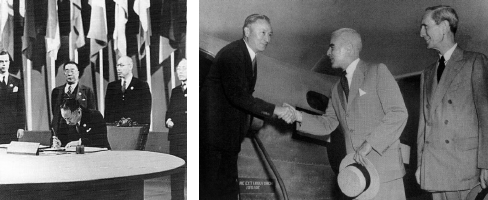
"Koo believed that to 'engage with the distant US… would be sufficient to contain an approaching, menacing Japan'," Jin continued, quoting Koo's own words. "It's fair to say that as a member of the US-educated elite, Wellington Koo played an important role in shaping US-China policy for more than two decades."
In the years after World War II, Koo acted first as the Nationalist government's ambassador to the US, and then after the founding of the People's Republic of China in 1949, continued to represent in Washington the regime in Taiwan until his retirement in 1956. Also in that year, Koo divorced his third wife Oei Hui-lan.
For the three years between 1946 and 1949, when the Communists fought the War of Liberation against the Nationalists, Koo had been trying actively to draw American support for the latter, but to little avail, as the American confidence in Chiang Kaishek and his government flagged.
On Oct 25, 1971, the United Nations General Assembly voted to admit the People's Republic of China and to expel the Republic of China (Taiwan). The PRC therefore assumed Taiwan's place in the General Assembly as well as its place as one of the five permanent members of the UN Security Council. On Jan 1, 1979, China and the US officially established diplomatic ties.
Reflecting on Koo's political stance, Young, the stepdaughter, said that he was "China oriented instead of party oriented". "I believe that his major concern during the civil war years was that China was being split up. And this is something he had spent his entire career preventing from happening," she said.
"One thing he always said-I heard this many, many times-was that 'wo shi yi ge wu dang wu pai zhong guo ren', meaning 'I'm a nonpartisan Chinese.'
"If you looked at his record throughout the 1920s, he had never ever participated in those internecine battles of the warlords," continued Young. "He started to work for the Nationalist government around 1929, but was only compelled to join in 1941, when he was appointed the Chinese ambassador to Britain. Why? Because per usual diplomatic convention, the appointment of an ambassador required the approval of the British government, which thought it would be better for the Chinese government to appoint a Nationalist party member."
In 1945, Koo was responsible for providing a list of candidates whom he would then lead to the San Francisco Conference. Among others, Koo recommended Tung Pi-wu (Dong Biwu), a veteran Communist. "I believed that there was no one line of political thought which could be absolutely right to the exclusion of others," he later said in the oral history project he did with Columbia University, his alma mater.
According to Young, Koo, who had never lived in Taiwan, was invited to return to Chinese mainland when Zhang Hanzhi, Mao Zedong's English teacher and a young diplomat, visited him in New York in 1972.
"Age, health and Grandma Juliana-that's the three main factors for him deciding not to go back," said Yuan, the granddaughter. "But he found a representative in my mother, who first went to the Chinese mainland with my father in 1974, a trip followed by others over the years. Every time she went, she went back to talk with Grandpa about what she saw."
Koo and Juliana Young, who had been working at the UN between 1946 and 1959, married in 1959. The couple lived in The Hague between 1957-67, when Koo was elected a judge on the International Court of Justice, before retiring as its vice-president and moving permanently to New York.
Yuan credited "Grandma Juliana" for taking good care of her grandfather during the 17 years between 1959 and 1976, when Koo, working with 5 scholar interviewers, recorded 500 hours of spoken memoirs as a Columbia University oral history project.