



Chinese economy's resilience helps ease unemployment challenges after COVID-19









The annual session of the National Committee of the Chinese People's Political Consultative Conference (CPPCC) opens on Thursday, a clear indication that COVID-19 is fully under control in China. As a result of the epidemic, China faces a huge unemployment challenge. Millions of students graduating from university this year and migrant workers are encountering unparalleled competition for jobs.
China is not the only country dealing with rising unemployment. The US, as the biggest economy in the world, has suffered a heavy hit on the labor market, too. So far, about 30 million Americans have made unemployment claims with the jobless rate hitting 4.4 percent, the highest since August 2017.
The global situation might become even worse. A recent report released by the International Labor Organization predicted that in the second quarter of 2020, COVID-19 may cost the equivalent of 305 million full-time jobs.
Pressure on the global labor market is another test of a country's governmental ability and economic resilience amidst the coronavirus pandemic. China has led the way with a rapid and effective response, fighting against COVID-19 while stabilizing the economy. Now that strong economic resilience will again help the country resolve unemployment pressures.
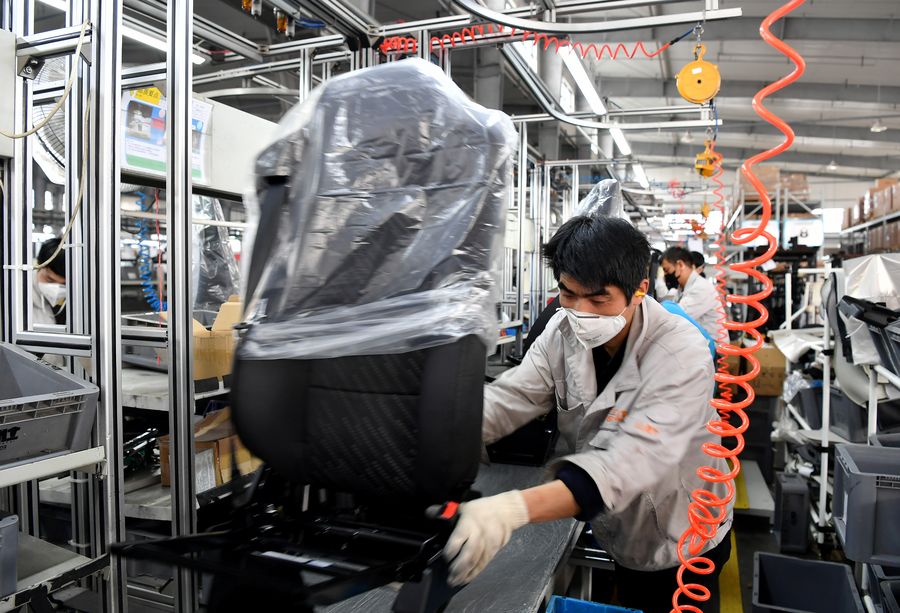
With comprehensive work resumption, companies are gradually going back to normal operations. As of April 15, according to official statistics, 85 percent of small and medium enterprises (SMEs) in China have resumed work. Chinese Ministry of Commerce data shows that more than 80 percent of enterprises in the service industry have resumed work. This data indicates that China's domestic industries are recovering at a fast speed, and this will become more evident over the rest of 2020.
One of the most obvious examples of the revival is tourism. During the recent International Labour Day holiday, the industry witnessed a rebound. According to holiday data from the Ministry of Culture and Tourism, 115 million domestic tourists were recorded and domestic tourism revenue reached 47.56 billion yuan – an increase of 166 percent month-on-month. Likewise, the hotel and catering industry and other service industries are gradually picking up, too.
In addition to the steady recovery of traditional industries, new businesses that grew fast during the outbreak are keeping a strong development trend too. For instance, social e-commerce has become a future development direction for retailing, which may further stimulate consumption and create more job opportunities.
China's economic resilience has laid a concrete foundation for the government to deal with the unemployment issue. However, the difficulties ahead cannot be underestimated. To relieve employment pressure, more work can be done in three areas.
First, the government should give more policy support to SMEs, which account for 95 percent of all enterprises in China and 80 percent of total employment. Helping SMEs survive the current crisis is vital for stabilizing the job market. During the epidemic, the state and local governments issued a series of preferential policies, including periodic tax exemptions, deferred payment or reduction of social security expenses, rent reduction and water and electricity price concessions to relieve the pressure on SMEs. These measures should be continued until the economic impact of the COVID-19 starts to fade.
Second, the Belt and Road Initiative can play a more significant role in boosting employment. BRI projects mainly concentrate on infrastructure, which demands long-term investment and is labor-intensive. It will also drive the development of upstream and downstream industries, including building material manufacturing, transportation, and operation. On top of this, "new infrastructure" projects can provide another boost for employment.
Thirdly, international cooperation should be emphasized to revive global value chains (GVCs). The pandemic has caused severe damage to GVCs, creating obstacles to work resumption, especially for manufacturing industries. Although most factories have reopened, the lack of key materials or orders is forcing manufacturers to reduce the number of employees or cut salaries in order to maintain basic operations. Even though the work resumption rate appears close to full capacity, actual production has not yet returned to desired levels. To recover and update the GVCs requires international cooperation. This should start with frequent dialogue and communication via multilateral institutions, such as the G20 and WTO.
Employment is about social stability and, more importantly, average people's daily lives. If unemployment becomes worse, the impact could surpass that of the coronavirus itself. In this case, China should put every effort into stabilizing the labor market and further promoting international cooperation on global economic recovery.





