China's economic recovery set to benefit ASEAN countries









Easing of restrictions, stimulus programs to help stabilization in Q2, economist says
China's economic recovery is set to benefit member states of the Association of Southeast Asian Nations, even amid continuing uncertainty over COVID-19, a leading Asian economist said.
"China is an important economic partner of ASEAN, and at a time when the developed economies are suffering from a sharp downturn, China is the only large source of demand that could still be growing," said Manu Bhaskaran, founding director and CEO of Centennial Asia Advisors, an economic consultancy in Singapore.
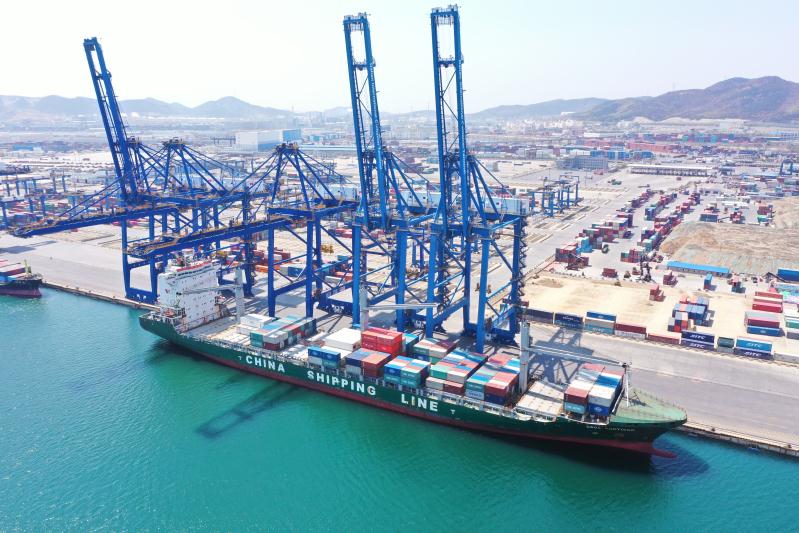
China has been ASEAN's largest trading partner for 10 years, according to the Ministry of Commerce. Meanwhile, in the first quarter of 2020, ASEAN replaced the European Union as China's largest trading partner, accounting for 15.1 percent of the nation's global trade volume during the period, according to the General Administration of Customs.
Noting the easing of restrictions and the stimulus programs to boost the domestic market, Bhaskaran told China Daily that the Chinese economy will be able to stabilize in the second quarter and then enjoy "a vigorous recovery".
"So far, the data seem to suggest that Chinese consumers are resilient and are stepping up spending, supporting demand," he said.
Despite the biggest GDP contraction in decades-the economy shrank 6.8 percent year-on-year in the first quarter-China's consumer market has shown signs of accelerated recovery. During the five-day May Day holiday, online sales of physical commodities witnessed a 36.3 percent year-on-year surge, according to the Ministry of Commerce.
With economic development a main topic at this year's two sessions, Bhaskaran sees some key issues that need to be addressed. "The employment situation remains tenuous and the sharp decline in global demand also points to continuing downside risks to the Chinese economy," he said.
China will prioritize stabilizing employment and ensuring people's livelihoods this year, aiming to create more than 9 million urban jobs, according to the Government Work Report delivered by Premier Li Keqiang on Friday.
More supply-side reforms will also help the Chinese economy sustain a recovery with good foundations, said Bhaskaran.
As China undergoes a recovery, it can affect ASEAN economies through many channels, said Bhaskaran.
For instance, the rise of demand in China could spill over into rising demand for ASEAN's exports of commodities and manufactured goods, while commodity prices and business confidence could also be boosted, said Bhaskaran, noting prices for commodities such as iron ore, coal and copper are already rising in line with China's recovery.
As for the proposed Regional Comprehensive Economic Partnership, Bhaskaran said the pandemic has not had any impact on participating countries' desire to finalize the agreement according to the timeline.
The RCEP is a proposed free trade agreement between ASEAN and its six FTA partners: China, Japan, South Korea, India, Australia and New Zealand. In March, the Ministry of Commerce said China will continue to advance the signing of the agreement at the end of 2020 as scheduled.
In addition, Chinese investment either through private channels or via the Belt and Road Initiative could also contribute to investment in ASEAN, Bhaskaran said.
China is one of ASEAN's most important sources of foreign direct investment. In 2018, FDI flows from China to ASEAN reached $10.2 billion, or 6.6 percent of ASEAN's total FDI, according to Xinhua News Agency, citing a statement by economic ministers from ASEAN and China.
However, Bhaskaran said tourism, a key area for ASEAN-China exchanges, is unlikely to reemerge as a growth driver for some time to come, due to the pandemic.
Given the pandemic's continuing impact, Bhaskaran said relaxation of restrictions on cross-border travel, especially for tourism, remains uncertain. And the travel restrictions, which he expects to last till next year, will also make travel less enjoyable, he added.






- Hainan sees 100 million tourist arrivals, increased spending in 2025
- Nuclear to power greener petrochemical industry
- TCM therapy gives students peace of mind
- Diving to discover details of distant past dependant on weather
- Nation's underwater archeology uncovered
- Dog weddings — how new industry laps up puppy love