Nation quick to lend helping hand in Latin America









Editor's note: The world faces huge challenges during the COVID-19 outbreak, and maybe even greater ones when it is over. Here, in the 13th part of a series titled "One World, One Fight", we look at how countries can work together to fight the virus and meet the challenges when the pandemic ends.
Experience in fighting pandemic shared with region
Hu Feifei, from Chifeng, Inner Mongolia autonomous region, had lived happily in Brazil for more than six years, starting her own business and a family.
Then, the novel coronavirus pandemic struck the vast Latin American country, changing life significantly for the 34-year-old.
"Before the outbreak, I operated a Chinese-language school in Rio de Janeiro, with more than 100 students attending each day for a course in the language and Chinese culture," Hu said.
"Sino-Brazilian relations have warmed in recent years, with more Chinese enterprises investing in Brazil-bringing job opportunities. As a result, many Brazilians have started to become interested in learning Chinese.
"Last month, Brazil saw a surge in the number of confirmed COVID-19 cases, and nearly all public schools have closed. I started to conduct my course through livestreaming on social media platforms. Surprisingly, this has attracted more students."
Hu's husband, Paulo, is a Brazilian. She said that since the outbreak emerged in Wuhan, Hubei province, the couple had bought thousands of face masks, using some themselves and sending others to family and friends in China.
"We also told our friends in Brazil to take the outbreak seriously and adopt measures to protect themselves," Hu said.
She added that to safeguard her family from exposure to the virus, she has not been out of the house for more than one month, and her husband has only ventured out twice-to shop for groceries.
Li Di, from Beijing, also lives in Rio de Janeiro, where he works for a Chinese infrastructure-building company. However, unlike Hu and her husband, he has been outdoors once a week during the outbreak.
"I go out to shop for food or just for a walk. I wear an N95 face mask and disposable gloves every time. I think it's OK to go outside and breathe fresh air if we have adequate protection," Li said.
He added that despite watching the news and seeing the number of confirmed cases in Brazil rise every day, his life is still relatively normal.
"The most important thing I have learned while working in Brazil is to be optimistic, which the locals are always telling me. They believe that humans will definitely defeat the virus," he said.
Li, who has been working from home for two months, has yet to return to the office.
"The current situation in Rio is very serious, but recent containment measures have been strictly enforced, including lining up at supermarkets and maintaining social distancing of at least 1 meter, wearing masks, and disinfectant being sprayed when shopping carts are returned to a store," he said.
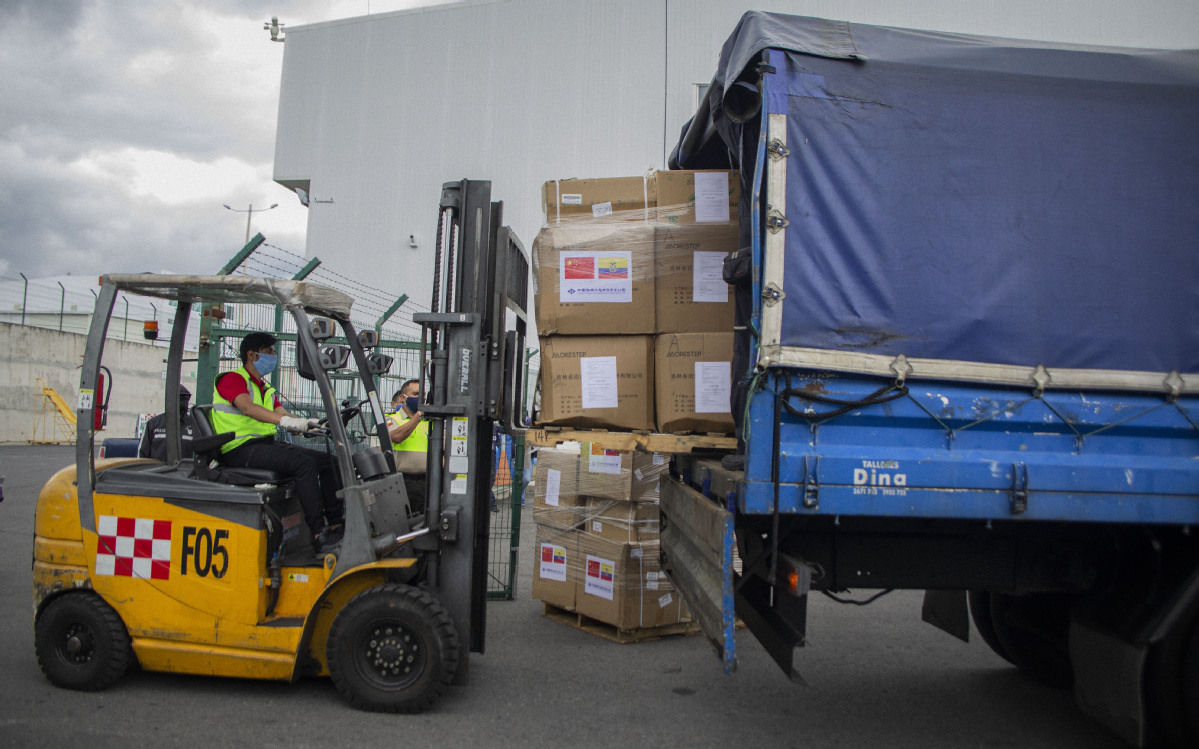
After hitting Asia, Europe and North America, the pandemic has raged across Latin America, which is home to about 650 million people, and where countries are stepping up efforts to fight the outbreak.
Brazil is the worst-hit nation in the region. As of Monday, the number of confirmed COVID-19 cases in the country stood at 691,962-ranking second worldwide after the United States. A total of 36,499 people have died from the virus in Brazil.
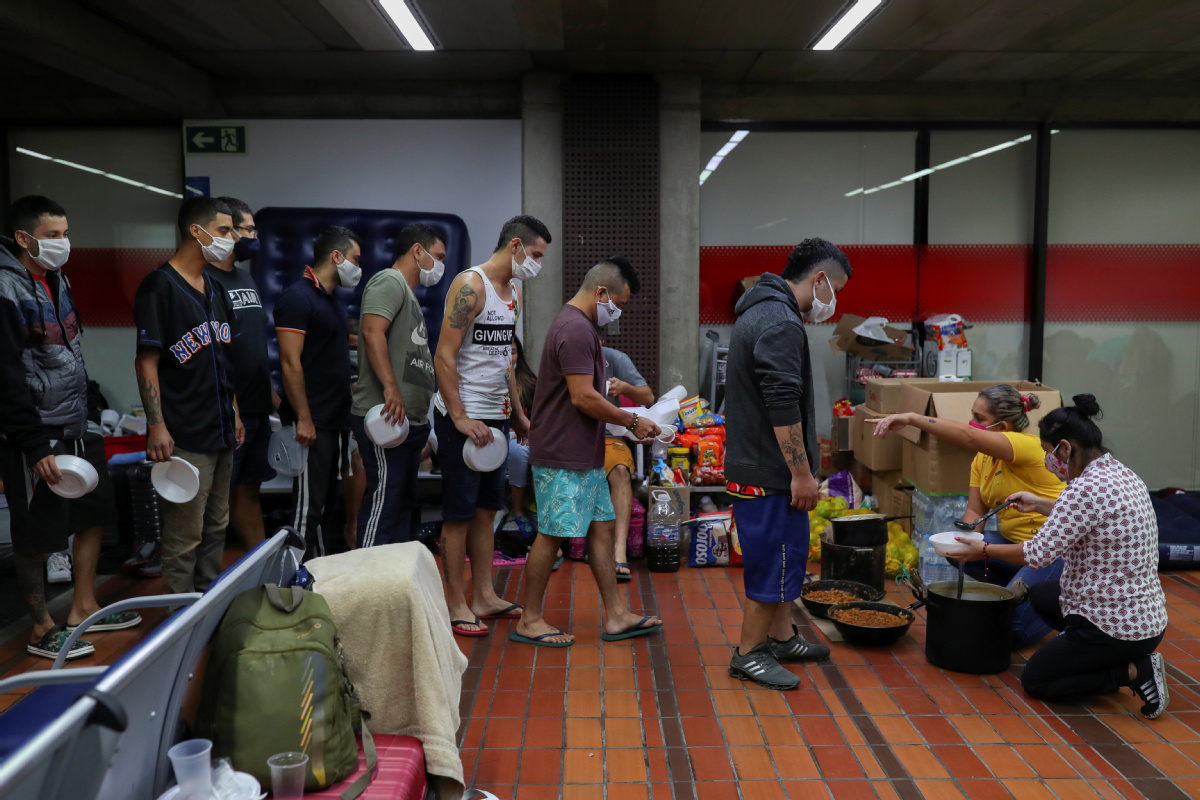
Other severely-hit countries include Peru, Ecuador and Chile. Blanket quarantine measures have been imposed, curfews enforced and most businesses closed.
In Chile, home to 19 million people, new restrictions were imposed in Santiago, the capital, after the number of cases doubled to more than 127,000. Peru, which borders Brazil to the west, has the eighth-highest number of confirmed COVID-19 cases in the world, with more than 196,000.
Many Latin American countries are sparing no effort to introduce practical and effective measures to fight or mitigate the impact of the virus.
In Rio de Janeiro last month, traffic restrictions were imposed in 10 districts and shops were banned from reopening. In the northeastern state of Pernambuco, the local government declared a 15-day lockdown in Recife, the state capital, and the metropolitan area to stop the virus spreading.
Brazil is also stepping up efforts to research and test vaccines.
Last week, the Brazilian government authorized testing in the country of a COVID-19 vaccine developed by the University of Oxford. The country's National Health Surveillance Agency said the vaccine is a "pioneer" in the fight against the virus, and Brazil will be the second nation-after the United Kingdom-to test its efficacy.
Meanwhile, in Santiago, subway usage fell by 67 percent after President Sebastian Pinera declared a 90-day state of catastrophe on March 18.
Concerts and sports events have been called off in major cities across Latin America. Restaurants and bars are empty and schools have closed.
In addition, Chile and other countries in the region have closed their borders and banned incoming flights, especially those from areas with severe outbreaks of COVID-19.
In Mexico, a network of Chinesemade thermographic cameras has been set up to screen for fever, one of the main symptoms of infection.
The cameras, which use infrared sensors to measure body temperature from a distance, have been installed outside shopping malls and office buildings in the capital Mexico City and in other major areas such as Monterrey and Guadalajara.
In Argentina, to compensate for schools being closed, the government has launched a website program, We Continue to Educate, providing households with educational content online, as well as on public television and radio networks.
Education Minister Nicolas Trotta said the site would provide all the educational tools needed to continue teaching and learning.
In Colombia, the education sector is following suit, according to Luis Alfredo Tellez, head of the Department of Communications at the University of San Buenaventura in Bogota, the capital.
Although the university already had some online educational material, this was insufficient, Tellez said, adding that the health crisis is a good opportunity for the institution to upgrade its online courses.
Similar to the difficulties faced by many countries in the fight against the pandemic, Latin American nations are struggling with unprepared and insufficient medical supplies. Health experts have warned that this situation could accelerate transmission of the virus.
For example, last month, more than 90 percent of intensive care beds were occupied in Santiago.
In some cities in the region, doctors reported a shortage of ventilators, and said patients could not get to a hospital quickly enough.
With intensive care units swamped, officials plan to move patients from national capitals, including Lima (Peru) and Santiago, to hospitals in smaller cities that are not as busy. However, they are running the risk of spreading the disease further.
Health workers have also complained of limited access to testing and of being overworked to the point of collapse.