


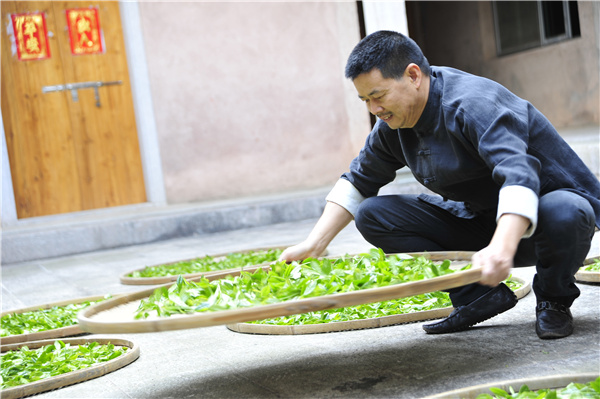
Tea producer seeks to preserve and promote China's tea-making heritage.
When Wei Yuede walked the rugged path through mountains in southeast China's Fujian province in the 1980s, he relied on the bags of tea he carried to provide him a route out of poverty.
Now the owner of a large tea corporation that produces, makes and sells tea with an annual sales revenue of $11.3 million, Wei is considering how to preserve and carry forward the traditional artistry of making Chinese tea, especially that of Tieguanyin, a premium variety of Chinese oolong tea which originates from his hometown in Fujian's Anxi county.
"Along the way, I have witnessed the dramatic changes in the Chinese tea industry," he says.
Born into a family that has been working in the industry for nine generations, Wei grew up with the fragrance of Tieguanyin and started to pick its leaves at the age of 13.
Tea picking is the very first of the 18 steps of making tea, but it is also "a woman thing" in many people's eyes, as it requires both speed and delicacy.
As a teenager, Wei quickly learned the skill and could pick more than 30 kilograms of tender leaves a day, more than the yield of his adult counterparts.
"To make good tea, you must be attentive and hardworking and put in lot of effort," says the 56-year-old, who still makes tea himself during the annual tea harvest.
By the age of 16, Wei had become quite skilled in tea tree planting, plantation management and tea production, among other areas of expertise.
"Enthusiasm is the best teacher. Sometimes one will even forget to eat and sleep just for making a good cup of tea," Wei says.
"But you also have to practice really very hard to be a master in this field," he adds.
In 1985, Wei established his own tea processing factory, the first of its kind in Anxi. The scale of his factory kept growing as his products found wider recognition in the market.
"At that time, we only sold loose tea, primary tea and some refined tea, but they were rarely packaged. Usually, State-owned factories would put just a few sentences of a product description on the bags in which the tea was packed, but it was still far from talking about tea culture," Wei said.
To better promote the tea industry in Anxi, in 1992 he initiated an annual contest to select the best Tieguanyin, which attracted tea merchants and experts from across the country. In 1996, that year's "king of tea" was finally auctioned off at a price of 160,000 yuan ($22,473) for 500 grams.
"The contest is very competitive and can attract the attention of the public with a lot of highlights, thus making Anxi tea more famous and bringing greater benefits to the tea farmers," he explains.
According to Wei, over past few decades there have been huge changes in so many aspects of China's tea industry, from the size of tea packaging to the means of transportation, from public understanding of tea to the scale of the tea drinking population.
As the representative successor of making Chinese oolong tea, a national-level intangible cultural heritage, Wei was invited to perform an on-site Tieguanyin tea-making presentation during the Shanghai 2010 World Expo.
"That profound experience will live long in my memory. I met leaders from China and also other countries. Many of them greeted and communicated with me. Some showed a strong interest in the tea making process and even asked me how the tea fragrance is released," Wei said.
In 2015, Wei established an institute in Anxi that teaches the making of Chinese oolong tea as a new model for transmitting the intangible cultural heritage and promoting the skills of making oolong tea.
Training courses including planting, picking and processing, and tea making, presented by Wei and several other teachers, are provided for free to interested parties who wish to become apprentices in the art.
Wei believes that however technology and equipment for tea making develops, the traditional craft should never be discarded, because technology and craft are two different things.
"The craft is passed down from the ancestors and it should by no means be discarded. I have the responsibility to pass it down. Otherwise, it will be lost forever," he says.
To recognize the long history and deep cultural and economic significance of tea around the world, the United Nations General Assembly proclaimed May 21 as International Tea Day in December last year.
"International Tea Day is an opportunity to celebrate the cultural heritage, health benefits and economic importance of tea, while working to make its production sustainable 'from field to cup' ensuring its benefits for people, cultures and the environment continue for generations," the Food and Agriculture Organization of the UN says on its website.
According to Wei, International Tea Day is a big event and, as China seeks to rejuvenate the tea industry further, it will help to raise people's awareness of drinking tea and also promote Chinese tea to the world.
"Given that many young people have so many other beverage options, hopefully, Tea Day will enable them to learn more about Chinese tea and finally fall in love with it," he says.
In the eyes of Wei, tea serves as a good bridge for exchanges between people.
"Sharing a pot of tea helps bring people together. When they put their faces into the fresh, sweet vapor of a cup of tea, they will also be reminded of places and people that they love but are thousands of miles away," he says.
Wei adds that, while it is important to preserve tea culture and the wisdom of Chinese people as an intangible cultural heritage, it is of the same, or even greater significance to protect the existence of the tangible material that carries this heritage so that future generations will always see and know about it.
"I would be carefree if I only think about the present, but the fact is, I'm always considering the future," he said.
Yang Jie contributed to this story.








