



Mass testing a go-to response









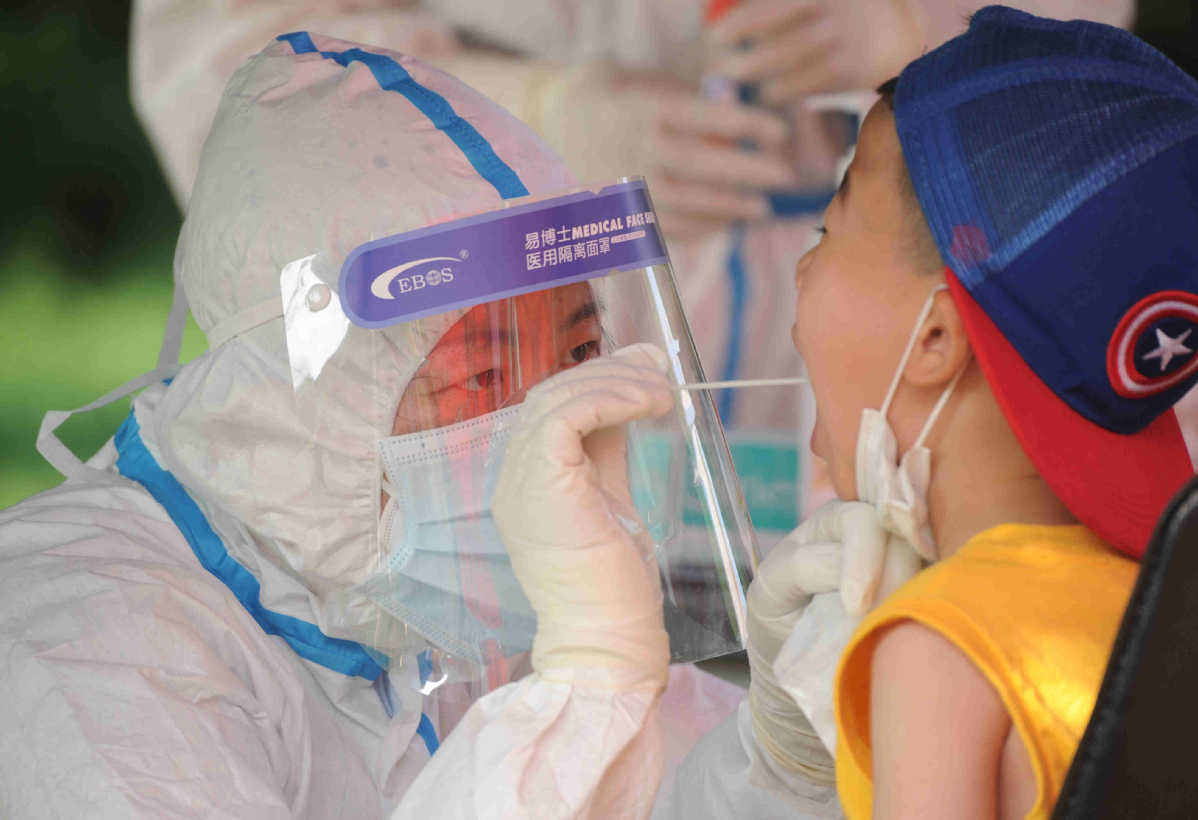
Effort helps curb fresh outbreaks by tracking down and isolating cases in incubation period
Backed by an expansive and efficient network of nucleic acid testing facilities, the rollout of fast and widespread screening has become the default response to new clusters of COVID-19 infections in China.
The robust testing capability has enabled the country to track down and isolate infected cases-with some at an asymptomatic stage-and curb fresh outbreaks at a faster pace, health officials have said.
Less than 10 days after a new outbreak was detected on July 15 in Urumqi, capital of Xinjiang Uygur autonomous region, the local government said it had taken over 2.3 million samples and initiated the second round of a free testing program in areas at a higher risk of infection.
In Liaoning province's Dalian city, where a new cluster tied to a seafood company emerged last week, more than 1.2 million samples were collected on the first day of a citywide testing blitz expected to be completed in four days.
Meanwhile, laboratories in Beijing, Fuzhou in Fujian province and Zhuhai in Guangdong province have also sprung into action to test entire neighborhoods where isolated cases were registered.
Zhang Wenhong, head of the infectious disease department at Huashan Hospital in Shanghai, said the prompt rollout of mass testing has underpinned China's disease control strategy that aims to detect all infections and bring the number of new cases down to zero quickly.
Taking the recent outbreak in Urumqi as an example, Zhang said the rapid expansion of tests, coupled with targeted containment measures, may stem the flare-up of the virus and allow resumption of normal activities in three to four weeks.
"As sporadic outbreaks continue to occur, such an approach is the optimal solution for China at present and may offer a point of reference for the international community," he said in a Weibo post.
The swift testing work stands in contrast to the delays and shortages experienced during the early stages of the domestic epidemic, which hit Hubei province the hardest. To cope with an overflow of patients who cannot access tests but demand immediate treatment, China decided to add a new group of confirmed cases based on doctors' analysis and lung imaging, known as "cases of clinical diagnosis".
This category was soon scrapped in late February after national resources were mobilized to aid the region's testing efforts.
"The new diagnosis method is only an interim measure aimed at hospitalizing all patients and reducing mortality rates," Wang Guiqiang, head of the infectious disease department at Peking University First Hospital, said during a news conference in February.
"As testing capability has caught up and all suspected cases can now receive quick diagnoses, we've decided to drop it."
The technology used to develop tests for the virus is not complicated and relatively mature, according to Peng Zhiqiang, deputy director of the Guangdong Provincial Center for Disease Control and Prevention's infectious disease unit.
"The key to boosting tests is exhausting all means to set up laboratories, gathering and allocating equipment and reagents, and training sufficient medical personnel to run tests," he said.
Mobilizing regional and even national resources to assist in local testing has been an essential approach amid the epidemic in China.
In Urumqi, less than 72 hours after the latest COVID-19 outbreak was detected, 10 medical aid teams were dispatched from across China to aid testing.
During a visit to Dalian last week, Health Minister Ma Xiaowei also stressed tapping into the potential of local testing institutions while making use of resources in nearby cities to cut turnaround times of mass testing.
Wang Xinming, a technician at the Chinese Academy of Medical Sciences and Peking Union Medical College who had participated in several aid missions, said laboratory workers are now armed with an "on-the-go" mindset.


- 2026 Spring Festival rush: 258M railway trips
- China renews blue alert for cold wave, strong winds
- Second volume of book on Xi's visits to people's homes published
- Respect Moment | Guardians of Peace
- Chinese tourists soak in festive vibes of Spring Festival
- China sees record daily passenger flow in Spring Festival travel rush








