Growth the answer to fiscal dilemma










The COVID-19 pandemic hit the Chinese economy hard in the first quarter, causing real GDP to shrink 6.8 percent year-on-year. But after Wuhan, the city worst hit by the novel coronavirus in China, emerged from the lockdown in early April, the economy has gradually returned to near normal, growing 3.2 percent in the second quarter. According to the majority view, China's current potential GDP growth rate is 6 percent. If it achieves this in the second half of 2020, the Chinese economy could post full-year growth of 2.5 percent.
But achieving that will require a boost in demand. And the lack of effective demand has impeded China's growth for years, with the pandemic making the situation much worse.
Consumption, which accounts for 55 percent of China's GDP, fell 3.9 percent in the second quarter, on top of a 19 percent decline in the first three months of the year. Some argue that consumption will now surge and become the main growth driver in the rest of the year. But this is unlikely because households will be anxious to replenish the savings they depleted during the lockdown and other anti-pandemic measures. The government can, and should, provide relief for households affected by COVID-19, but it cannot do much to stimulate consumption.
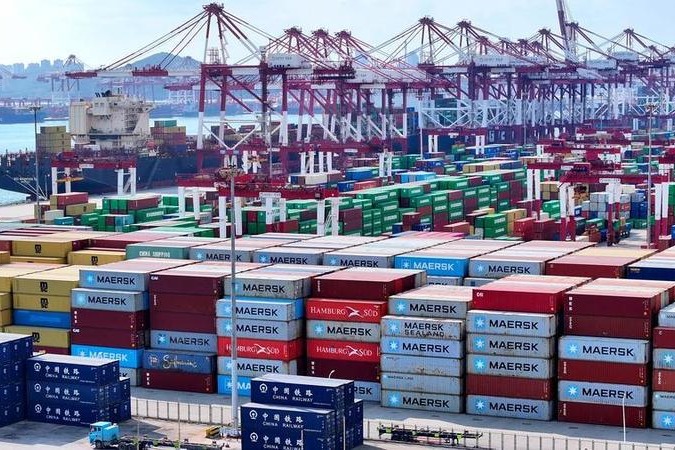
China's exports and imports fell 3 percent and 3.3 percent, respectively, in the second quarter. But since the share of net exports in China's GDP is less than 1 percent, export performance will in any case have a limited impact on growth in the second half of 2020.
Although fixed-asset investment turned only marginally positive in the second quarter, it was a significant improvement on the 16.1 percent contraction in the January-March period. A back-of-the-envelope calculation suggests that, given the likely growth rates of consumption and net exports, fixed-asset investment would have to increase at a double-digit rate in the second half for the economy to grow 2.5 percent for the year as a whole.
In China, fixed-asset investment consists mainly of three categories: real estate, manufacturing, and infrastructure. Investment in real estate grew 1.9 percent year-on-year in the first half of 2020, and is expected to increase at a rate of 5 percent for the rest of the year. But investment in manufacturing shrank 11.7 percent in the first half, and will most likely continue to be a drag on growth in fixed-asset investment for many quarters to come.
So, the only way for fixed-asset investment to show double-digit percentage growth in the second half is for investment in infrastructure to grow much faster still. Which would be new in China, as in the middle of 2009, infrastructure investment grew at an annual rate of 50 percent, owing to the 4 trillion yuan ($570 billion) government stimulus package introduced in November 2008. Infrastructure investment growth fell rapidly to low-single-digit rates only after 2018, largely as a result of deliberate policy choices.
As such, Chinese policymakers should draw several lessons from the implementation of the 2008 stimulus package. One of the most important is that infrastructure investment should be financed mainly by issuing government bonds, rather than by bank loans to sub-national authorities through so-called local government financing vehicles. China still has sufficient financial resources to support a big infrastructure investment drive, but this time the central government should be responsible for funding the bulk of it.
When the Chinese government announced early this year that it was aiming for a total budget deficit in 2020 of 3.76 trillion yuan, equivalent to 3.6 percent of GDP, it implicitly assumed that nominal GDP growth would be 5.4 percent. This is obviously unrealistic now, so budget revenues will be lower than forecast. And if the government does not reduce expenditure, China's fiscal position may worsen rapidly in the second half.
But if the government decides to reduce spending to prevent the deficit from increasing, economic growth may be less than 2.5 percent. That would make it impossible for China to create as many jobs as planned, and would also significantly increase its financial vulnerability.
The government is therefore likely to face a dilemma in the second half of this year. If it loosens fiscal policy, public finances will worsen significantly. But if it cuts expenditure to offset the revenue shortfall, growth will be lower, with dire consequences.
In my view, China should adopt an expansionary fiscal policy aimed at accelerating economic growth. The government should issue more bonds to finance additional infrastructure investment, and the People's Bank of China should adopt various policy measures to facilitate this, including quantitative easing if necessary.
The resulting problems-a worsening fiscal position and a rising debt ratio-can be dealt with later. Chinese policymakers should never forget Deng Xiaoping's maxim that "development is the only hard truth". And right now, China urgently needs a growth boost.
Project Syndicate
The views don't necessarily reflect those of China Daily.
The author, a former president of the China Society of World Economics and director of the Institute of World Economics and Politics at the Chinese Academy of Social Sciences, served on the Monetary Policy Committee of the People's Bank of China from 2004 to 2006.