Tibet set to realize Chinese Dream









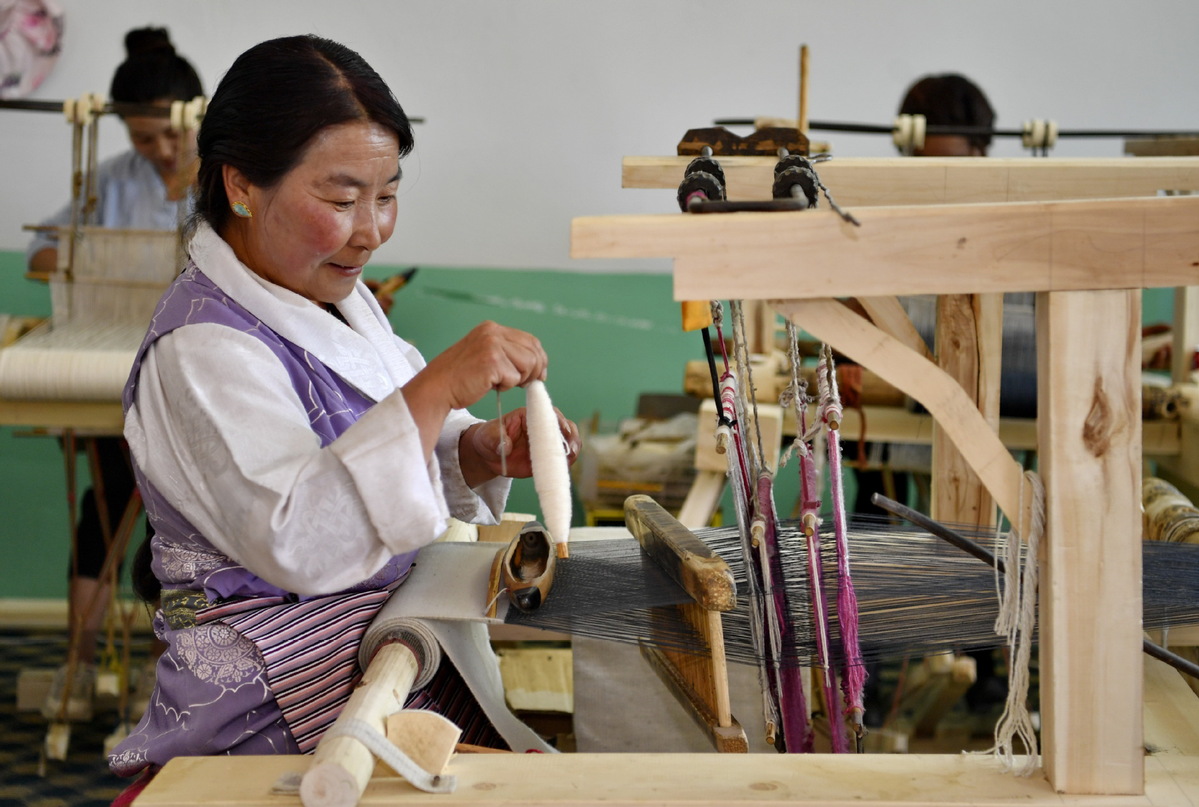
This year marks the 55th anniversary of the founding of the Tibet autonomous region and implementation of the socialist system, which fostered equality, unity, mutual assistance and common prosperity of all ethnic groups in the region. With the central government's support, the autonomous region has made progress on multiple fronts in sync with the rest of China.
The Communist Party of China has developed the system of regional ethnic autonomy to deal with the ethnic problems and guarantee political rights to the Tibetan people.
Like in the other four provincial-level autonomous regions for ethnic minorities, all the chiefs of the Tibet autonomous region and the local people's congress have been ethnic Tibetans in accordance with the Law of the People's Republic of China on Regional National Autonomy. Other smaller ethnic minority groups such as Monba and Lhoba are also represented in the local people's congress. In fact, more than 90 percent of the deputies to the Tibetan local people's congress and over 77 percent members of the local people's political consultative conference are from the Tibetan and other ethnic minority groups.
Since its foundation in September 1955, the Tibet autonomous region has registered impressive economic growth, with its GDP increasing from 327 million yuan ($47.63 million) in 1965 to about 170 billion yuan in 2019. And thanks to its rapid growth, per capita disposable income of people in Tibet has risen from 141 yuan in 1965 to 19,501 yuan in 2019. The rapid economic growth has also helped Tibet shift its focus from quantitative to qualitative development centered on innovation, coordination, green policies, openness and the philosophy of sharing.
The population in the region has increased from about 1.37 million in 1965 to 3.51 million in 2019, but ethnic Tibetans still comprise the overwhelming majority of the region's population. Also, the average lifespan of the people in Tibet has increased to 70.6 years, due to the central government's special focus on the livelihoods and healthcare of the Tibetan people.
Besides, Tibet has built a complete modern education system, with the average years of schooling increasing to 9.55. Children in Tibet have also been enjoying 15 years of free education-from kindergarten to high school-since 2012. Apart from preferential compulsory education policies, children of farmers and herdsmen in Tibet also get free meals and dormitories in schools, and are exempted from paying tuition. And children from poor families in urban areas, like their counterparts in rural areas, have equal access to government grants and subsidies.
In addition to education, the Tibetan people enjoy favorable policies in other fields too, such as social insurance and medical care. For instance, the numbers of beds and medical staff per thousand people-4.87 and 5.89 respectively-in Tibet, have reached the national average.
Meanwhile, the Tibetan people's health has greatly improved, with the maternal mortality rate declining to 56.52 per 100,000 people and the infant mortality rate to 1.15 percent. The Tibetan people enjoy comprehensive social security from cradle to their twilight years-including pensions, healthcare, unemployment allowance, occupational injury allowance and childbirth benefits. The autonomous region also attaches great importance to vulnerable groups such as orphans and senior citizens living in poverty, and provides them with special and timely care.
In the past, given its difficult natural conditions and relatively low development level, Tibet was stuck in poverty, and identified as the only province or region with a wide range of poverty-stricken areas in China in 2010. The incidence of poverty in Tibet was as high as 32.33 percent before the central leadership launched the targeted poverty-alleviation campaign in 2012.
But thanks to the preferential policies and central funds, the region announced in 2019 that 74 counties had been lifted out of poverty, and extreme poverty had been eradicated. As such, Tibetans along with the people in the rest of the country will step into xiaokang, or a moderately prosperous society in all respects by the end of 2020.
The central government, and other provinces, regions and cities have played a big role in helping eliminate poverty in Tibet. The central government has also convened the Central Symposium on Tibet Work since 1980, which have come up with policies to boost Tibet's economic and social development. The latest symposium was held on Aug 28-29.
So far, more than 18,000 cadres and technicians have been sent to Tibet by central ministries, State-owned enterprises and other provinces. The development assistance of more than 40 billion yuan to over 10,000 programs, too, has helped boost Tibet's economic and social development. The achievements made by Tibet over the past 55 years are the result of the central government's continuous focus on the development of all the autonomous regions and ethnic groups nationwide, which is a prominent feature of socialism with Chinese characteristics.
As Tibet, along with the rest of the country, enters a new era of development, it can take advantage of the government's favorable policies and resources to develop tourism, clean energy and trade to achieve high-quality development in accordance with its geographical conditions.
On Jan 11, the third session of the 11th Tibet regional people's congress unanimously passed "regulations on the building of national-unity-and-progress model district in Tibet". This shows the Tibetan people believe that national unity is the lifeline of all ethnic groups, and governance based on law is key to solving the ethnic problems and, along with the rest of the country, all the ethnic minority groups are getting closer to realizing the Chinese Dream of the national rejuvenation.
The views don't necessarily represent those of China Daily. The author is a researcher at the China Tibetology Research Center.