Wuhan's fighting spirit emerged on two fronts









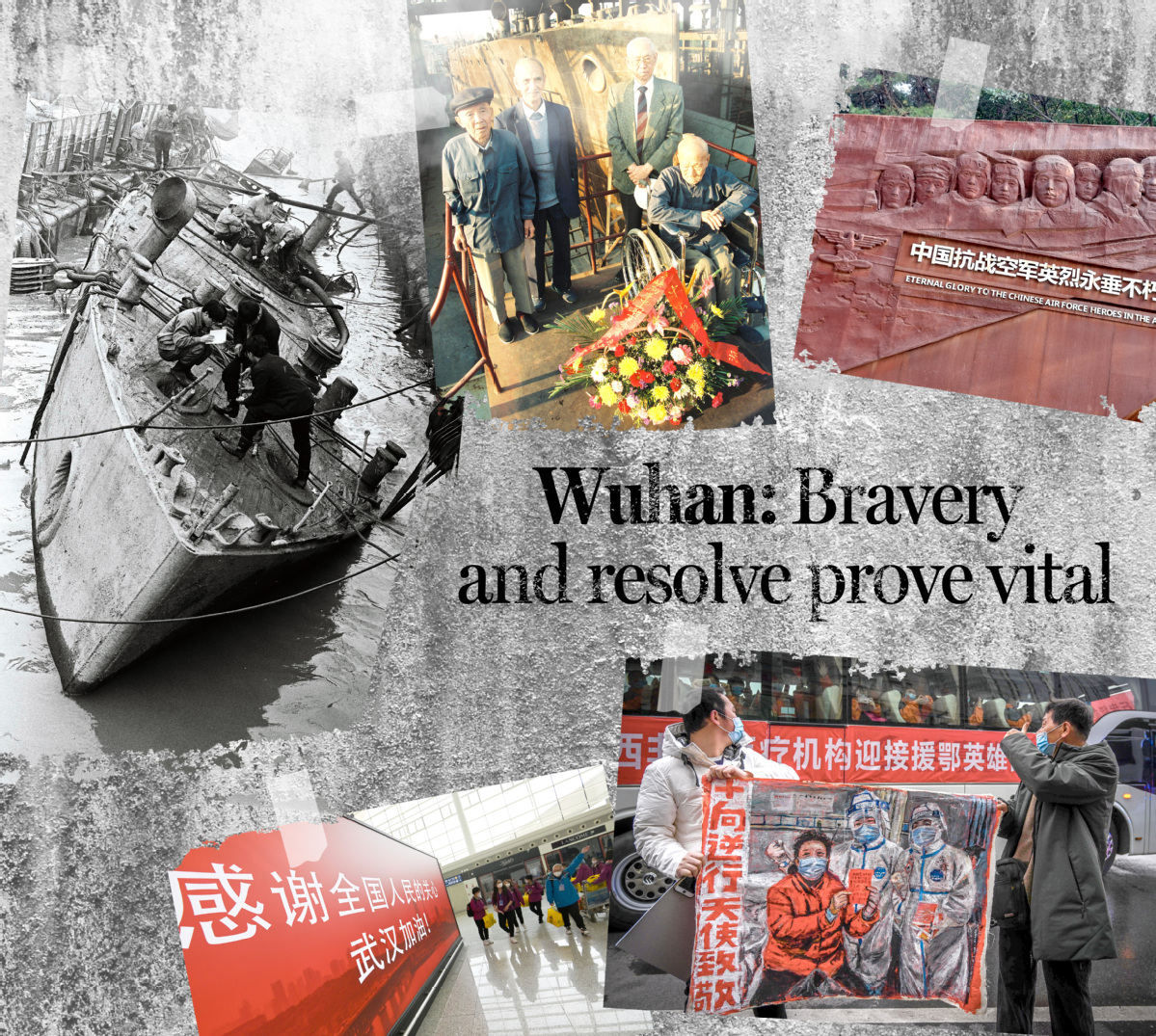
Determined efforts made in battle against Japanese, COVID-19
The determination shown by medical workers fighting the novel coronavirus outbreak in Wuhan, capital of Hubei province, evoked poignant memories for Chen De, whose uncle died defending the city from Japanese invaders in 1938.
"There is no doubt that the fight against COVID-19 earlier this year was another war for local people following the Defense of Wuhan. This time, we defeated an invisible, aggressive enemy," Chen, 71, said at his home in the city.
The Defense of Wuhan, from June 11 to Oct 27, 1938, was the biggest and longest battle in the War of Resistance Against Japanese Aggression (1931-45). It is also known as the Battle of Wuhan.
Over 1.1 million Chinese troops and 300,000 Japanese forces took part in the battle, which inflicted heavy losses on Japan and is credited with blunting its advance.
With Thursday marking the 75th anniversary of the Chinese people's victory against Japanese aggression, memorial services were due to be held nationwide to remember the war veterans and heroes who lost their lives.
Many people in Wuhan said the fighting spirit shown against the Japanese also helped the city win the battle against COVID-19.
In 1937, Japanese troops were responsible for the massacre in the former Chinese capital Nanjing, capital of Jiangsu province, with the Republic of China government fleeing inland.
The Japanese then set their sights on Wuhan, a key transportation and industrial hub on the Yangtze River seen as key to Japanese war planning, as capturing the city would leave Central China open to rapid conquest.
In January, some 82 years after the Defense of Wuhan, the city's strategic location meant that the central government had to impose a lockdown to prevent the COVID-19 outbreak spreading to other areas of the country. The lockdown was in force from Jan 23 to April 8.
As of Monday, 3,869 people from Wuhan, the city hardest-hit by the pandemic in China, had died from the highly contagious virus and 50,340 local cases of COVID-19 had been confirmed. The number of deaths in Wuhan from the disease account for more than 83 percent of the national total.
Aerial combat
Chen De said he grew up listening to stories of how his uncle, Chen Huaimin, a fighter plane pilot, was determined to help defeat the Japanese and protect the Chinese people.
As the Defense of Wuhan began, Japanese forces launched a series of air strikes on the city. On April 29, 1938, more than 100 Chinese and Japanese fighter planes were involved in combat in the skies over Wuhan.
Chen De said: "Local people were watching. They cheered every time a Japanese plane dropped out of the sky. It's hard for us to imagine having that many fighter planes over our heads."
He said his uncle, who was 22 at the time, shot down a Japanese plane five minutes after taking to the air, but then became a target for the enemy pilots.
Hit by Japanese fire, the fuel tank on Chen Huaimin's plane was set ablaze, but instead of ejecting from the stricken aircraft, he decided to fly it into a Japanese plane to bring it down. He lost his life as the two aircraft crashed into the Yangtze River.
Earlier, Chen Huaimin had shot down eight Japanese fighter planes in five aerial skirmishes, Chen De said.
"The bravery and determination of my uncle to win the battle at all costs was also shown by the medics who risked their lives to save COVID-19 patients in Wuhan," Chen De said.
"Without this fighting spirit, especially during the onset of the pandemic when little was known about the virus, the outbreak in Wuhan would not have been brought under control in such a short time. More lives would also have been lost."
Wang Ruiduan, a community worker from the Yongqing subdistrict in Wuhan, said the city suddenly became quiet after it was put under lockdown as the outbreak worsened. Local officials said Wuhan had entered a "state of war" as fear began to spread among the population of more than 11 million.
Wang, 31, who was in charge of taking local residents showing symptoms of COVID-19 to hospitals, said, "Medics from around China came to help Wuhan almost immediately, even though they knew there was a severe shortage of personal protective equipment and medical supplies.
"In 1938, the Chinese troops also didn't give up during the Defense of Wuhan against the Japanese at a time when they had insufficient supplies of ammunition and weapons."
Xu Ying, 46, director of the Department of Hematology and Endocrinology at Wuhan No 5 Hospital, said medics have a duty to save lives, but the outbreak transformed them into frontline fighters to protect the country.
"We played the same important role in defending China as the troops who fought in the Defense of Wuhan," Xu said.
On Jan 23, the hospital was designated to treat COVID-19 patients. At the height of the outbreak, medics at the institution were caring for an average of 1,030 patients a day.
Founded by Irish missionaries in 1923, the hospital also treated soldiers and civilians injured during the Defense of Wuhan.
Norman Bethune, a member of the Canadian Communist Party and a well-known thoracic surgeon, performed surgeries at the hospital for seven consecutive days during this battle, saving the lives of Chinese troops and local people.
More than 40,000 medics from around the country, along with their local counterparts, fought the COVID-19 outbreak in Wuhan, with their efforts key to determining the course of the pandemic in China.
On Feb 24, the National Health Commission said 3,387 medics nationwide had been infected with the virus, 90 percent of them from Hubei.
Chen De said: "Chinese, especially those from Wuhan, were united in the fight against Japanese aggression. The Communist Party of China and the Kuomintang also worked together in the Defense of Wuhan. History shows that when Chinese people reach a consensus and march in the same direction, they are unlikely to be defeated."
On July 7, 1938, supported by the CPC, the Republic of China government launched a campaign to encourage people in Wuhan to make donations in support of Chinese troops.
Yuan Lin, curator of the Museum of the Eighth Route Army's Office in Wuhan, said, "Because so many people wanted to donate money, the campaign, which was due to last for three days, ran for five."
The army office, established by the CPC in 1937 in an area controlled by the Kuomintang, played an important role in coordinating efforts to combat the Japanese.
Yuan said people flocked to donation points set up throughout the city. Some, who had not eaten for days, donated their food and money to support the Chinese troops. More than 500,000 people from all walks of life made donations.
In addition, locals volunteered to care for wounded soldiers. They also made warm clothing and sent it to the frontline, Yuan added.
"During a major crisis, Chinese people can be quickly mobilized and united. This will never change. The way in which people joined hands to fight the pandemic also proved this," she said.
Joint efforts
Wang, the community worker, said: "Instead of taking to the streets, as they did 82 years ago to show their support for the Chinese troops, this time Wuhan people contributed to efforts to stop the virus spreading by staying home and complying fully with the government's measures, such as wearing face masks. Such measures are not that easy to enforce in a city as big as Wuhan."
Ye Jiusi, who volunteered to deliver urgently needed drugs to chronic-disease patients during the lockdown in Wuhan, described local people who stepped forward to help as an "elite taskforce".
"We all wanted to help win the battle against COVID-19 as quickly as possible, because we knew it could cause more casualties if it was allowed to spread. Wuhan people have a sense of responsibility and urgency," the 50-year-old said.
In 1938, the Japanese expected the city to fall quickly. However, the Defense of Wuhan was much more effective than previous anti-aggression efforts.
When Wuhan eventually fell, Chinese forces headed to Chongqing, and although the Japanese subjected that city to intensive bombing, they did not succeed in capturing it. As a result, the prolonged defense of Wuhan marked a turning point in the Chinese resistance against the enemy forces.
After World War II, Wuhan grew to become one of the most prosperous cities in China, and locals are now recovering from the pandemic, economically and psychologically.
There are still reminders of the Defense of Wuhan and the battle against the pandemic.
Banners in the city showing local people's appreciation for the medics who fought during the darkest moments of the outbreak have still to be taken down.
Tourists also flock to the city every year to see the cherry blossom at Wuhan University. Cherry trees were first planted on the site by Japanese forces after they invaded the city and turned the campus into a field hospital.
A street in the city has also been named after Chen Huaimin, the pilot who sacrificed his life during the Defense of Wuhan.
Chen De said, "I am sure my uncle would have been pleased to see Wuhan declare victory in the fight against COVID-19 and would be proud of the Chinese people."
Liu Kun in Wuhan contributed to this story.

- China moves to set national standards for pre-made dishes
- Chinese company unveils plans for commercial space flights
- Latest addition to Shiziyang Bridge constructions brings main tower above 300 meters
- Hebei's 'ancient pressure cooker' setting internet ablaze
- Major urban renovation restores Xi'an's ancient moat
- China launches nationwide employment assistance program