Guizhou's efforts cut school dropout rate









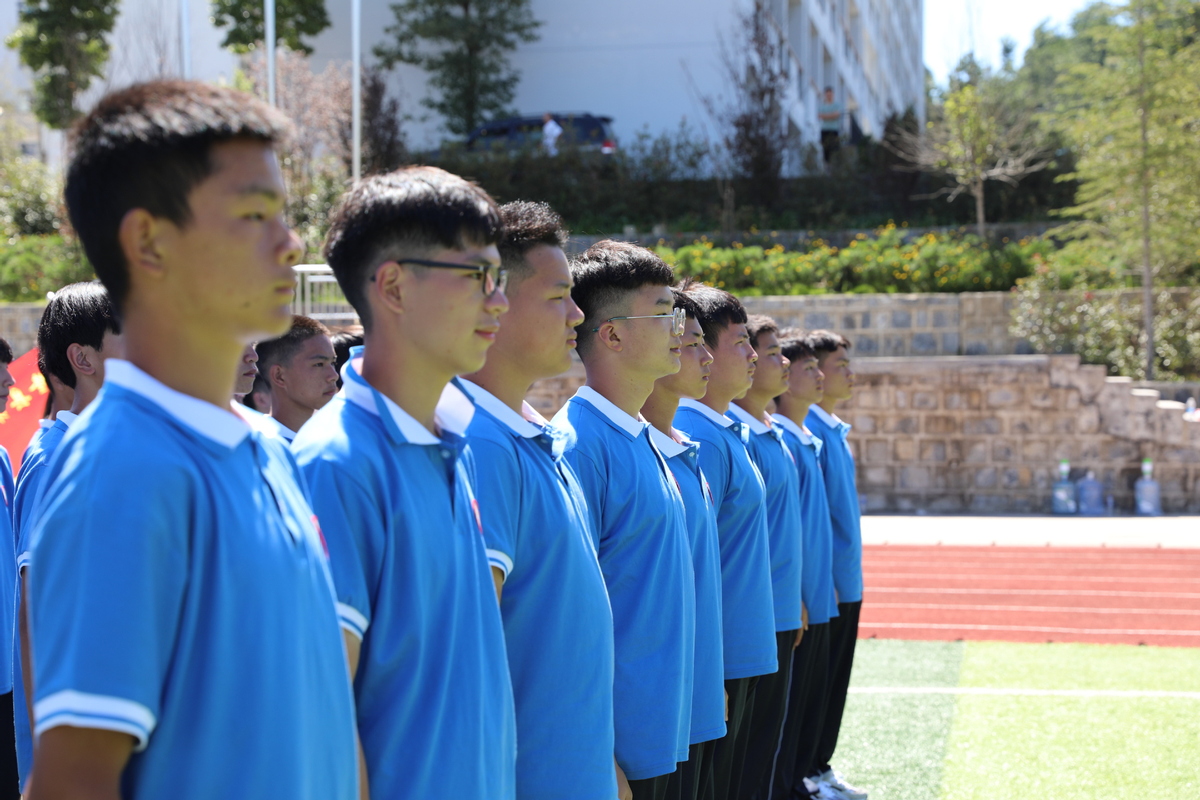
When two students failed to register for the start of the Grade 8 autumn semester at his middle school in Southwest China's Guizhou province in late August last year, head teacher An Huaqiang was quick to notice their unexplained absence.
He grew suspicious as both were from registered poor families-the target of China's sweeping poverty reduction campaign that aims to eradicate absolute poverty by the end of this year. Word was spreading in the classroom that they had left for Guangdong province with their parents, probably to seek illegal employment there.
As part of efforts to end the poverty cycle in mountainous Guizhou, provincial authorities have enlisted schools and teachers in the fight against rural poverty. They have been tasked with ensuring that every school-age child attends classes until at least the end of China's nine years of compulsory education.
To fulfill his duties, An booked a bus ticket to Jiangmen, Guangdong-where the boy and girl, both 15, were believed to be-determined to bring the pair back before the new semester started.
Once there, he learned the boy's father-the head of a timber processing factory in Jiangmen-h(huán)ad recently been sentenced to three years in prison over a fatal accident at the plant and compensation payments had left the family mired deep in debt. The girl, from a single-parent family, had become less sociable after her father had died a decade earlier and was unwilling to continue with her studies.
He spent two grueling days explaining the benefits of attending school to the children's parents, while also encouraging the boy and girl to complete their nine years of compulsory education. After being told by the two students and their parents that they would return to school, he then traveled to the nearby city of Zhongshan, where a 14-year-old boy from another class was believed to be.
"Traveling long distances to talk students into going back to school is exhausting, but fulfilling as well," said An, who eventually reunited with all three students on campus.
Guizhou saw a significant decline last year in dropout rates in the first nine years of schooling. Provincial government figures show there were just 52 by the end of last year, compared with more than 10,000 at the beginning of the year.
Since 2012, Guizhou has stepped up efforts to reduce dropout rates at primary and middle schools-which are covered by China's compulsory education period-as part of a nationwide effort to empower the rural poor and break the poverty cycle.
Early dropouts used to be widespread in impoverished regions, even though the country's Compulsory Education Law warns against keeping school-age children away from campus.
Many dropouts turned out to be from poor households, with parents who wanted them to start working earlier to help relieve the family's financial woes.
Some of the others who failed to attend school were so called "left-behind" children, whose parents worked in other cities to earn better salaries but failed to ensure their children received a proper education. The 2008 report estimated that China had 58 million left-behind children that year-28 percent of the rural child population.
Guizhou was home to many left-behind children for years due to a constant outflow of rural workers. The provincial authorities even faced scrutiny after several tragedies involving such children attracted national attention.
In November 2012, five boys died of carbon monoxide poisoning in a trash bin in Bijie, Guizhou. Their parents were working elsewhere and the five children were believed to have started a fire with charcoal inside the trash bin to seek shelter from the cold. Three years later, four siblings in Bijie killed themselves by drinking pesticides. Their parents were migrant workers and had been away from home for a long time.
The absence of proper parental guidance in Guizhou was widely suspected to have taken a toll on youngsters' education. According to provincial government figures, the enrollment rate for compulsory education there was 78.6 percent by the end of 2012, significantly lower than the national average at the time of 91.8 percent. Meanwhile, the dropout rates in Guizhou had been climbing for years, and in some counties more than a quarter of teenagers had dropped out of middle school.
The tragic deaths prompted the provincial government to step up efforts to "control the dropouts and protect schooling"-an easy way to track disadvantaged children-and made it a critical part of year-end evaluations of local officials' jobs. The province also set up a special fund to aid children's schooling.
Over the years, the province also initiated other mechanisms to boost school turnouts. Among them was a "complete handover" principle, which requires primary and secondary schools to share data in a bid to quickly identify students who discontinue schooling after graduation. "Persuasion teams" would be dispatched to find them and urge their parents to let them return to campus.
In a 2018 circular, the provincial government required that the enrollment of school-age children should reach 95 percent by the end of 2020, a politically important juncture by which time the central authorities have pledged to eliminate absolute poverty domestically so that the nation can complete the building of a xiaokang shehui-moderately prosperous society-a term created by ancient Chinese scholars to describe an envisioned society of affluence and vibrancy. Students who missed classes for three consecutive days would be recorded in a digital registration system, the circular said, and follow-up efforts would be made to persuade them to return to classes.
Last year, Guizhou prosecutors and other provincial agencies also drafted a guideline to blacklist employers who hired underage workers, as part of a broader effort to make dropping out of school less tempting.
An Jinlin, the 14-year old who quit school to work in Guangdong and was later brought back to school in Guizhou, said working conditions were harsh for underage workers.
"We cannot enter licensed factories," he said. "The only places that want us is back kitchens at some small diners. We work as hard as a bull but get little money."
Che Weiwei contributed to this story.






- China ramping up Nipah virus surveillance
- Shanghai to host embodied intelligence expo in July
- Chongqing sets GDP growth target of over 5% for 2026
- Xinjiang strengthens economic, cultural ties with Hong Kong, Macao
- Former senior political adviser sentenced to 12 years for bribery
- Hubei's government becomes first in China to add 'emotional value' to work report