



Carmakers step on the gas with research into fuel cell vehicles









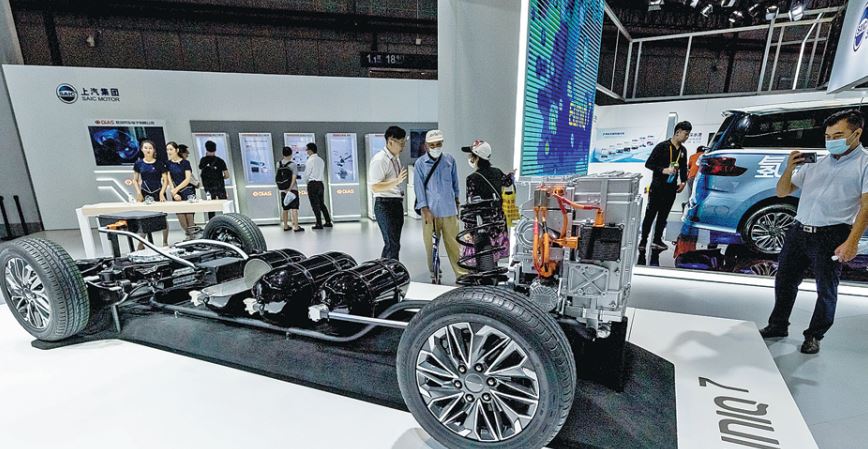
SAIC among companies investing in hydrogen as alternative power source
Hydrogen fuel cell vehicles, one pillar of the troika of new energy vehicles in China, are gaining traction to catch up with the more popular options of electric cars and plug-in hybrids.
Statistics show that China has 4.17 million electric vehicles and plug-in hybrids but fuel cell vehicles number merely around 7,200, most of which are trucks and buses. But that is going to change.
The country should strive to build a fleet of 1 million hydrogen fuel cell vehicles by 2035, said Ouyang Minggao, a Tsinghua University professor, at a forum last week.
He said the segment has made remarkable progress and as long as it reaches a certain number, it is expected to achieve what electric cars have done over the past decade.
Local authorities in some cities have released plans to promote the segment. Shanghai is scheduled to have 10,000 fuel cell vehicles and around 100 hydrogen stations by 2023.
Beijing has the same sales goal but with a deadline of 2025. Other regions, including Shandong and Guangdong provinces and Tianjin city, are working on their plans.
Carmakers, meanwhile, are coming up with new products. Statistics show that 92 carmakers have joined the list of eligible producers compiled by the Ministry of Industry and Information Technology. Around 220 fuel cell vehicle models are on offer.
Last week, SAIC Motor President Wang Xiaoqiu said the carmaker is to offer 10 fuel cell vehicles in five years and aims to secure a 10 percent share of the country's growing segment by 2025.
Wang announced the goal last week in Shanghai when the company unveiled its first fuel cell MPV, which is also the first of its kind in the world.
The model, called EUNIQ 7, features SAIC's third-generation fuel cell system. It has a driving range of 605 kilometers and can be refilled with hydrogen in three to five minutes. Electric cars can have a similar range, but take hours to be fully charged.
SAIC said it is building a team of more than 1,000 people for fuel cell system research, development and operation by 2025. Its annual vehicle sales are expected to reach 10,000 around that time.
Sales of SAIC's fuel cell systems are expected to exceed 30,000 by 2025 and this would make the carmaker a leading company in the field. SAIC aspires to become a globally competitive fuel cell vehicle maker in 10 years from now.
SAIC is one of the first Chinese carmakers to develop fuel cell vehicles, with its first project started in 2001. The company has spent more than 3 billion yuan ($438.95 million) in the segment over the past two decades.
SAIC said its latest third-generation fuel cell system is comparable to those of Toyota and Hyundai in many aspects.
Great Wall Motors, China's largest SUV maker, revealed a plan to roll out the first fuel cell SUV in 2021 featuring the carmaker's own engine.
However, there remain hurdles for fuel cell vehicles to reach the popularity of electric vehicles, let alone gasoline ones. They include the number of hydrogen stations and the cost of fuel cell systems.
Ouyang, the Tsinghua professor, said they stand a chance against electric vehicles if they can halve the cost of fuel cell systems by 2030.
International carmakers are joining the effort. Japan's Toyota has established a Beijing research facility dedicated to fuel cell vehicles in partnership with State-owned carmakers FAW, Dongfeng, GAC and BAIC as well as Beijing SinoHytec Co, a Chinese fuel cell engine maker.
In a statement, Toyota's operating officer Shigeki Terashi said: "There is no other automobile market with such a sense of speed. "I believe we will be able to establish the foundation for the widespread use of fuel cell vehicles in China."



















