Peacekeeping police a 'pillar force', ministry official says









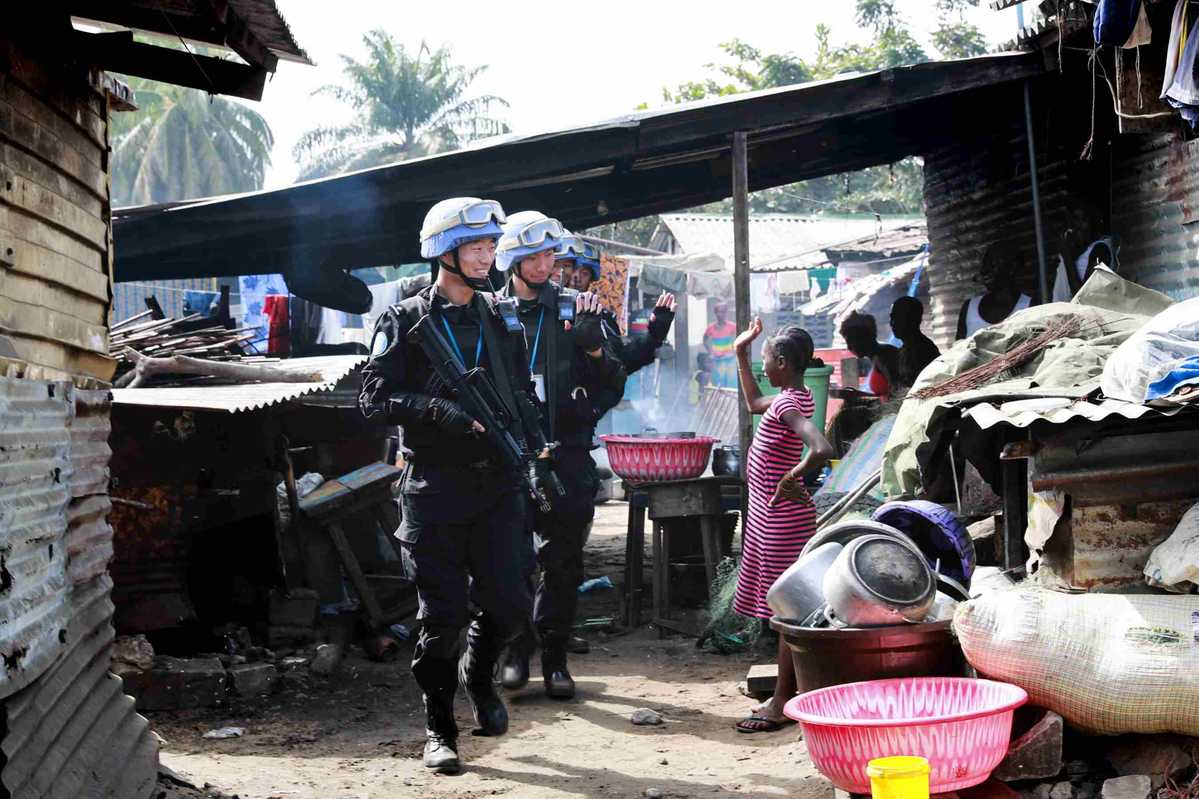
Officers overcome difficulties as most assignments are in less-developed areas
China's peacekeeping police have become a "pillar force" for United Nations peacekeeping missions, impressing the world body and host countries with their professionalism and strict discipline, a senior official from the Ministry of Public Security said.
"China is a peace-loving country and is willing to contribute forces and resources to peacekeeping missions. Also, it is China's duty to participate in such activities as it is a permanent member of the UN Security Council," said Yu Chengtao, deputy director-general of the ministry's Department of International Cooperation.
"Upholding peaceful development, China will always be a contributor to world peace."
China is now the second-largest financial contributor to UN peacekeeping, after the United States.
"The job of peacekeeping police officers includes protecting civilians, quelling riots and conducting security patrols," Yu said.
"Most of the assignments were in less-developed areas, where officers overcame poor conditions to carry out difficult missions."
Chinese police officers have been deployed for UN peace operations since 2000, when 15 were sent to East Timor.
Over the past two decades, more than 2,600 of them have taken part in nine peacekeeping operations. Eight have died during their missions.
Currently, 33 Chinese police officers are on peacekeeping operations in Sudan, South Sudan and Cyprus, and some serve at the UN headquarters.
A 160-member police squad will soon be dispatched to Abyei, a disputed area on the border of Sudan and South Sudan.
When President Xi Jinping attended the summit meetings for the UN's 70th anniversary in 2015, he announced several measures to support UN peacekeeping missions, including contributing to the UN's standby force mechanism, training 2,000 international peacekeepers split evenly between soldiers and police officers-and setting up a fund to sponsor UN work.
All have been delivered.
In June 2016, China established the first permanent police squad for UN peacekeeping operations, consisting of 330 members, to support the UN's standby force.
In addition, China has trained more than 1,000 police officers from around the world for peacekeeping, from high-level experienced officials to new officers with limited understanding of the UN system.
The China-UN Peace and Development Fund has provided $67.7 million for over 80 projects, supporting the UN's efforts in areas including peacekeeping and counterterrorism.
There are three types of UN peacekeepers: soldiers, police officers and civilians.
According to the UN peacekeeping program's website, UN police provide operational support to host-state counterparts in various fields including the protection of civilians; the facilitation of secure elections; the investigation of incidents of sexual and gender-based violence; and the prevention of serious organized crime and violence.
They also assist with the reform, restructuring and development of host-state police services and other law enforcement agencies.
Although China has been a great contributor to world peace, some foreign analysts have claimed that China's participation in peacekeeping is driven by pragmatic reasons, such as protecting assets and Chinese people abroad.
"People who understand the deployment procedure will know this argument is unreliable," Yu said."China is not taking the State's interests as a standard to choose an area to deploy peacekeepers."
The procedure is usually initiated by an international dispute. The UN Security Council will evaluate whether the disputed area is a threat to international peace and security and vote for a resolution. The UN secretariat then sends out invitations to UN member states based on the resolution.
"China will make a full evaluation based on our capacity and strength to answer the call, such as language skills," said Lu Cong, deputy head of the department's peacekeeping police division. "For instance, China has a shortage of French-speaking police officers and cannot offer much help to French-speaking areas."
Lu said that after China submits its response to the UN, and the UN acknowledges it, assignment details will be sent to a provincial public security department to recruit qualified police officers to join the team.
Yu said the deployment of peacekeepers to a certain area was a UN decision and not based on any Chinese initiative. He added that the UN evaluates the capacity of responsive member states to make contributions in areas where assistance is needed.
Assessments are mostly based on technical matters, such as if the state has previous experience in the areas. The UN would then determine the number of personnel to be deployed.
"It is a reality that most mission areas are less developed and less attractive to foreigners," he said. "Even in a mission area with Chinese businesses and people, it is more likely a coincidence. We peacekeeping police officers protect local civilians, including the ones who happen to be Chinese."
It can seem like a no-win situation, said He Yin, associate professor at the China Peacekeeping Police Training Center of the People's Police University of China.
"China sometimes finds itself caught in a dilemma," He said. "If it shies away from international affairs, some may accuse it of not shouldering its global responsibilities, and if it takes an active part in international affairs, some may accuse it of being 'assertive' and trying to reshape the world order."




- China's Global Governance Initiative receives positive feedback at forum
- China's Xizang sees steady tourism growth in 2025
- First-of-its-kind pearl auction held utilizing Hainan FTP
- Agarwood exhibition steeps Shanghai museum in fragrance
- The Fujian Coast Guard conducts regular law enforcement patrol in the waters near Jinmen
- IP protection for new fields to improve