



Women actively join national poverty reduction drive









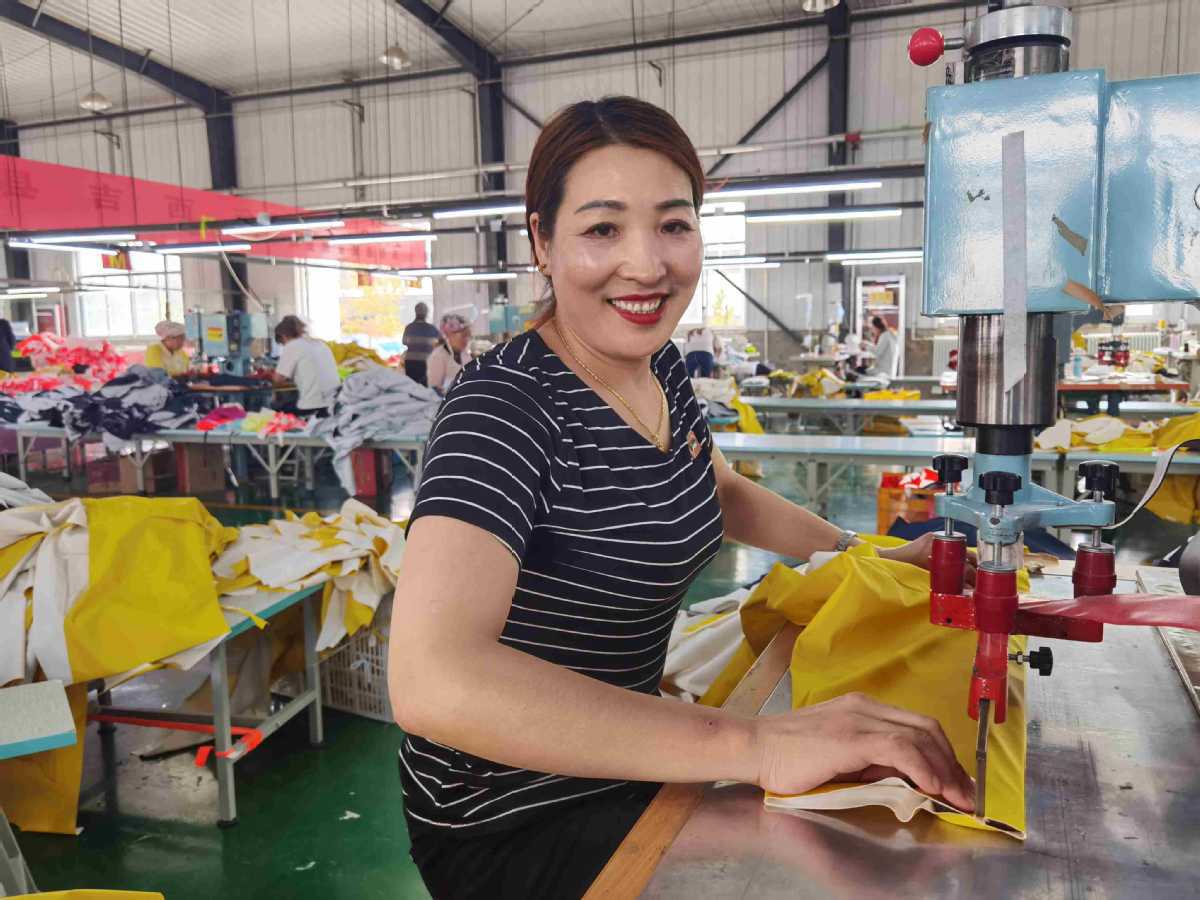
BEIJING - In a workshop in Central China's Henan province, more than 20 sewing machines make "chuka, chuka" sounds as the needles punch through the fabric.
"To meet the delivery deadline, we have to work against the clock to make over 7,000 pairs of school uniform trousers," said 31-year-old Zhong Yanhong, supervisor of the "poverty relief workshop" in Ligang village, Weishi county.
The trouser processing workshop employs more than 40 women from nearby villages including 19 from poverty-stricken households, offering them an average monthly salary of 3,000 yuan (around $440).
"Sewing trousers is simple. With low educational backgrounds, rural women like us can quickly master the skills," Zhong said.
TAILORED PROGRAMS EMPOWER RURAL WOMEN
Years ago, Zhong's father-in-law was diagnosed with cancer. The high cost of medical care plunged the family into poverty. To keep the family afloat, Zhong had to leave her two-year-old son and landed a job at a textile enterprise far away from home in 2015.
Zhong's dream of working at her doorstep came true in 2017 when a "poverty-relief workshop" was established in her village. Zhong applied for a job when she heard the news. Sewing skills are her forte, so she was appointed supervisor of the workshop.
Benefiting from a poverty-alleviation program called "Qiaoxifu," a raft of such workshops have been set up in Henan, empowering impoverished and "left-behind" women to take new roles in their families.
"The workshop enables women from rural areas to land a job near their homes and take care of their children," said Zhong, who earns more than 6,000 yuan a month. Her mother-in-law, 68, can earn over 1,000 yuan each month by doing odd jobs for the workshop in the slack farming season.
China has slashed the number of people living in poverty by more than 700 million since 1978. Women accounted for about half of those brought out of poverty.
Yet the country is still in an uphill battle to enrich millions of people who still live below the poverty line and to achieve the goal of eliminating absolute poverty by the end of this year, in a country with a population of 1.4 billion.
Thanks to the "Qiaoxifu" program, more than 1 million rural women including 120,000 from registered poverty-stricken households in Henan have been employed by businesses near their homes, such as garment and handcraft factories and tourism and e-commerce sectors.
Answering the central leadership's call for "targeted poverty alleviation," which demands tailored policies to suit different local situations, various provinces and municipalities seek to tap the power of women in the fight against poverty.
Beijing has paired up with 90 poor banners and counties in seven provincial-level regions including Tibet, Qinghai and Xinjiang to offer skill training and develop industries to help local women shake off poverty, according to the Beijing Women's Federation.
With a huge demand in the home services industry, the federation has also established partnerships with their counterparts in 10 provinces and autonomous regions to help around 300,000 people, most of whom were women, find jobs related to housekeeping services in the national capital.
"SHE-POWERING" THE FIGHT AGAINST POVERTY
Women are not only the targets of China's fight against poverty but also the driving force in the battle.
Taking off her fancy dresses and high heels, Gao Yanmei, a former researcher in a local women's federation in Tianjin municipality, flew to Northwest China's Gansu province and became a poverty alleviation cadre in 2016.
In the following three years, the woman in her 40s trekked through every corner of Gannan Tibetan autonomous prefecture despite the cold, thin oxygen and rugged terrain.
"The local medical conditions were really poor. Villagers sometimes had to travel hundreds of kilometers to Lanzhou, the capital city of Gansu, to see a doctor," said Gao, adding that many residents got stuck in poverty due to illnesses in the plateau region.
Gao contacted the Tianjin health authorities who allocated 20 medical experts to the prefecture in 2018. A long-term medical pair-up program was later launched, with 10 top-notch hospitals in Tianjin offering support to the People's Hospital of Gannan.
During her stay in Gannan, medics from the Tianjin Eye Hospital performed nearly 400 free cataract surgeries for the plateau residents.
"Every time I saw them take off the gauze and look around the new world with tears of joy, I felt more excited than them," Gao said.
China has actively implemented the United Nations' goal and objective of promoting gender equality and improving the status of women, and has made unique contributions to drive the development of the women's cause globally, said Du Jie, a researcher with the Women's Studies Institute of China.
A series of data gives an optimistic outlook on women's development in China. In 2017, there were 340 million working women, doubling the figure in 1978, according to the white paper, titled "Equality, Development and Sharing: Progress of Women's Cause in 70 Years Since New China's Founding."
The illiteracy rate among females aged 15 and above dropped from 90 percent before the founding of the People's Republic of China to 7.3 percent in 2017, which was a historic change.
The maternal mortality rate has fallen 79.4 percent from 88.8 per 100,000 in 1990 to 18.3 per 100,000 in 2018, the white paper said.
"To ensure that women can equally share poverty reduction dividends, we should protect their rights and interests, build a harmonious and inclusive social culture and create an international environment conducive to their development," Du said.


- F1 Chinese Grand Prix returns with major upgrades
- Taiwan's 'goodwill mission' criticized as futile bid for 'independence' support
- Chinese biotech innovator Jacobio Pharma reports its 2025 annual results
- Xinyang aims to become open gateway in southern Henan, says NPC deputy
- Honor launches its latest foldable smartphone Magic V6
- Students and teachers from Colorado plant 'Panda Friendship Bamboos' in Chongqing





