



Foreign capital flows can't be allowed to create asset bubbles









While the rest of the world still has negative growth caused by COVID-19-related shutdowns, China is the only major economy that has returned to positive growth.
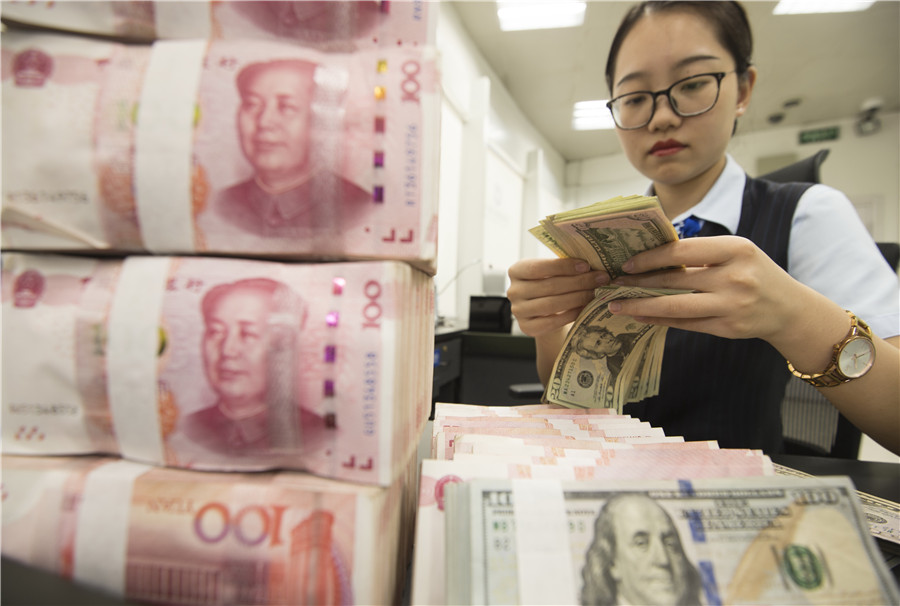
A bit ironically, this relative economic recovery combined with policies that have opened up China's financial markets to outside investors are leading to a rise in the yuan versus the dollar rate and to large flows of capital into the Chinese market.
China's capital markets are now very attractive due to the nation's success in fighting the pandemic while also, almost uniquely, sticking to a prudent monetary policy.
China should continue to liberalize and open up these markets, but flows of money need to be controlled, especially in the current extraordinary situation.
In an Oct 14 news conference, the People's Bank of China, the central bank, said that macro leverage should be allowed to rise in stages and credit support for the real economy should be expanded.
But this clearly did not mean that the PBOC is abandoning its long-standing policy of following a prudent monetary policy in order to instead implement anything like the "whatever it takes" liquidity infusion now being followed by the US Federal Reserve.
On Oct 12, Xinhua News Agency reported PBOC Governor Yi Gang as saying that China's policy of keeping a prudent monetary policy has enabled the nation to be one of the few major economies in the world to be following normal monetary policy. "Keeping a normal monetary policy, positive interest rates as well as an upward yield curve is generally conducive to sustainable economic and social development," he said.
Some expansion of credit is consistent with the International Monetary Fund's guidance issued last month. The October edition of the IMF Global Financial Stability Report concluded: "As economies reopen, accommodative monetary and financial conditions, credit availability, and targeted solvency support will be essential to sustaining the recovery."
A liquidity increase of the magnitude we are now seeing in the US will smooth the current crisis, but it will cause severe long-term problems. High US inflation is a real possibility. Furthermore, high corporate debt will limit future real investments. High personal debt will reduce consumption and may cause retirement viability problems for an aging population.
The immense liquidity in the system is driving up asset values (mainly stocks and housing) since the money has few other places to go. Little of it will go into real productive investment until and unless retail sales rise. What's the point of investing to produce products that won't sell?
Worst of all, a liquidity-driven asset price boom is simply an unearned gift of new wealth to people who already own lots of assets. As we have seen in the US over the last two decades, a loose monetary policy makes income inequality worse and exacerbates social tensions.
Chinese third-quarter data showed a year-on-year GDP growth rate of 4.9 percent, which counteracts the sharp decline in the first quarter so that the full-year growth rate should still come out at a positive 0.7 percent.
Compared to Chinese growth rates in normal years, this may appear disappointing. But it is much higher than the huge declines in the US, Europe and elsewhere.
Much of global growth for the next decade depends on the Chinese economy. The IMF predicts that the level of global GDP in 2021 will be only 0.6 percent higher than that of 2019-with almost all of the growth driven by China.
Even in the longer term, the IMF predicts that in 2025 China will contribute 27.7 percent of global growth, compared to 13 percent from India and 10.4 percent from the US.
Because of China's growth and relatively restrained monetary policy, market forces will lead investors to shift funding toward the Chinese capital market.
The very slow recovery of all other major economies will naturally slow Chinese economic growth. Noting that the national economy has continued a steady recovery from the pandemic, the National Bureau of Statistics warned: "However, we should also be aware that the international environment is still complicated and severe, with considerable instabilities and uncertainties, and that we are under great pressure of forestalling epidemic transmissions from abroad and its resurgence at home. The economy is still in the process of recovery and the foundation for sustained recovery needs to be consolidated."
One problem is that China's retail sales grew 3.3 percent year-on-year in September and only 0.9 percent in the third quarter, much slower than total GDP growth. Online retail sales of physical goods rose 15.3 percent from last year, now constituting almost 25 percent of total sales.
This means that many brick-and-mortar stores, especially small businesses, might fail and jobs will be lost. It will take some time for these people to transition to new jobs and careers.
But, NBS data show that the unemployment rate declined somewhat to 5.4 percent in September from a high of 6.2 percent in February-much lower than the rates in other countries.
The "dual circulation" development pattern, with a somewhat increased emphasis on domestic consumption, might be looked at as a response to lack of international demand during the pandemic. But it is more accurately looked at as a necessary response to the fact that the Chinese economy is large and growing rapidly and has accomplished two decades of rising wages and, thus, rapidly rising domestic demand. This would have been a necessary policy course-adjustment regardless of the virus.
The value of the yuan versus the dollar has been rising due to market forces leading foreign investors to move their money into China. The US Fed is flooding the world with dollar liquidity that has to go somewhere. Yields in US and European bond markets are very low or negative. US stocks now have very high price-to-earnings ratios, and there are a wide variety of risks in the US and Europe. So, money is moving to the more stable, higher-earning Chinese markets.
"It is normal for the yuan to appreciate, driven by market-oriented forces, or the demand-support relationship in the market," said Sun Guofeng, head of the monetary policy department of the PBOC, during a news conference on Oct 14. According to Sun, market forces are a dominant factor in China's managed floating exchange rate regime.
Similarly, the Hong Kong dollar is also being driven to historic highs by demand for HK-listed stocks.
In an interview with CNBC, Neeraj Seth, head of Asian credit at BlackRock, said that Chinese bond yields, low inflation, strong credit data and central bank liquidity policy lead investors to see that the Chinese bond market has a high real yield, compared to near zero or negative yields elsewhere.
Plus, it is not correlated with other markets, so there is a strong desire of foreign investors to diversify into the Chinese financial products. Seth added that China's onshore bond market is $16 trillion, so investors can build a diverse portfolio with good returns.
China's government has taken great steps to open up China's financial markets to foreign investors and foreign competition in the last two years. In the long run, this will improve the economy's efficiency by introducing more competitiveness and innovation into the domestic financial system.
But in this year when there is extraordinary foreign demand for Chinese assets, it is critical that inflows of foreign capital not be allowed to drive inflation or create an asset bubble in China.
The writer is vice-president and senior economist at the Center for China and Globalization, a non-governmental think tank based in Beijing.
The views don't necessarily reflect those of China Daily.



















