Reusability tech set to help carrier rocket blast off in 2025









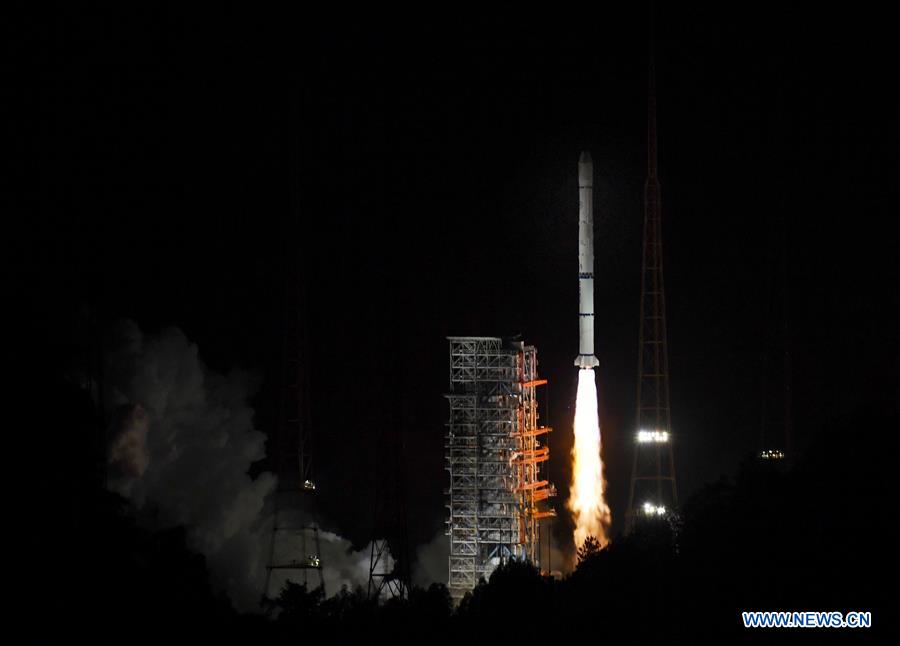
China's first reusable carrier rocket is scheduled to be built and launched around 2025, according to a key figure in the nation's space sector.
Wu Yansheng, chairman of China Aerospace Science and Technology Corp, the country's leading space contractor, said at a recent technology forum in Chengdu, Sichuan province, that the rocket's major parts will be able to return to Earth making an engine-propelled vertical landing and will be reusable.
This new launch vehicle is now under research and development and will represent a breakthrough by Chinese engineers in rocket reusability technology, he said, without elaborating.
The rocket, together with a super heavy-lift launch vehicle that is also being designed by China Aerospace Science and Technology Corp, will extensively boost China's space transport capabilities, he said.
Sources from the China Academy of Launch Vehicle Technology, a subsidiary of CASC in Beijing and the largest manufacturer of carrier rockets in China, said Wu was referring to the reusable variant of the medium-lift Long March 8 liquid-propellant rocket.
The Long March 8 is scheduled to carry out its maiden mission before the end of this year at the Wenchang Space Launch Center in Hainan province. The current type of rocket cannot be reused.
Designers plan to develop an integrated first stage for the rocket's future reusable variant. This new first stage will consist of a core booster and two side boosters. Instead of breaking up and falling back to Earth, the core and side boosters will stick together and conduct propelled landing as a whole onto a recovery platform at sea, sources said.
Lu Yu, a senior scientist at the China Academy of Launch Vehicle Technology, said: "If we can control the descent process of the first stage of a rocket and recover it, we will be able to tremendously improve the economy of our launch service and also reduce risks and disturbances to residents living along the rocket's trajectory."
Demand for space-based services from the government, the business sector and the public keeps increasing, and consequently creates a huge need for carrier rockets, Lu said. "Making rockets recoverable and reusable is an ideal approach to reduce the launch costs and boost mission efficiency."
Reusable rockets are not easy to make, as they require low-cost manufacturing techniques, lightweight materials and advanced autonomous landing technology with high accuracy, the scientist said.
The most renowned reusable rocket in the world is SpaceX's Falcon Heavy, which made its maiden launch in February 2018. All boosters on the US rocket's first stage can be recovered and reused as they separate from each other and perform controlled reentry and landing.
The first model of the Long March 8, which will soon make its debut mission, has a modular design and incorporates technologies that have been used by the Long March 3A and Long March 7.
With two core stages and two boosters, the rocket is 50.3 meters tall, has a liftoff weight of about 356 metric tons, and will be propelled by liquid oxygen, liquid hydrogen and kerosene.
It can transport a 5-ton spacecraft to a sun-synchronous orbit 700 kilometers above Earth, designers said, adding that its launches will be based at the Wenchang center as well as Jiuquan Satellite Launch Center in the northwestern Gobi Desert.



- Deepening of Sino-Finnish ties stressed
- Over 7.3 million people recorded as registered organ donation volunteers in China
- China says Nipah outbreak poses limited risk
- PLA's aerobatic jets arrive in Singapore to take part in air show
- China's garbage sorting drive still has a long way to go in many cities
- Former Chengdu official Bao Hui under investigation