



Trade deal comes at right time









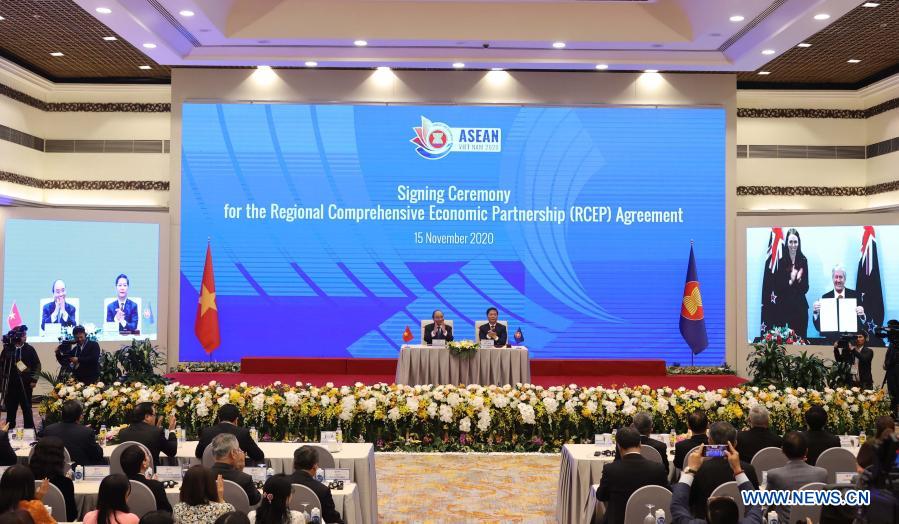
The signing of the Regional Comprehensive Economic Partnership by 15 Asia-Pacific economies on Sunday is a marvelous achievement after eight years of tough negotiations.
The world's largest free trade agreement, it covers about one-third of the global population and GDP. It is set to progressively lower tariffs on 90 percent of goods in the coming years.
The signing could not come at a better time after nearly four years of US President Donald Trump's "America First" unilateral and protectionist trade policies, which have wreaked havoc on global trade and supply chains, especially the closely linked Asian supply chains and trade-dependent Asian nations.
In 2018, Asia's share of intra-regional trade stood at nearly 60 percent. About 43 percent of global inward foreign direct investment went to Asia, while Asia's share of global outward FDI rose to 49 percent, its highest, according to the Asian Economic Integration Report 2019/2020 published by the Asian Development Bank.
By signing the RCEP, the 15 countries-the 10 ASEAN nations and China, Japan, the Republic of Korea, Australia and New Zealand-h(huán)ave sent an unequivocal message that they are adamant in upholding multilateralism, free trade and an open global economy that has fostered the region's prosperity.
It also sent a clear signal to those who cast doubt on China's resolve to continue its policy of reform and opening-up.
The leaders, including Chinese Premier Li Keqiang, Singaporean Prime Minister Lee Hsien Loong and Vietnamese Prime Minister Nguyen Xuan Phuc, all applauded the deal as a milestone for the region and the world. The signing ceremony was held online due to COVID-19 social distancing measures, even though the 15 countries have carried out effective pandemic responses.
The deal is especially significant for China, Japan and the ROK, the region's three major economies, which have for the first time joined the same free trade agreement. There is great hope that it will facilitate the negotiation of an FTA among the three, for which talks have also gone on for eight years.
It is wrong to question whether the RCEP is led by China or ASEAN or carries geopolitical motivation. The fact that the 15 parties include such diverse countries shows that they are led by all the members on an equal basis. In this sense, the RCEP, besides boosting trade, will also help to promote trust, peace and stability in the region.
Gone are the days when former US president Barack Obama's administration tried to use the Trans-Pacific Partnership as a geo-political tool against China. Countries in the region have made it crystal clear that they want to forge good relations with both China and the United States and do not want to be forced to choose sides. It is not about whether China or the US sets the rules, it is about how countries in the region, large and small, are setting the rules together.
The RCEP signing is a strong rebuff to US Secretary of State Mike Pompeo, who continued to desperately hawk the Trump administration's push for "decoupling from China" during his trip to Asia in late October.
Sadly, while some US politicians are obsessed with making free trade agreements a geopolitical tool, the public support in the US for joining the multilateral pacts has been dismal. All the major presidential candidates in the 2016 election opposed joining the TPP. No candidate in the 2020 election dared to entertain such an idea for fear of losing votes.
Asia has been the most dynamic region in the world. A McKinsey Global Institute report said Asia is on track to top 50 percent of global GDP and 40 percent of the world's total consumption by 2040, along with rapid strides in human development, from life spans and greater literacy to a dramatic surge in internet use.
The RCEP is a landmark step toward that bright future.
The author is chief of China Daily's EU Bureau based in Brussels.










