Characters from comic strips are not confined to pages. Their action-packed lives can also be portrayed on the screen to an appreciative new and larger audience. This has been done the world over.
One new production, portraying an adventurous story based on the intriguing and popular board game Go, might raise questions as to why it took so long for such a classic 1990s Japanese manga comic to transition from the printed page to the screen.
Thanks to streaming media platform iQiyi, Hikaru No Go, a domestically produced 36-episode series based around the monochromatic board game, known in Chinese as weiqi, finally got the TV show treatment when it first broadcast on Oct 27 to the delight of fans in both countries.
Despite of the popularity and mass appeal of the original comic, until now, no live-action adaptation of Hikaru No Go has been realized.
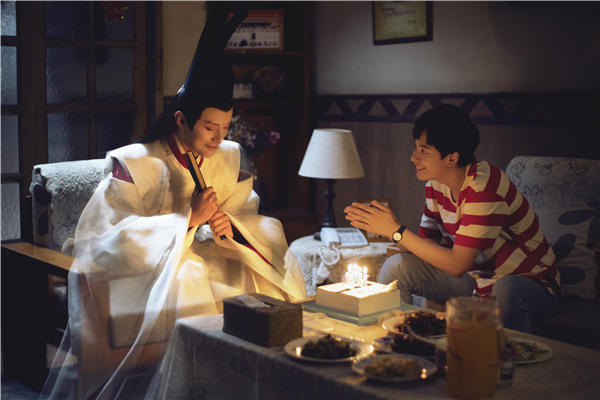
In the story, a Chinese boy named Guang (named Hikaru in original Japanese manga, both meaning "light") unwittingly discovers a Go board in which the spirit of an ancient master player named Chu Ying (named Sai in the original Japanese version) is imprisoned. The boy is encouraged and taught by the ancient spirit, gradually becoming a master player himself.
"We were under huge pressure for this adaptation because we also loved the original material so much," Zhu Zhenhua, founder of the Beijing-based Sugarman Media and producer of the series, tells China Daily. "Finally, we can now enjoy a breath of relief."
Its ranking of 8.4 from a total of 10 points on Douban, one of China's main platforms for film and TV critiques, proves that it is a domestic hit. Meanwhile, on social media in Japan, it has been greeted with overwhelming support and praise.
"If Sai was a real person, it would be probably like this," one Twitter user, named "mochi_fzkrm15", commented. "The adaptation is a good connection with China, but it doesn't stubbornly copy the original work."
That said, the adaptation still features many original lines of dialogue from the source material.
More Japanese fans online, who grew up with the original manga, said "Thank you", while giving a nod to the series.
For Zhu, the support of these fans is more important than the recognition of Yumi Hotta, the manga's original author.
"The key to adapting manga into a real-person series is to fully understand the core of the characters and respect them," Zhu says. "In this story, that is persistence without obsession. Even though so much effort is put into Go, it is not the protagonists' whole lives."
"Spare no effort on every game-that is the biggest respect you can pay to your opponent." This edict of Chu Ying's in the story may also ring true for the production team.
The basic background of the story resembles fantasy, but Zhu explains that Hikaru No Go has a typically realistic narration, which may trigger strong emotional resonance among Chinese audiences.
"The story is not unusual to us," he says.
For example, the beginning of the tale is set in the late 1990s-a time when South Korea dominated the international Go arena and China was a perennial flop. All the major Go battles in the series are inspired by real games in history.
To prepare for production, Liu Chang, director of the series, learned how to play Go more seriously, and even joined a ranking system for amateur players.
The production team also worked hard to ensure that the series is down-to-earth and relatable. On one occasion in the show, a player loses a game and says: "Now I'll go for gaokao (the college entrance exam) like many people do."
It is a moment of real "local flavor" that will resonate with the Chinese audience, and indicates that the series is not just for Go fans, which is arguably a niche market, but for everyone.
"In the story, the players grow through winning and losing, and their emotions can be felt by the audience, who also face challenges and seek achievement and success in their own lives," Zhu says. "No matter what the career, when people find something they are passionate about, they will shine."
Some Go fans, however, have complained that there should be more time devoted to the on-screen Go contests in the series.
"It's tricky to keep a balance that satisfies both Go professionals and amateurs," he says and smiles.
Some elements of the adaptation also arouse questions. For instance, Chu is wearing a look almost the same as Sai's in the original material, and many online have expressed doubt as to why, in a Chinese story, he has a "Japanese" appearance.
However, it turns out to be a lesson in traditional culture. As Chu is meant to be a Go player from the Liang Dynasty (502-557) during the Southern Dynasty (420-589), which later influenced Japan's Heian Period, the time from which Sai originates, the costume echoes historical fact.
"We make it look a little bit more exaggerated to match the tone of the comic's illustrations," Zhu says. "However, we have to refer to traditional aesthetics and ceremonies since we use true historical background."
Romance is absent from Hikaru No Go, despite the fact that, to please young Chinese viewers, it is almost an inevitable theme in other shows aimed at the same demographic.
"You cannot attach specific genre labels to a story before it was created," Zhu says. "What matters is that the story emotionally moves the audience on its own, not deliberately including certain elements in order to achieve that."