



Global COVID-19 responses: 'Zero COVID-19 Case Policy' vs. 'Coexisting with COVID-19 Policy'









Editor's note: How come the metropolises around the world with concentrated medical resources are so vulnerable to the COVID-19 pandemic? Why China has managed to control the outbreak so quickly? Why Western countries and Japan are seeing a resurgence in the coronavirus outbreak? Professor Zhou Muzhi, president of Cloud River Urban Research Institute, offers his interpretation by comparing the COVID-19 responses adopted by different countries around the world.
On Jan. 23, 2020, Wuhan and its surrounding cities like Ezhou and Huanggang announced the suspension of all public transportation such as bus, subway and ferry, temporary cancellation of all flights and trains departing from Wuhan, and temporary closure of all highway entrances to slow the spread of the new virus. The announcement shocked the world. On Jan. 24, Hubei province launched the level I public health emergency response, with other parts of China following suit until all provinces, autonomous regions and municipalities were in the highest level for a public health emergency by Jan. 29. At the press conference of the Joint Prevention and Control Mechanism of the State Council held on Feb. 8, the new infectious disease was named as the Novel Coronavirus Pneumonia (NCP). Later the World Health Organization (WHO) renamed the disease as COVID-19 on Feb. 11.
As the first big city to confront the COVID-19 outbreak, Wuhan saw a surge in coronavirus infections that crippled its medical system. As the virus continued to spread around the world, many cities saw a heavy blow to their medical services. On March 11, the WHO declared COVID-19 a pandemic.
In a study of the medical system overwhelmed by the pandemic, I on April 20 published an article titled "COVID-19: Why is medical system in metropolises so vulnerable?" (Hereafter referred to as the April article) [1]. The article explains why metropolises are so vulnerable to the COVID-19 pandemic and how effective Wuhan was in response to the new disease.
It was published on China.com.cn and reposted by over 100 media outlets like people.com.cn, xinhuanet.com and gmw.cn.
On April 21, the English version of the article was published on China.org.cn [2] and later reposted by English media outlets both at home and abroad including the websites of the State Council Information Office of China and China Daily.
On May 12, the Japanese version was published on japanese.china.org.cn[3].
The article analyzes the good practices and lessons learned from Wuhan's COVID-19 response as well as major concerns and measures that should be taken by the medical system amid the pandemic. It serves as a reference for cities around the world in their battle against the novel coronavirus.
After six months, I write this article to explore different measures and effectiveness of the global COVID-19 responses based on the April article with some statistical updates, new diagrams and endnotes.
1. 2019 ranking on health care radiation of Chinese cities
As part of the China Integrated City Index, Cloud River Urban Research Institute has released the 2019 ranking on health care radiation based on a research of 297 cities at prefecture level and above across China. The top 10 are Beijing, Shanghai, Guangzhou, Chengdu, Hangzhou, Wuhan, Jinan, Zhengzhou, Nanjing and Taiyuan. The following 10 are Tianjin, Shenyang, Changsha, Xi'an, Kunming, Qingdao, Nanning, Changchun, Chongqing, and Shijiazhuang. And the next 10 are Urumqi, Shenzhen, Dalian, Fuzhou, Lanzhou, Nanchang, Guiyang, Suzhou, Ningbo and Wenzhou. Please note that Wuhan, the first city to confront COVID-19, ranked sixth.
Jointly developed by Cloud River Urban Research Institute and the Development Planning Department of the National Development and Reform Commission, China Integrated City Index is a system that evaluates growth performance of cities across the country. The institute has been publishing the city index annually since 2016.
The index measures urban development in three dimensions: the environment, society and economy. Under each dimension lies many indicators that support its three sub-dimensions at different layers. The health care radiation is among those indicators.
All of its indicators are supported by 785 data sets, which come from statistical data, satellite remote sensing data, and internet data. China Integrated City Index is a multi-modal index[4] to analyze and measure a city's development through statistical resources of different fields.
The radiation index measures a city's capacity in providing goods and services in certain areas. A high radiation score means the city has the capacity to sell its goods and services, while a low radiation score means that it needs to purchase certain goods and services from other places.
Evaluating a city's health care radiation mainly focuses on the number of physicians and the 3A-grade hospitals. The top 30 cities account for 15% of the certified physicians, 30% of hospital beds and 45% of 3A-grade hospitals in the country. China's medical resources, especially the best hospitals, are mainly concentrated in cities higher in the ranking, which serve local residents as well as people from all around China.
The questions raised in the April article are: Why cities like Wuhan, equipped with one of the top medical resources in China, could be so vulnerable to the COVID-19 outbreak and even overwhelmed by the influx of patients? What should cities do to prepare for future epidemics?
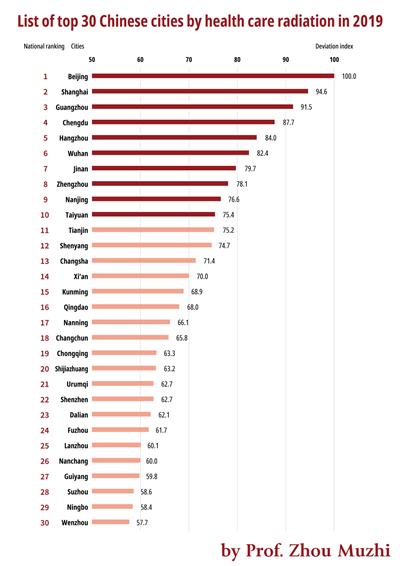
Source: Cloud River Urban Research Institute


- Chinese scientists develop CO2-based method to recycle lithium from spent batteries
- China warns Japan against missile deployment, citing risk of self-destruction
- Suzhou AI association advocates for rational development of OpenClaw AI
- Koala named ‘Koko’ symbolizes China-Australia university friendship
- Chinese-led team finds evidence of binary-origin supernovae
- Yangzhou: Where lanterns glow and spring blooms





