Striking a chord of empathy









Hong Kong youths are rising to the occasion, helping the underprivileged and the vulnerable as COVID-19 takes its toll on caring services in the community. Wang Yuke reports from Hong Kong.
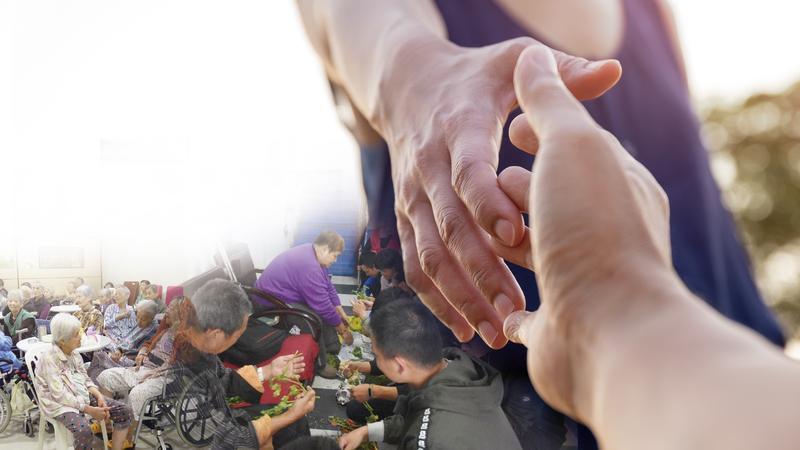
A miserable new normal confronts the bedridden, wheelchair-bound and the sick who are vulnerable and rendered incapable as the coronavirus pandemic rages on.
She groaned in pain, twitching in bed. Her daughter tried to help but was unable to soothe her anguish; he tried to use all his strength to lift himself up from the wheelchair. His son rushed to help but in vain. He then plumped himself down the wheelchair; he was perilously reaching out for a cup with no one around, but failed. Frustrated and exhausted, he panted, beating himself up for being unable to perform such a simple job; she did her rehab routines at home, limping along aided by a relative. She nearly tripped, missing her steps several times.
These are a plethora of pathetic scenarios in the community as the coronavirus dealt the sick and handicapped a merciless blow. Besides the virus threat itself, they've been left in the lurch with tough social distancing measures in place and rehabilitation centers shut, rendering caring services impossible, says Choi Pui-yan, a Form 2 student.
"It's disturbing and painful to see them struggling to navigate their lives," she laments.
To Choi and many other youngsters, the global health catastrophe does offer some positive takeaways. They've found themselves more compassionate and emphatic toward the underprivileged. "I don't see the pandemic (as) a downright bad thing as it has inspired me to better put myself in others' shoes," she says.
But Choi has also learned that for some isolated or neglected elderly people, their basic forms of entertainment, such as strolling in the park or dining out with friends, may have now slipped into oblivion. "They feel lonely, helpless and detached. They've my feelings too."
"Even for us these days, with the internet and being in tip top physical shape, we sometimes do feel lost. I can imagine how hard life could be for the disabled and destitute," says Choi. "I told myself I've to do something about it."
She then enrolled in Easyvolunteer — a program organized by the Hong Kong Federation of Youth Groups to help the needy and the desperate. Through her research, Choi found that some disabled people are even hindered in using mobile devices due to physical impairment. Shying away from communicating with others, they are gradually reduced to distress and loneliness.
The rigid social distancing routine has robbed the disabled of offline caregiving and rehabilitation services. The onus came crashing down on their families. "What's worrying is that their family members could be very amateurish in looking after the sick and disabled. A mishap could mean serious consequences," says Choi.
After group brainstorming, she came up with the idea of streaming caregiving manual videos on social media platforms for domestic caregivers to watch and learn.
It isn't the first time Choi got involved in volunteering work. But this experience differs from her previous encounters in that her empathy for the vulnerable has become more visceral and acute. This, she says, inspires her persistent charitable commitment.
"What volunteering meant to me before the pandemic hit was 'I need to make the people (I help) happy today'. The goal was short-term and the task was over and done with on that day," Choi reminisces.
The coronavirus is an enduring scourge blighting the lives of the vulnerable group, which means that voluntary help, care and kindness shouldn't be "one-off" but "sustainable", she says.
The pandemic has also evoked the heroic aspirations of youths for a better world. "A lot of people want to save the world and me too. But I'm only 13. It's impossible for me to do big," moans Choi. "However, I can make full use of my time and talent, not necessarily to make the world a better place, but someone's life better."
What the health crisis and the program have taught Choi is to use her limited abilities and resources to protect the vulnerable from further suffering. Small drops of water make a mighty ocean, she believes.
Turn distress into acts of kindness
Chan Yu-lam, 16, who also joined the volunteer program, says it has deepened her understanding of the struggles of the underprivileged, and boosted her aspiration to be an occupational therapist.
When their distress unfolds literally in the presence of a youngster, he or she will identify with them and internalize their agony, motivating acts of kindness, says Cheng Qijin, assistant professor of social work at the Chinese University of Hong Kong.
Having gone through catastrophes plaguing a large population, youths' motivation for self-actualization could be activated, says Cheng. Behind the motivation could be the effect of modeling. "Seeing society celebrate the life-saving acts of frontline workers, youths are empowered to emulate. This is a process of social learning."
Li Junlei, a senior lecturer in early childhood education at the Harvard Graduate School of Education, says young people inherently long for a "purpose" that is both shared by their peers and larger than their own personal daily concerns. "In a world that offers them very little such purpose (except the pressure to study hard and get into a good college), they yearn for that sense of connection to the larger world. COVID-19 just provided that."
The prospect of the coronavirus haunting the world for a long time has injected a bitter specter into children who lack a full-fledged coping mechanism in the face of disaster and uncertainties.
However, children are remarkably resilient — to the extent that they turn their panic and confusion over the virus into creativity.
Marcus Li Lok-ching, 9, had ritually traveled with his parents on every summer vacation. But this year, he remains confined to home — no sightseeing and no playground time. Tired of the lackluster life, he decided to create some luster. He constructed a magnetic levitation bridge model, using only wooden strips and sticks, and adhesive tape, with the help of instructors at Diverse Learning Hub, which is designed for students with autism and mild to moderate learning disabilities.
"I was scared of the virus, but it's more hurtful seeing victims and their families fighting to survive," he says. "I was dismayed by a TV scene of a mother dying of the coronavirus, alone in an isolated ward. Her daughter, not allowed to visit her mother, clambered the hospital building just to kiss her mother goodbye."
The touching scene still sticks in his mind. "I used to dream of being a police officer because it's cool. But now I only want to be a doctor to save lives," says Li.
Any disaster that befalls a certain group of people makes us feel distant from them, while a disaster that afflicts everyone everywhere creates a larger shared identity across a country or the globe, says Li. "It reduces the social distance between the carer or giver and the victim. This concept is known as 'social distance' in studies of compassion and giving," he says.
"Children and young adolescents, too, long for a sense of agency — I can choose to do something and I'm able to impact my world, and a sense of purpose. I'm needed in the world because I impact the world," he adds. "COVID-19 had offered them a social context in which they can feel meaningful and exercise their agency, by helping and caring."
Human beings are hard wired for empathy and compassion too. An infant who understands that his or her smiles can make another adult smile is beginning to understand giving, reciprocity and empathy. A toddler who understands that he or she needs to gently touch another child starts to understand empathy and caring, explains Li. "The key meaning of 'compassion' is in its root words — com (with) and passion (suffer in Latin). Compassion is about identifying with the poor and being with them.
Nevertheless, the innate capacity would taper off as we grow up and gain savior-faire. What stops us from exercising such capacity is the categorization of "us" versus "them", says Li. "When we feel the people who are struggling are not 'one of us', compassion and empathy are severely limited," he says.
'Compassion can be trained'
As we get older, we are constantly exposed to various societal elements, such as biases, stereotypes, in-group and out-group thinking, competition and envy, shame and anger, which all "can get in the way of caring and empathy for our fellow citizens", argues Richard Weissbourd, a senior lecturer in human development and psychology at the Harvard Graduate School of Education. That makes us lose the intrinsic emotional agility to lavish others with kindness and care, which leads to what we have to contend with today, such as xenophobia, self-centered nationalism and segregation of any kind.
As we get into adulthood occupied with big and small affairs, we've to regulate our emotion and care for others. We can only show care for a select group of people, otherwise, we'll be exhausted emotionally, argues Weissbourd. "Whereas, youngsters are very open to experience and haven't learned to manage their care expression in the same way." They tend to accommodate as many of their impulses to empathize with others.
"We adults often harbor a thought that we care about things but can't change them," which discourages adults from caring much. But youngsters are more "idealistic", says Weissbourd. "It's somewhat a beautiful aspect of idealism."
This difficult time of humanity allows youths to expand their circle of concern. People who make our lives work at the cost of their own safety, such as medical, sanitation and delivery workers, come into their radar and line of vision, which expands their circle of gratitude and care, says Weissbourd.
Compassion and empathy can be trained and relearned. The coronavirus pandemic presents a golden opportunity to nurture the mindset of caring in youths, contends Weissbourd. This is an opportune time for them to intimately understand others' hardships, some people's sacrifices for the good of the general public, and to value those who are not within the youngsters' tribe or community, but who deserve appreciation or attention.
Both children and adults can be trained for empathy, but children are easier to be shaped as they're more impressionable and more likely to absorb surrounding influences, admits Cheng.
Fostering and improving their psychological flexibility is important to spur pro-social actions and attitude among youths, notes Chong Yuen-yu, assistant professor of medicine at the Chinese University of Hong Kong. Her research centers on compassion-oriented psychotherapy.
Psychological flexibility describes the ability to contact the present moment despite the awareness of the threats, adversities and uncertainties, while continuing to engage in something to attain meaning and purpose. Psychological flexibility involves pretty much perspective thinking, which encourages and enables "a bird-eye view of not only an individual's, but others' status quo and needs. This perspective of others is at the core of pro-socialness," says Chong.
COVID-19 has thrown all of us a curve ball, upending our lives, work and studies. It's all bad. But a positive takeaway from it is the opportunity to foster empathy and compassion in youths and inspire them to recognize social inequity, care for the underprivileged and work for justice.
As the famous saying goes: "Our wings are small, but the ripples of the heart are infinite."




- Fuzhou hosts cutting-edge marine equipment expo
- Liulaozhuang legacy inspires modern infantry company
- Art festival opens in Chengdu
- HK man wants to help 100 people earn a million yuan through AI marketing system
- Mission marks 600th launch for Long March fleet
- China records a big drop in workplace accidents and deaths