Ignorance is not strength









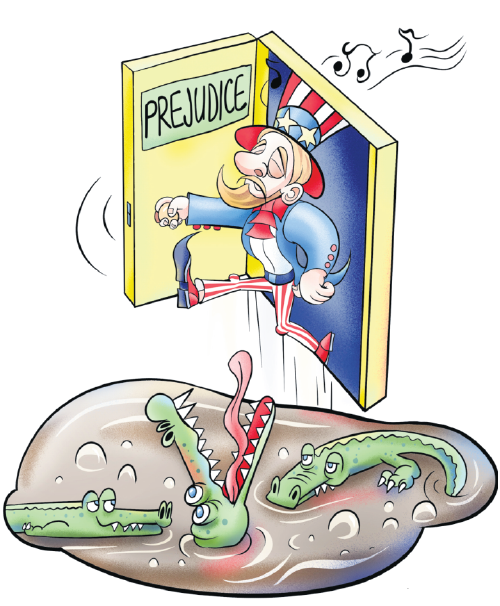
US policymakers would benefit from listening to those who understand the realities of China
The debate on China in Washington has taken a turn for the worse over the last few years. Fear and loathing of an aggressive China has become the mainstream opinion among policymakers, despite little evidence that this is the case.
This anxiety has spread throughout the Republican and Democratic parties, oddly at a time when the Chinese tend to have a more positive image of the United States than do many other countries.
In fact, just about every ailment in the US that cannot be pinned on the COVID-19 pandemic is attributed to China and Chinese aggressiveness.
You would think that with a hysterical media hyping a "China threat" 24/7 that the US would be making a massive investment in acquiring real expertise about China and that those who know the Chinese language and who have detailed knowledge of Chinese culture and politics would be in high demand.
You would be wrong.
Although military and intelligence contractors have obtained enormous budgets by playing up the new Cold War theme, understanding of the details of the Chinese economy, Chinese politics, Chinese local government and Chinese foreign policy has declined in Washington at precisely the time that it should be scaled up in order to respond to a world in which China will play a major role.
If anything, the federal government has made it far harder for experts with extensive experience in China, or command of Chinese, to obtain a security clearance, or to get promoted.
When I was in Washington last year, I discovered, to my surprise, that many of the real experts on China are completely ignored in the current "China threat" circus.
The bottom line is that the promoters of a new Cold War seemingly adhere above all to the famous slogan of Big Brother in George Orwell's novel 1984: "Ignorance is strength."
It would be funny if it were not so dangerous. China's growing influence in science and technology and the rise of Chinese research institutes as global leaders over the last decade means that there are now significant numbers of publications on nanotechnology, artificial intelligence and biotechnology that appear only in Chinese and that are not readily accessible to the English speaking audience. That trend will only increase and it will be imperative for the US to produce large numbers of experts in the sciences with near-native command of Chinese.
Part of the current political delusion in Washington about understanding China can be traced back to its reliance on technology. Many assume that if you feed raw data on a massive scale into a supercomputer (satellite images, Chinese documents, radio broadcasts) that somehow an understanding of China will pop out on the other side. But the truth is that only a nuanced understanding of China in its cultural and historical context on the part of humans can have any real meaning for US strategy. Supercomputers can bury you in data, but they cannot come up with creative responses.
The basic assumption in national strategy should always be that a nation such as the US has neither permanent friends nor permanent enemies.
Although there may be tensions with China now, we cannot know what the future holds. It would be strategic foolishness to drum up an emotional response to a China threat and then use it to justify the "dumbing down" of China for the US political elite as well as the US public.
No White House trade adviser can be certain that there will never be a future in which the US works closely with China. Such a scenario is entirely plausible, even probable. The problem will be whether the US has the expertise to seize such an opportunity.
Specifically, the field of Sinology needs to become a major field for investment in the US so that we can cultivate the expertise on Chinese culture, history and language.
The reality is that many provinces in China are the equivalent of major countries in terms of their economic and technological power and the US will need people who can respond to developments not only in Beijing, but in places such as Xi'an in Shaanxi province and Chengdu in Sichuan province.
Finally, the assumption that a deep, long-term strategy for responding to China that takes into account history, culture, science and unprecedented developments in technology is not important, that you can simply build more aircraft carriers or revamp nuclear forces, is an extremely dangerous development.
If there are differences in perspective and in interests between the US and China, which there will always be, we need experts who understand China, who can come up with creative solutions, who can explain to politicians how the Chinese see the world, who can describe how some conflicts are not between nation states at all, but are between transnational groups.
If there are no such experts in Washington, if it is assumed that any person who understands Chinese is already biased from the start, then there is tremendous risk that US politicians will feel compelled to increase tensions with China simply because they lack the resources to engage in any sort of meaningful discussion with China. If there are no players in US politics who could name the mayor of Shanghai, or the top semiconductor producers in China, it is the US, and not China, that will be at a strategic disadvantage.
The author is president of the Asia Institute. The author contributed this article to China Watch, a think tank powered by China Daily. The views do not necessarily reflect those of China Daily.