



HK primed for part on national stage









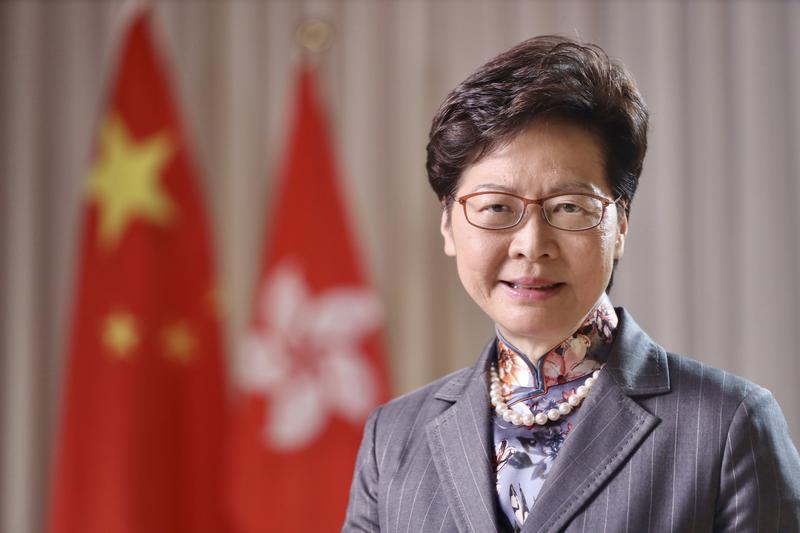
The Guangdong-Hong Kong-Macao Greater Bay Area has what it takes to be an "entry point" for Hong Kong to hook onto the next big story unfolding in the country, as the city doubles down on efforts to make it more relevant than ever to the world's second-largest economy, said Hong Kong's chief executive.
On top of the long-cherished roles as a super connector and active participant, Hong Kong - having the best of both worlds - "wants really to play an integral role in the development of this regional economy", Hong Kong leader Carrie Lam Cheng Yuet-ngor said in a wide-ranging interview.
As the Chinese mainland economy emerges smartly from chaos still seen in much of the world, it's very natural for the Asian financial center to stay closer to and better align with the nation's grand development plan, Lam said.
Integration and collaboration are the name of the game, as the SAR government has made good efforts in nurturing ties with surging neighbors and the mainland as a whole, in a more proactive manner.
Lam and five other top local officials made a five-day visit last month to Beijing, Guangzhou and Shenzhen for talks on reviving the economy of the pandemic-stricken city and making it more closely involved in a southern regional powerhouse in the making.
During her support-canvassing tour to Beijing, Lam said she got a resounding yes from the Ministry of Commerce to facilitate Hong Kong companies based in the Bay Area "shifting their focus from export to the domestic market".
The paradigm shift moves in line with the country's "dual-circulation" strategy, an economic development pattern at the heart of the 14th Five-Year Plan (2021-25) that takes domestic development as the mainstay, with domestic and international development reinforcing each other.
The fruitful trip delayed Lam's Policy Address, which was originally slated for Oct 14 but was postponed to Nov 25. But it allowed the Hong Kong leader to set out a new vision that fits the city well into a bigger picture of the country's long-term, overarching goals.
"Not many people have realized that all those things listed out (in the policy blueprint) after my trip to Beijing are very important policy directions, be it going further as a strong international financial center, reinforcing our role as an international aviation hub, or developing an international innovation and technology center with Shenzhen," Lam said.
At a critical historic juncture, the mega plan to create a globally competitive cluster of metropolises in the Pearl River Delta, with no doubt, took center stage in Lam's annual Policy Address - her fourth since she took the helm as chief executive.
Home to a combined population of over 72 million, roughly twice that of Canada, and a gross domestic product of US$1.68 trillion that is on track to be comparable to that of the Tokyo Bay, the Bay Area spells potentially huge opportunities for those with the foresight to jump on the bandwagon.
Those on the trail include the city's business community and predominantly service sector, be it education, healthcare or elderly support, known for their burning desire to tap the near-unlimited potential of the nation's most productive, vibrant geographical area.
Also included are Hong Kong youngsters, some of whom may find it harder to secure jobs or kick-start their own businesses in the pandemic-torn local market, yet seldom think of setting their sights on the Bay Area for greener pastures, right here under their nose, Lam said.
"I'm not urging or forcing them to go," said Lam, clarifying some misinterpretation of her initiative. "I'm really facilitating."
Lam recalled when she took office back in 2017, she was asked what she expected the new generation in Hong Kong to be. Lam placed her hopes on the younger generation having "the strong sense of national identity and a global perspective".
With geopolitical proximity and infrastructural connectivity - alongside the cultural and linguistic similarities - the Bay Area has all the elements required to be a natural fit to start exploring their careers and business prospects outside of Hong Kong, she stressed.
Yet Lam doesn't shy away from the fact that many Hong Kong youth today simply don't have an accurate understanding of the Chinese mainland, be it the political system, the national development, or even the way of living.
Her government has bankrolled big efforts in government backed entrepreneurship and employment programs to "fit different wishes of Hong Kong young people".
On the employment side, however, "heading north" seems to be a matter of urgency. According to Lam, the latest statistic showed that over 70,000 unemployed in Hong Kong were university graduates.
"In the near future, it will not be too easy for Hong Kong's economy to revive to the extent that every university graduate will be able to find a job," Lam said. "But there are jobs in the Bay Area not far away."
The new employment plan, outlined in the latest policy blueprint, will encourage businesses with a presence both in Hong Kong and elsewhere in the Bay Area to recruit and send 2,000 local university graduates over the boundary. Government subsidies for the next 12 to 18 months could "remove the initial barrier to go", Lam said.
Two thousand places, albeit not a lot, should be good as a starting point. "I don't know yet whether 2,000 places are enough. But if there is a very positive response, we could do more," she said.
As Hong Kong seeks to not be a bystander in the creation of a large stage, the city is betting big on an even larger stage to reassert its vital role on a national level as a flag bearer of free trade and investment flows.
"Hong Kong will strive very hard to gain accession to the Regional Comprehensive Economic Partnership trade bloc," Lam said. "We certainly want to be the first new member economy to join."
As a staunch supporter of free and open trade, Lam pointed out, Hong Kong has been endowed with the continuation of the family membership of the World Trade Organization and the status of the separate customs territory by the Basic Law since 1997, which allows the city to negotiate and sign free-trade agreements on its own.
"Especially in this term of government, we have signed more FTAs than any previous administration," Lam said.
On Nov 15, Asia-Pacific nations including China, the 10 members states of the Association of Southeast Asian Nations, Japan and South Korea formed the world's largest free-trade bloc, overtaking the European Union and encompassing nearly a third of the population worldwide as well as the global economic output.
The signing of RCEP paves the way for a reduction in trade barriers at a time when the coronavirus pandemic poses challenges to global commerce.
The Asian financial center well indicated its aspiration to join two years ago after it negotiated and signed the FTA with ASEAN, Lam said.
"Of the 15 member economies of RCEP, we actually have bilateral free-trade deals with 13 already. This, I hope, makes Hong Kong a well-positioned and ready candidate to join RCEP, once it opens its door to new members," she noted.
Among Hong Kong's free-trade pacts currently in force are those with ASEAN, New Zealand and Australia, as well as the Closer Economic Partnership Arrangement with the Chinese mainland, another form of FTA.
Total trade between Hong Kong and the 15 member states of RCEP amounted to US$765.5 billion last year, accounting for 71 percent of the city's total trade on goods.





