



Three net science award in Shanghai









The development of a revolutionary material that may help propel today's digital products into a new era is being accelerated, with laboratories in many countries contributing to the effort, scientists said.
The material — a topological insulator that insulates the interior of a semiconductor while supporting the flow of electrons — may also help realize the dream of more-efficient quantum computers, said Charles L. Kane, a professor of physics at University of Pennsylvania in the United States.
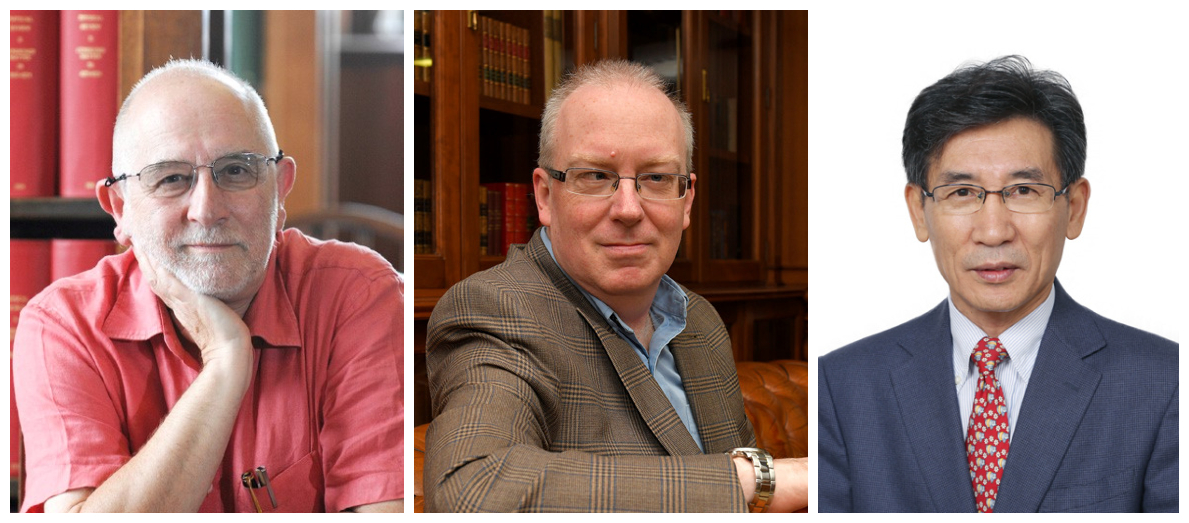
Kane and two other scientists — Michael V. Berry, a professor of physics at University of Bristol in the United Kingdom, and Xue Qikun, a professor of physics at Tsinghua University in Beijing — were awarded the 2020 Fudan-Zhongzhi Science Award for their extraordinary contributions to research in topological geometry.
A ceremony was held at Fudan University in Shanghai on Sunday, with the two scientists from abroad participating through video linkups.
Fudan said Berry was given the award for the theoretical discovery of the geometric phase, widely known as the "Berry phase", in basic quantum mechanics. Kane was recognized for his pioneering contributions in the field of topological insulators, and Xue received his award for his discovery of the quantum anomalous Hall effect, which promotes the organized flow of electrons in a system without the use of an external magnetic field.
Kane explained that based on the "Berry phase", the novel material will theoretically make semiconductors more efficient.
"One problem about the current ones is that electrons flowing inside constantly bump into things. It's like you're in a crowded room and you constantly crash into things when moving to the other side," Kane told China Daily ahead of the awards ceremony.
"But the flow of the electrons in a surface conductor with the new material is much more organized. It's like a highway with divided lanes going both directions."
Kane said this helps lessen heat production and energy waste, which may affect the speed and efficiency of a digital device.
When electronics are made smaller, the problem of disorganized electron motion gets worse, making the heat problem more obvious, he added.
Berry, who discovered his namesake "Berry phase", a general idea that has applications in various branches of physics, in 1983, said, "the new material would have very different electric and magnetic properties, which all types of applications in transistors, cellphones and computers may need."
Speaking about the new material's possible application in quantum computers, Kane said one idea is to take advantage of the special properties of the topological insulators.
"China is making enormous investment in academic infrastructure to build up research capabilities, and that investment will pay off," he said.
Xue's lab has been conducting basic research in topological geometry for years and has made groundbreaking discoveries.
One of its latest research breakthroughs is increasing the temperature at which the new material can be effective from around -273.12 C to -270.15 C by optimizing materials, he said.
His team also discovered a new synthetic magnetic material, which may be "much easier to be realized and applied in semiconductors in the future than previous materials".
However, the scientists said they have no idea how long it will take for the promising material to actually be brought into being, and its ultimate application may be something they haven't thought of.
"Loads of efforts should be made, including manufacturing, discovering better materials that have a lower cost and are easier to produce, developing related technology and boosting the supply of raw material," Xue said.
The Fudan-Zhongzhi Science Award was jointly founded by Fudan University and the Zhongzhi Enterprise Group in 2015 to recognize scientists who have made fundamental and groundbreaking achievements in the fields of physics, mathematics and biomedicine.
Each year, the laureates share a prize of 3 million yuan ($459,000), which is donated by Zhongzhi Enterprise.


- LIVE: Deputies to the 14th NPC take passage interview
- Macao establishes 4 state key laboratories: national political adviser
- Metronome and navigator: How China's five-year plans steer unprecedented modernization
- China's new five-year plan charts world's largest modernization by population
- China's top political adviser visits press representatives
- China Coast Guard vessel Sandu conducts patrols in South China Sea





