



Chang'e 5 samples handed over for research









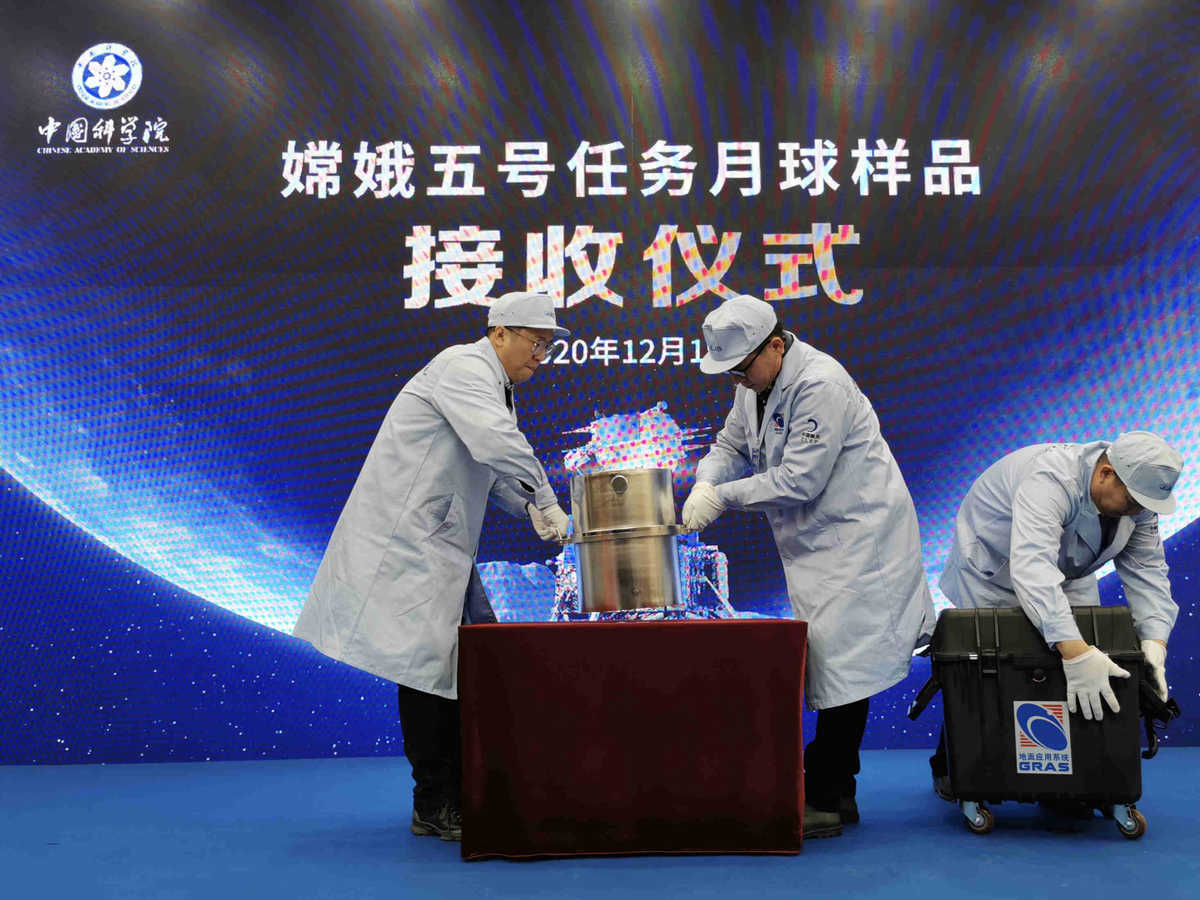
National Astronomical Observatories to commence study of lunar rocks and soil
The National Astronomical Observatories, a subsidiary of the Chinese Academy of Sciences, has taken charge of the lunar rocks and soil brought back by China's Chang'e 5 robotic probe and will start research on them soon.
A ceremony for receiving the 1,731 grams of lunar samples was held at the National Astronomical Observatories headquarters in Beijing on Saturday morning shortly after Zhang Kejian, head of the China National Space Administration, handed them over to Hou Jianguo, the academy's president.
At the ceremony, Hou formally handed the samples to Chang Jin, head of the National Astronomical Observatories, and also gave Chang a certificate authorizing the research.
The Chang'e 5's reentry capsule landed in Siziwang Banner, Inner Mongolia autonomous region, on Thursday morning, and the cargo, sealed in a vacuum container, was transported by plane to Beijing on Thursday afternoon. It was initially handled by experts at the China Academy of Space Technology.
The completion of delivery marked the start of research into the samples, the administration said in a statement, adding that it will publish guidelines on the sample's distribution and use and will encourage scientists from around the world to participate.
The samples have entered China's first Lunar Sample Laboratory in Beijing, where they will be unsealed and processed for further research. The observatories said the research will help deepen humanity's knowledge of the moon and the evolutionary history of the solar system.
Chang said the lunar samples have significant scientific meaning because the site where Chang'e 5drilled and scooped up the soil was new, as were the technologies applied.
The Chang'e 5 probe, comprising four main components-an orbiter, lander, ascender and reentry capsule-was launched on Nov 24. Its lander-ascender combination touched down on Dec 1 in the Mons Rumker region of the moon's Oceanus Procellarum, Latin for Ocean of Storms, on the western edge of the near side of the moon.
The landing site was on a vast volcanic plain that had never been sampled before, and the rocks and soil in the area are believed to be much younger than previous samples collected by the United States and the former Soviet Union.
Scientists believe the new lunar samples, the first retrieved by humanity in 44 years, could help fill an important gap in their understanding of the moon's volcanic activity and evolution.
"We will organize teams of scientists to work carefully, to not waste a single sample and to explore the infinite scientific value hidden behind each sample scientifically," Chang said.
The CAS has played key roles in China's lunar exploration project and has participated in all the Chang'e missions. It is also responsible for developing many key supporting technologies, such as a ground application system and payload subsystem.
Hou said Chang'e 5's success in bringing back the lunar samples made China the third country in the world to retrieve samples from the moon after the US and the former Soviet Union.
The handing over of the samples to the CAS was both an honor and a great responsibility, he said, adding that all relevant departments at the academy will promote cooperation and strengthen collaborative research, conserve and use the lunar samples well and aim to produce significant scientific results.
Scientists will also work to popularize science and stimulate innovation and creativity in society and vigorously carry forward the spirit of lunar exploration, he added.
The China National Space Administration said at a news conference in Beijing on Friday that China welcomes joint research and is willing to engage in friendly, sincere cooperation with the US depending on the policy of the US government.
It said the samples will be used in research, exhibited in museums, shared with international peers or be given as gifts to heads of state and dignitaries. Research will be the most important and primary use.


- Three die in Jiangxi rappelling accident
- Xi's article on promoting high-quality development of marine economy to be published
- China releases reports on budgets, national economic and social development plans
- China issues guidelines to enhance professional social work workforce
- China-Vietnam friendship exchange to strengthen bonds, security, ministry says
- Beyond the racetrack: F1 Chinese Grand Prix showcases Shanghai culture





