



Long March 8 rocket makes maiden flight









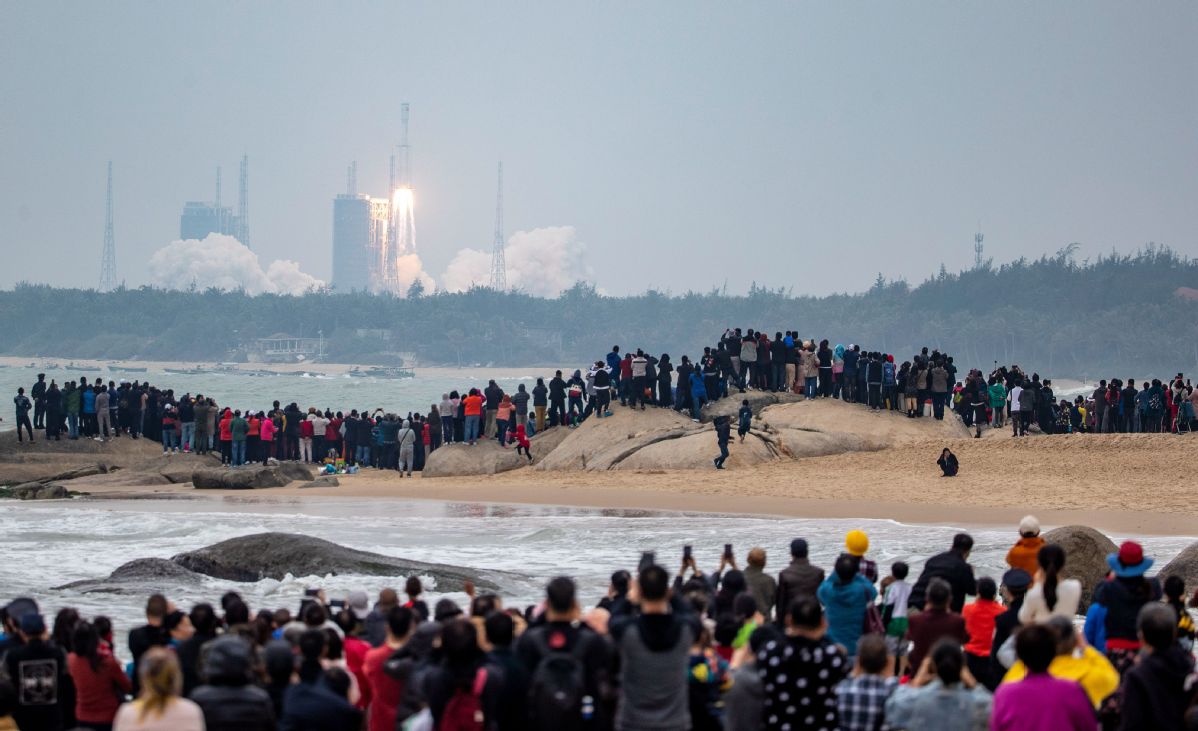
Five days after China concluded its historic 23-day Chang'e 5 lunar mission, Chinese space engineers made a new achievement with the debut flight of the country's newest carrier rocket.
The Long March 8, the latest in China's Long March launch vehicle fleet, lifted off at 12:37 pm on Tuesday from a coastal launchpad at the Wenchang Space Launch Center in southern China's Hainan province.
After about 15 minutes, the 50.3-meter rocket reached a sun-synchronous orbit with an altitude of 512 kilometers and then deployed the New Technology Demonstrator 7 experimental satellite and four small private satellites.
Xiao Yun, Long March 8's project manager, said the rocket's successful maiden flight is a new accomplishment in China's efforts to upgrade its medium-lift launch vehicle system and will push forward the nation's effort to become a world-class space power.
The rocket's service will also give a strong boost to the development and deployment of satellites operating in low-and medium-altitude orbits, he said.
The mission marked the 356th flight of the Long March rocket family, the pillar of China's space transport system.
Designed and built by the China Academy of Launch Vehicle Technology, a subsidiary of China Aerospace Science and Technology Corp, the Long March 8 has two core stages and two side boosters. It has six engines propelled by liquid oxygen, liquid hydrogen and kerosene.
With a liftoff weight of 356 metric tons, it is capable of sending payloads weighing 4.5 tons to a sun-synchronous orbit 700 km above Earth or satellites with a combined weight of 2.8 tons to a geostationary transfer orbit, according to the academy.
The Long March 8 is capable of transporting various types of spacecraft to multiple types of orbit, but its main task is to place satellites in sun-synchronous orbit to meet the surging demand for launch services from commercial satellite companies at home and abroad, according to its designers.
In China and many Western nations, an increasing number of newly founded private companies have started to design and build satellites, generating huge demand for commercial launch services. Many of these privately made satellites are set to operate in sun-synchronous orbit.
In addition to the Wenchang launch facility, the rocket can also be launched at the Jiuquan Satellite Launch Center in the northwestern Gobi Desert.
Research and development started in 2017 and took about three years. Construction of the first Long March 8 was completed in October.
"It is not common for designers and engineers to build a new rocket type within just over two years," said Song Zhengyu, Long March 8's chief designer. "From the very beginning, we decided that this project must be market-oriented so the rocket could be competitive in terms of its cost and carrying capacity."
As a result, the rocket's design and technologies are mainly based on those already used by the Long March 3A and the Long March 7. The adoption of proven designs guarantees Long March 8's reliability and cost-effectiveness, he said.
Mou Yu, a senior structural engineer, said the vehicle is an ideal option for communications network operators to put multiple satellites into low orbit to establish their space-based networks.
Project managers have estimated that at least 10 Long March 8s will be used per year, given the strong demand from domestic and international satellite businesses, while its annual manufacturing capacity will soon reach 20.
Pursuit of reusability
In order to increase its commercial competitiveness, the rocket is expected to eventually become the first reusable model in the Long March series.
Designers intend to develop an integrated first stage for the rocket's future reusable variant. This new first stage will consist of a core booster and two side boosters. Instead of breaking up and falling back to Earth like the first stages of all previous Chinese rockets, the new core and side boosters will stay together and make a powered landing on a recovery platform at sea.
Mou said designers will strive to develop crucial apparatus for the pursuit of reusability, such as a variable-thrust engine and vertical landing gear.
Lu Yu, a senior scientist at the China Academy of Launch Vehicle Technology, said that if engineers could control the descent and landing process of the first stage of a rocket and recover it, then they could greatly improve the rocket's cost-effectiveness and also reduce risks and disturbances to residents living along its trajectory.
"Making rockets recoverable and reusable is an ideal approach to reduce launch costs and boost mission efficiency," he said.
Wu Yansheng, chairman of China Aerospace Science and Technology Corp, said at a recent technology forum in Chengdu, Sichuan province, that China's first reusable carrier rocket is scheduled to make its debut flight around 2025.
He did not reveal whether this reusable model will be based on the Long March 8, but said that the rocket's major parts will be able to fly back to Earth through engine-propelled vertical landing and will be reusable.
The best-known reusable rocket is SpaceX's Falcon Heavy, which made its maiden launch in February 2018. All boosters on the US rocket's first stage can be recovered and reused as they will separate from each other and perform controlled reentry and landing.
During the past six years, China has made tremendous strides in its rocket industry. Six new-generation models in the Long March family were put into service, ranging from the comparatively small, solid-propellant Long March 11 to one of the world's mightiest types, the Long March 5.
In addition, several private enterprises have attempted to develop and operate their own carrier rockets and two of them-i-Space and Galactic Energy-have succeeded and used their rockets to fulfill orbital launches.


- Deputies highlight Yunnan's dynamic culture-tourism interplay
- Escalating conflict would produce no winners, only push the Middle East into a 'dangerous abyss': China's Defense Ministry
- Military use of AI should remain human-led to prevent it from spiraling out of control: China's Defense Ministry
- National political adviser proposes to enhance talent cultivation for elite engineers in China
- Efforts intensify to preserve and promote ethnic cultures in Xizang
- Interwoven communities in China foster cultural unity and development, says national political adviser





