Indian farmers continue protests amid government resistance









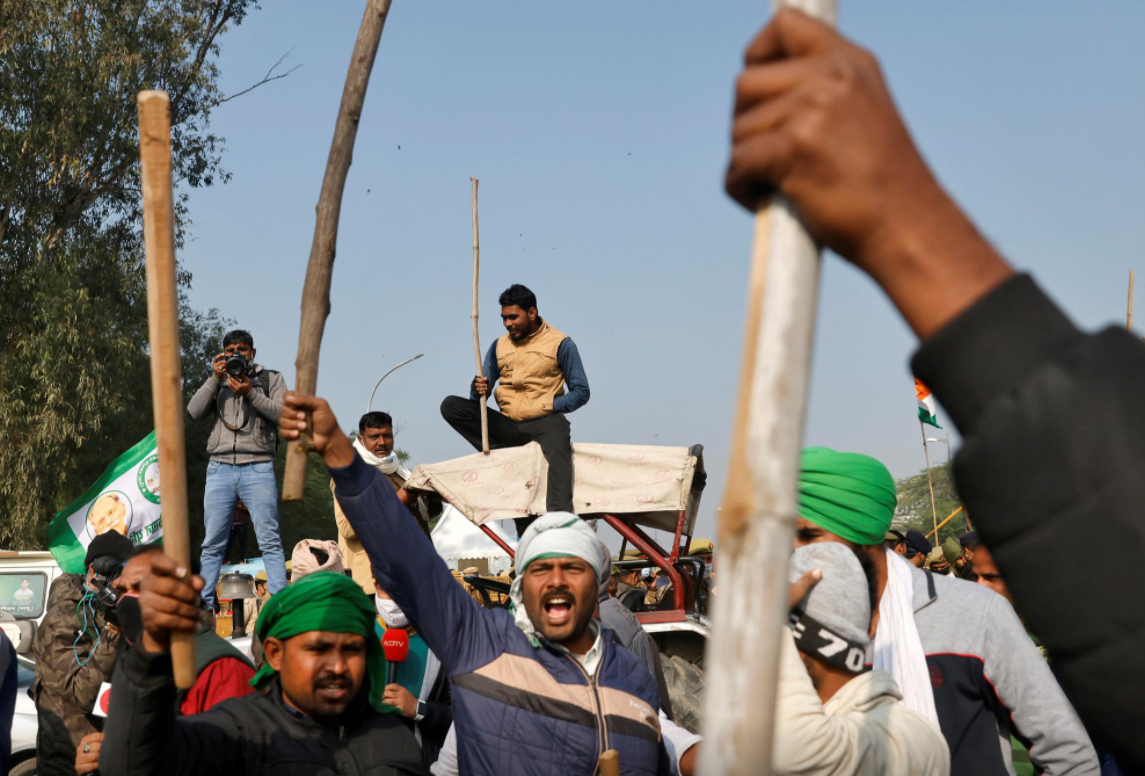
New Delhi's enactment of three farm bills has intensified widespread resentment among thousands of farmers throughout the country.
But Indian Prime Minister Narendra Modi's party said on Tuesday there was no question of the government repealing agriculture laws fiercely opposed by farmers who are worried about income losses.
Farmers' protests have continued despite Modi's repeated assurances the new farm laws will bring market-oriented reforms and free them from the clutches of middlemen, and that the existing mechanism of minimum support prices won't be altered — but many farmers are not convinced.
The farm laws have not been introduced overnight. Over the last 20-30 years, central and state governments had detailed discussions on these reforms, Modi said recently while addressing farmers in Madhya Pradesh through video conference. Agriculture experts, economists and progressive farmers have been demanding reforms, Modi added.
Gopal Krishna Agarwal, a spokesman for the Bharatiya Janata Party, was reported on Tuesday to have made clear the government's refusal to back down.
The government claims reforms are necessary for India's huge farming sector, which accounts for nearly half of the country's workforce but contributes only 16 percent of GDP.
Hundreds of thousands of farmers have been protesting on the outskirts of Delhi for several weeks, blocking many of the main arteries into the capital. Irate farmers are camping on at least five major highways on the outskirts of Delhi since Nov 26, despite the harsh winter, pandemic conditions and heavy police deployment.
More than 300,000 farmers marched from the states of Punjab and Haryana — on foot and in convoys of tractors — to reach the Indian capital. They have braved water cannons and tear gas. They won't leave until the government rolls back the farm laws. Around 22 farmers, many of them from Punjab, have so far died of natural causes or in road accidents, and a few died by suicide.
Earlier in the day, Agriculture Minister Narendra Singh Tomar appealed to the protesting farmers to hold further talks.
Thousands of farmers throughout the country believe the new farm laws will lead to lower prices of their agricultural produce, pave the way for corporate takeovers of their small farms and devastate their earnings. On the other hand, other farmers' unions have extended support to the government, upholding the three farm laws.
The three laws— the Farmers' Produce Trade and Commerce (Promotion and Facilitation) Act, the Farmers (Empowerment and Protection) Agreement on Price Assurance and Farm Services Act 2020 and the Essential Commodities (Amendment) Act, 2020—were passed in the Upper House of Parliament after being introduced by the BJP-led government and enacted on Sept 27.
The first act allows farmers to sell their farm produce outside government-controlled Agriculture Produce Market Committees, so any license-holder trader can buy produce from farmers at mutually agreed prices. The second act allows farmers to do contract farming and market their produce freely. The third takes away cereals, pulses, oilseeds, edible oils, onion and potatoes from the list of essential commodities. It will do away with the imposition of stockholding limits on such items, except in extraordinary circumstances.
More than 40 farmers unions who have participated in the protest have expressed their fears the first two laws will eliminate minimum support prices and do away with mandis (rural markets), leaving them at the mercy of big corporations.
"Mandis may not formally shut, (but) if the government stops buying at the mandis, it will automatically disappear. We will be left with only the big corporates to sell to," said Gurmeet Singh, a farmer from Panipat (Haryana) who is taking part in the agitation at Singhu, on the border between the territory of Delhi and the state of Haryana. APMCs have yards (mandis) established by state governments, run by committees made up of farmers, and often large land owners and traders.
"The new farm laws have no provision to regulate the traders. So, they will start to exploit us, just like the big fish eating small fish," farmer leader Jagjeet Dallewal said.
"The MSP mechanism will cease to exist if corporations control prices in the absence of APMCs. In such a scenario, poorer farmers in the country with less land holdings will be the losers."
Although some economists say the reforms are necessary, many have criticized the manner in which the laws were imposed and suggested there are leakages in the new laws as well.
"The government did not consult a single farmers' organization," said Yogendra Yadav, the national president of Swaraj India, a political party that supports the farmers' demands.
"In practice very few states in India have benefitted from this MSP. It is concentrated to a very few states," said Chandralekha Ghosh, an agricultural economist of West Bengal State University and Samapti Guha, a development economist at the Tata Institute of Social Science.
"With the new act, if there occurs competition among private players the farmers will benefit from obtaining higher prices. But if buyers control the market as well as the prices then the farmers will be the losers," they said.
"If the new buyers decide pricing by keeping prices low artificially, then we should have the option to return to our mandis and get MSP of our produce," said Dharamveer Bidhuri, a farmer who has taken part in the protest near the Delhi-Noida border, near the entry and exit gate between Delhi and Uttar Pradesh.
"Now only the big farmers go to the APMC markets directly. They sell to a trader who comes to their village," said National Bank for Agriculture and Rural Development chair professor and economist at the TISS R Ramakumar. "(But) with the new laws you are moving from regulated to unregulated. APMC markets over a period of time would become weakened."
"The government should assure procurement will be done at MSP with the big corporate buyers," said Harjinder Singh, a farmer from Gujarat, Modi's home state. He traveled more than 600 miles to join the protest at Singhu.
According to data from the Union Ministry of Agriculture, over 86 percent of Indian farmers own fewer than two hectares of land.
"The anger over injustice to farmers was brewing. Now it's getting channeled through this protest against the new laws," said Devinder Sharma, a food and trade policy analyst.
The writer is a freelance journalist for China Daily.