Officials slam US sanctions on Xinjiang products









The United States' sanctions on the Xinjiang Production and Construction Corps in the name of "forced labor" are groundless and won't affect the healthy development of the corps, officials said.
"More than 70 percent of the XPCC's cotton and 95 percent of its textile products have been sold domestically in the past two years," Sun Huantao, deputy director of the XPCC's Commerce Bureau, told China Daily in an exclusive interview at its headquarters in Urumqi, capital of the Xinjiang Uygur autonomous region.
"We don't have much direct trade volume with the US. The US' latest sanctions on cotton and cotton products produced by the XPCC indeed have affected our businesses, but they have only had a limited impact," Sun said.
The XPCC, also known as Bingtuan, is a special provincial-level entity entrusted by the State to cultivate and guard China's border areas in Xinjiang. It has administrative control of several cities as well as farms and industrial facilities.
In 2020, China produced 5.91 million metric tons of cotton, of which 87.3 percent came from Xinjiang, according to figures released by the National Bureau of Statistics in December. In 2019, the XPCC produced more than 2 million tons of cotton, making it the key cotton producer in China.
On Dec 2, US Customs and Border Protection issued a withhold release, or detention, order that applies to all cotton and cotton products produced by the XPCC and its subordinate and affiliated entities, along with all products made in whole or in part from XPCC cotton, such as apparel, garments and textiles, because of concerns about "the risks of forced labor", the agency said.
In the days leading up to the withhold release order, Customs and Border Protection sent detailed questionnaires to US importers of apparel to obtain information on supply chains in Xinjiang.
"The sanctions have affected the exports of cotton and cotton products from the XPCC," Sun said. "It means that many foreign businesses will be unable to use good-quality cotton from the XPCC.
"Global businesses and consumers, particularly those in the US, are the real victims of the sanctions. It's a move of extreme trade protectionism and not in line with principles of a market-oriented economy. It will surely damage the international supply chain," Sun added.
To cope with the sanctions, the XPCC will further explore the domestic market, which is strong enough to support the healthy development of the corps' cotton industry, she said.
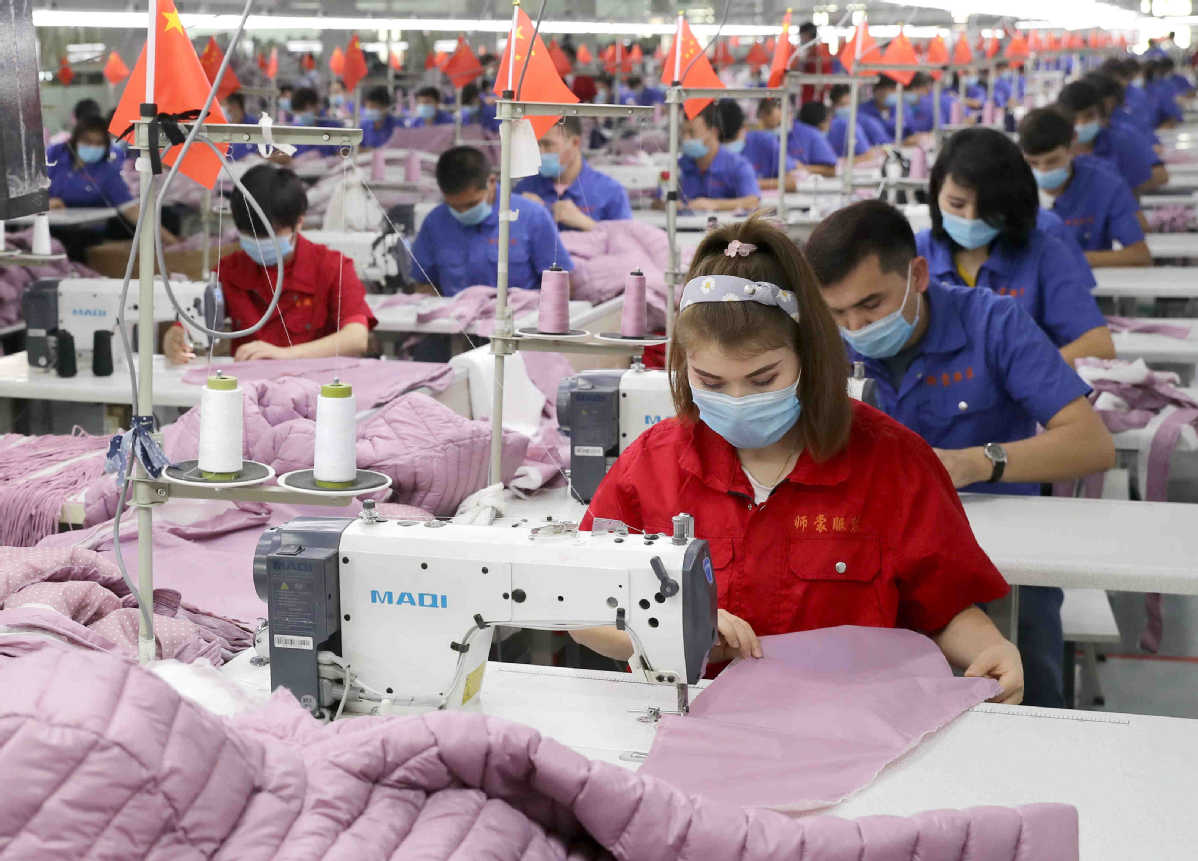
Han Yongjiang, a spokesman for the XPCC's Human Resources and Social Security Bureau, said all workers' rights are fully protected in accordance with the law, and not a single complaint about forced labor has been received in recent years.
About 46 percent of employees in the corps' textile and apparel enterprises in 2020 are from ethnic minorities such as Uygurs.
It also employees many seasonal workers in the agricultural sector.
These seasonal workers can make an average of 6,000 yuan ($915) in two months, which is very competitive in Xinjiang, Han said, and such employment is at the free will of employers and workers.
"We have stepped up the inspections to ensure any action that violates the rights of employees of the XPCC is punished in a timely manner. Also, employees from all ethnic groups can complain about possible misconduct via multiple channels, such as online, social media and by phone," he added.
"If we don't treat our employees with a better attitude or pay them well, they will quit. Their absence will severely affect the enterprises' operations. So accusing the XPCC of using forced labor doesn't stand, either factually or logically."
The US Customs and Border Protection's order follows the announcement in July by the US Office of Foreign Assets Control that it had designated the XPCC as a "specially designated national". This designation essentially prohibits people in the US from engaging in any transactions with the XPCC or any companies of which the XPCC owns more than 50 percent.
Xiao, the manager of a tomato sauce company in which the XPCC holds shares, felt the bite of the sanctions as early as mid-August, although the company doesn't directly export to the US, but mainly to European markets.
"Because we are on the sanctions list, we started to experience problems in international bank transfers. Also, one of our international shipping partners clearly told us they will no longer provide services to us for fear of being sanctioned by the US for doing business with us," said Xiao, who wished to give only her surname.
The company, established in 2008, is currently appealing the US decision because the XPCC owns only about 45 percent of the shares of the company.
Because of the quality of tomatoes grown in Xinjiang, more than 90 percent of tomato sauce exported to other countries from China is produced there. In September, US Customs and Border Protection considered a much broader import ban on all cotton and tomato products from Xinjiang.
Xiao said, "Our business partners in Europe have asked us about the sanctions. If the situation deteriorates, the business ties that we've built over the years may be cut and will be difficult to reestablish. If we lose our contracts, it's the growers and employees who will suffer in the end."
Of the more than 300 tomato growers for the company based in southern Xinjiang, about 40 percent are locals from ethnic minorities, including Uygurs. During the harvest season, the company also annually employs about 200 seasonal workers, mainly Uygurs.
"Many of them keep coming back to work for us, year after year, because we can provide them with a good working environment and good pay, as stated in their contracts. They even ask their families and friends to come along, so we have never had recruitment problems. I don't think they will introduce us to their loved ones if the seasonal workers are ever forced to work," Xiao said. "They will lose their income if the company cannot survive the sanctions."
"All we can do is to continue to improve the quality of our products and make them irreplaceable in the global market," she added.





- Court awards MH370 victims 2.9m yuan each
- A golden win and a missing reward
- HK election hailed as a milestone for democracy
- China's top political advisor meets delegation of A Just Russia party
- Pooled efforts expected to deepen reforms in Hong Kong with new legislature elected
- Nanfeng mandarins of Jiangxi are going global