



An Analysis Report on Population Change in Xinjiang










Recently, the population issue concerning Xinjiang has attracted much attention. Adrian Zenz, a German Anti-China scholar in particular, quoted data from unknown sources and pieced up his Research Report "Sterilizations, Intrauterine Devices and Compulsory Birth Control: the Chinese Communist Party's Campaign to Suppress the Birth Rate of Uyghurs in Xinjiang". The report falsely claims that "the natural population growth in Xinjiang has dropped sharply", and slanders that there is so-called "forced sterilization" in Xinjiang.
In view of the wrong points and absurd logic of the report, this paper provides an overview of the population change in Xinjiang, analyses reasons for the rapid population growth in southern Xinjiang, and expounds the rationality of the general trend of population change in Xinjiang.
I. Analysis of Reasons for the Continuous Growth of the Total Population in Xinjiang
At the time of the first national census in 1953, the total population of Xinjiang was 4.8736 million. According to the sixth national census in 2010, the figure registered 21.8158 million, an increase of 3.3 times in 57 years.
In recent years, the total population of Xinjiang has kept growing steadily. The statistical data show that from 2010 to 2018, the population of ethnic minorities and that of the Uygurs in Xinjiang has witnessed steady growth, while that of the Han ethnic group in Xinjiang has slightly increased.
In terms of population size, from 2010 to 2018, the permanent resident population of Xinjiang increased from 21.8158 million to 24.8676 million, an increase of 3.0518 million, or 13.99%.
Among them, the population of ethnic minorities increased from 12.9859 million to 15.8608 million, an increase of 2.8749 million, or 22.14%; from the perspective of ethnic groups, the Uygur population increased from 10.1715 million to 12.7184 million, an increase of 2.5469 million, or 25.04%; the population of Han ethnic group increased from 8.8299 million to 9.0068 million, an increase of 176,900 people, or 2.0%.
The growth rate of the Uygur population is higher than not only that of the regional in total, but also that of other ethnic minorities, and is obviously much higher than that of the Han population.
From the perspective of growth areas, the population of four southern Xinjiang prefectures increased from 8.951 million to 10.355 million, an increase of 1.404 million, or 13.55% during that period, which is the fastest in Xinjiang.
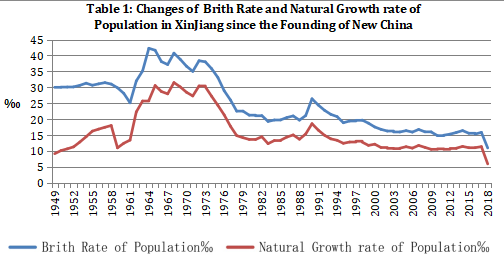
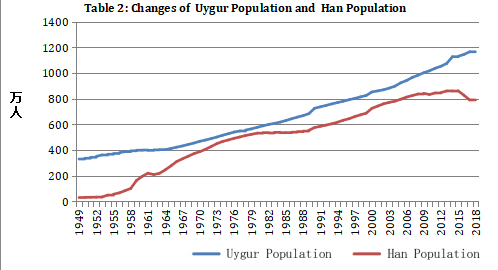
Since the founding of New China, the total regional population and ethnic minorities' population in Xinjiang, especially the Uygur population, has maintained a rapid growth. In particular, the growth of Uygur population in southern Xinjiang is prominent. The reasons can be summarized as follows:
1. The long-term implementation of differential policies on Han and other ethnic groups.
The Chinese government lawfully advocates family planning policy among all ethnic groups. Proceeding from the perspective of ensuring coordinated and sustainable development of ethnic minority population, it implements relatively loose policy on limiting the number of births by each couple for ethnic minorities, which is different from that for Han people.
In 1975, Xinjiang started the implementation of the family planning policy in Urumqi and other cities where Han population was relatively concentrated. In 1981, with the publishing of Interim Provisions on Issues Concerning Family Planning, the implementation of family planning policy has been fully carried out among Han people.
In 1992, the Family Planning Measures of Xinjiang Uygur Autonomous Region was issued, and a more lenient family planning policy on ethnic minorities was implemented: each Han couple in cities and towns were encouraged to give birth to one child only, while each Han couple in rural places were allowed to give birth to two children; whereas each ethnic minority couple in cities and towns were allowed to have two child, and in rural area, they were permitted to have three children.
In 2017, with the improvement of economic and social development, and the convergence of the kid-bearing wishes of the people of all ethnic groups, Xinjiang revised its Regulations on Population and Family Planning, stipulating that all ethnic groups should implement a unified family planning policy, which is, a couple in urban areas can have two children, and a couple in rural areas can have three children.
According to the sampling survey on national fertility and birth control in 1988 (2 ‰ samples surveyed), Uygur women in average had 6.13 children in their lifetime from 1970 to 1974, and 5.4 children from 1985 to 1987; whereas the Han women in the same area had 5.2 children and 2.5 children respectively during the two time periods.
In 1981, Tibetans (5.84) and Uygurs (5.59) held the highest total fertility rate among all ethnic populations in China; in 1989, Uygurs (4.65) and Tibetans (3.80) were the highest again; in 2000, the highest total fertility rates went to Kazakhs (3.195), Uygurs (3.156), and Tibetans (2.755). It shows that the fertility rate of Uygurs has maintained at a higher level compared with other ethnic groups in China.
2. The improvement of health care has greatly reduced the mortality rate of the population.
In the early days of the founding of new China, the mortality rate in Xinjiang was as high as 20 ‰. With the improvement of medical conditions, in the middle 1960s, the mortality rate dropped below 10 ‰ and continued to decrease later, with natural growth rate and birth rate changing basically in synchronization (see Figure 1).
From 1949 to 1983, 232 people died in a Uygur populated village in Yingjisha county, Kashgar prefecture. The average age of death was 18.76. Among them, 127 infants died within one year old, accounting for 54.74% of the total deaths. In 2016, the author investigated in the village and found that 8 people died in that year, with an average age of 73.9 years old. From 2014 to 2015, 282 babies were born in the village, and only one infant died.
The physical quality of people of all ethnic groups in Xinjiang has been greatly improved, especially the health care level of women and children has been continuously improved. The maternal mortality rate has decreased from 43.41/100,000 in 2010 to 26.65/100,000 in 2018; the infant mortality rate has dropped from 26.58 ‰ to 14.02 ‰; and the average life expectancy has reached the age of 74.82 (data in 2015).
3. The family planning policy was not strictly implemented, resulting in the emergence of a large number of additional population.
Affected by various factors, it was difficult to promote and implement family planning policy in Kashgar, Hotan and other southern Xinjiang areas for a long time, leading to the rapid population growth in those regions.
Some locals there opposed the family planning policy because they insisted on their old childbearing concept and cognition, which hindered the implementation of the policy.
Some religious extremists bewitched or even coerced people to get married by holding religious rites like "Nikah", getting divorced by threefold repetition of "Talaq". They claimed the marriage certificates issued by the government as "Haram", and the termination of pregnancy as the practice of "Kafirs".
These extremists also incited locals to resist the family planning policy, resulting in prevailing early marriage and bigamy, and frequent unplanned births.
In some areas, the family planning policy was not fully implemented with greater importance was given to reward the policy followers than to punish the violators, and to service than to management.
Limited number of officials engaged in family planning work has also seriously affected the implementation of the policy. For example, one official in family planning work had to serve 15,000 residents on average in Shache county (Yarkand) of Kashgar, with the furthest couple living 130 km away.
In 2015, special statistics on the implementation of the policy was carried out in a county in Kashgar prefecture. It was reported that from 1989 to 2014, 359,000 people were born in the county, of whom 10.5% were unplanned births.










