China's plan for inclusive future vital for region










This year, the agenda of the National People's Congress, China's top legislature, includes a critical item that is only discussed once every half a decade, a new five-year plan. The 14th Five-Year Plan (2021-25) is bound to be one of the most transformational plans since the founding of the People's Republic of China, as it departs from the emphasis on economic growth and restructuring that was characteristic of past plans to focus on the sustainability of growth and the quality of life.
To this end, the 14th Five-Year Plan outlines renewed efforts to close the rural-urban income divide, promote innovation, and move faster toward low-carbon development. These objectives are reinforced by the longer-term perspective ingrained in China's Vision 2035, which lays down the path for China to become a moderately developed country by 2035 and a global leader in innovation. It also foresees domestic demand to be a main driver of future growth under the "dual circulation" development paradigm.
The 14th Five-Year Plan aims to advance the quality and sustainability of China's development, by addressing the social and environmental challenges that have emerged after decades of rapid growth. Given the country's size, carbon footprint, and growing regional and global role, the plan's success is not only important to China, it is also important to the region.
Implementing the plan will require new policies and reforms to deepen social inclusion in the context of rapid population aging, and mainstream environmental sustainability into the development paradigm. The plan's main policy guidelines will be refined, and implementation blueprints will map out the envisaged reforms. Making the right policy choices is essential for China's successful transition toward higher quality development. Social inclusion, population aging, and low carbon development are all priorities that deserve attention.
But despite remarkable achievements in extreme poverty eradication, income inequality remains a challenge and hampers social inclusion. Addressing inequality requires policy actions to close the rural-urban divide by reducing gaps in the economic, environmental and social conditions between regions, provinces and cities.
As economic reforms progressed in China, State distributive mechanisms weakened. And funding to local governments has not kept pace with decentralization and the increasing responsibility to provide public services. Reforms in taxation, however, provide a means to increase revenues for government services, and they can promote a more balanced distribution of income and greater social inclusion.
International experience suggests large fiscal transfers for health, education and pensions are effective in reducing inequality, as sizable redistributive impacts can be achieved through increased public expenditure. Reforms to broaden the tax base and increase the progressivity of taxation have also been successful in other countries. In China, increasing social spending and sufficient transfers of fiscal resources to local governments will ensure a more equitable income distribution and greater opportunities for lower-income households.
Social safety nets, too, are a powerful equalizing tool, especially when accompanied by further reforms of healthcare and pension systems, which in turn are essential to address demographic challenges.
China's population is aging rapidly and brings a new dimension to the challenge of social inclusion. The number of people aged 60 years or above is expected to reach 30 percent by 2050, the highest share in the world. Aging has broad repercussions beyond fiscal sustainability and long-term care costs. If left unaddressed, labor shortages and imbalances could undermine economic growth and future development.
Moving forward, there is a recognized need to prioritize the development of inclusive long-term elderly care systems. Efforts in this direction include establishing a sustainable financial framework, as well as expanding the provision and quality of eldercare services with adequate medical facilities and human resources funded by both public and private sources.
China's aging population also calls for labor market reforms. It is imperative to increase labor productivity to arrest the decline in the labor force and skills, and gain competitive advantages in innovation-intensive industries. The 14th Five-Year Plan's call for China to become a global leader in innovation requires higher-skilled workers. So improving the productivity of workers needs to be prioritized over protecting lower-productivity jobs, and greater efforts are needed to improve the efficiency of research and development spending and upgrading the quality of secondary and tertiary education.
Besides, an evolving labor market should accommodate the need for workers' mobility by further relaxing the hukou (household registration) system, thereby ensuring greater opportunities for all and a more optimal allocation of resources.
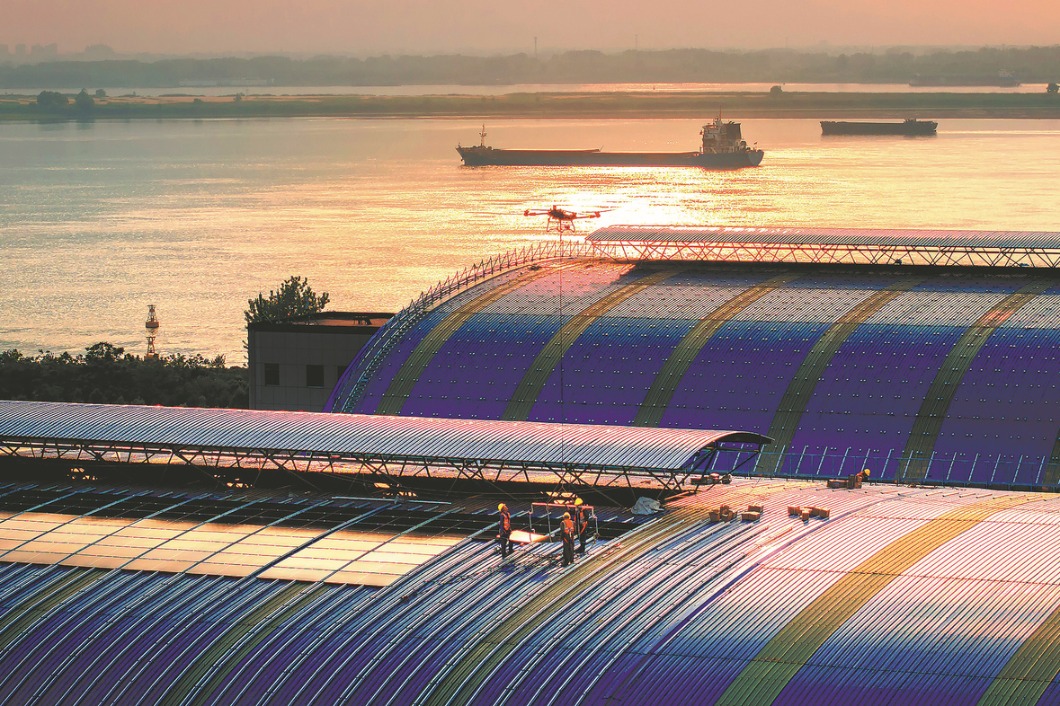
The new government agenda to achieve green, high-quality development also emphasizes environmental protection and low-carbon development. The 14th Five-Year Plan builds on the remarkable environmental achievements of the 13th Five-Year Plan (2016-20) and provides a pathway to achieve peak emissions before 2030 and reach carbon neutrality by 2060. These ambitious goals require determined policies and innovative approaches to accelerate low-carbon development.
To contribute to inclusive sustainable development, China's low-carbon framework is also aligned with efforts to better manage urbanization and the country's natural resources. The impacts of environmental degradation fall disproportionately on the vulnerable, especially in rural areas, where residents depend on forests, water, wetlands, fields and pastures for their livelihoods.
Developing a circular economy, more livable cities and low-carbon transport, and better managing natural resources cannot be achieved by the government alone. So there is a need to expand sources of green and blue finance and increase private sector investments in sustainable infrastructure, new technologies, and digital solutions.
Consistent with China's focus on sustainability, the Asian Development Bank country-level support has moved away from investments in physical infrastructure to focus on green, high-quality development.
The ADB's new country partnership strategy for China is aligned with the main priorities of the 14th Five-Year Plan and supports environmentally sustainable development, adaptation to and mitigation of climate change, as well as the challenges of health security and an aging society. Given that these areas of partnership will also contribute to regional and global goods, China's development strategies and plans for the coming years foretell a more inclusive and sustainable future for the country, the region, and the rest of the world.
James Lynch is director general of the Asian Development Bank's East Asia Department; and Yolanda Fernandez Lommen is country director of the ADB's office in China.
The views don't necessarily reflect those of China Daily.
If you have a specific expertise and would like to contribute to China Daily, please contact us at opinion@chinadaily.com.cn, and comment@chinadaily.com.cn.