



China pursues its own model of modernization









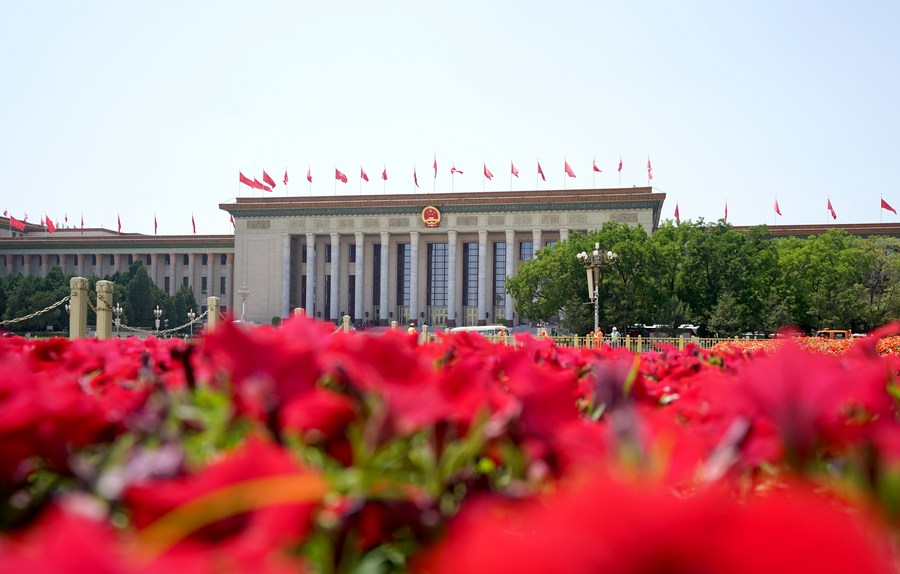
The Chinese people have never been so close to their dream of modernization.
For more than a century, China has been pursuing modernization with unremitting efforts -- from Dr. Sun Yat-sen's cry to "Revitalize China" to the "four modernizations" slogan launched after the founding of New China in 1949, referring to agriculture, industry, defense and science.
Today, socialist modernization is no longer out of reach for the Chinese people. Remarkable achievements have been made since the third plenary session of the 11th CPC Central Committee in 1978, which introduced reform and opening up that would bring the nation on a new journey to build a modern socialist country in the new era.
So what is the modernization that China seeks, and what is the difference between socialist modernization and Western modernization?
China has explained the characteristics and logic of "an alternative model of modernization" to the world with its unique practices, from poverty alleviation to pandemic response measures.
In the fight against poverty, China has kept its promise that "no one should be left behind" and regarded the people's livelihood as the most important political issue. The country always protects the right to subsistence and development for the poor, and stimulates enthusiasm and initiative by empowering its people with aspirations and education, thus promoting their independent development.
Battling COVID-19, China put people and life first, and walked the talk in ensuring that every patient had access to hospital treatment. By taking swift and resolute lockdown measures to curb early outbreaks, and by using big data and implementing mass testing, the country has made major strategic achievements in the fight against the virus.
Behind these unique ideas and practices are China's institutional design and policymaking based on national conditions, along with its care for the people.
China's victories in eliminating extreme poverty and fighting COVID-19 can be attributed to strong Party leadership.
Though China's practices clearly differ from Western ways of dealing with the relationships between government and market, individual and collective, security and freedom, and economic growth and social development, there is growing recognition of China's great progress, albeit achieved in a different manner.
China has always protected lives rather than only focusing on GDP, emphasizing the development of the vast majority rather than that of a small group, said Chen Shuguang, a professor at the Party School of the Communist Party of China Central Committee, noting that such choices reflect socialist modernity and highlight its difference from the capitalist model.
"The primary impetus for capitalist modernization is capital, and the logic of capital dominates everything," Chen told Xinhua. "China's efforts to promote people-centered development continue to expand and inject rationality into socialist modernization."
"Modernity" has always been pluralistic, and there is by no means a unified plan for modernization. It is increasingly clear that the modernization China seeks will not be "a mere re-creation of the Western one."
China will not copy the Western model of modernization. That is not only because there are not enough resources on the planet to support it, but it is also due to the country's unique cultural traditions, historical mission and current national conditions.
Alan Macfarlane -- an anthropologist, historian and professor at King's College, Cambridge, who authored "The Making of the Modern World" -- said that the social civilization of Britain, the first modern country in the world, was based on individualism, while collective civilization has been rooted in the Chinese soil since ancient times. In such a culture, individuals can only become complete when they are combined with others.
In socialist modernization, people-oriented development is increasingly emphasized, which not only represents a huge leap in economic production capacity but also an upgrade from economic growth alone to comprehensive social progress, achieving common prosperity for all and the harmonious coexistence of humanity and nature.
In China's modernization vision, there is not only an "efficient market" but also a "capable government," and both play their roles. There is not only urbanization but also coordinated urban-rural development.
When studying China's poverty reduction experience and theory, experts from across the world have found that although the country has distinctive national conditions, cultural traditions and values, as well as a distinctive political system, its poverty alleviation experience still bears universal significance, which can be summarized in the "5Ds."
The "5Ds" are the determined leadership of the ruling party and its top leader; the detailed blueprint for strategic planning and long, medium and short-term goals; the development-oriented strategy to translate economic growth into poverty alleviation; data-based governance emphasizing the application of advanced digital management in the whole process of poverty alleviation; and decentralized delivery based on the country's governance structure.
From a global perspective, the "5Ds" can be seen as China's experience and wisdom in solving the common problems of mankind on the road to modernization.
China inevitably continues to face many challenges in its pursuit of modernization, such as fighting COVID-19 and boosting the economy. Exploring solutions to these global issues will be China's contribution to the model and path of modernization.





