



Xinjiang women see more opportunities









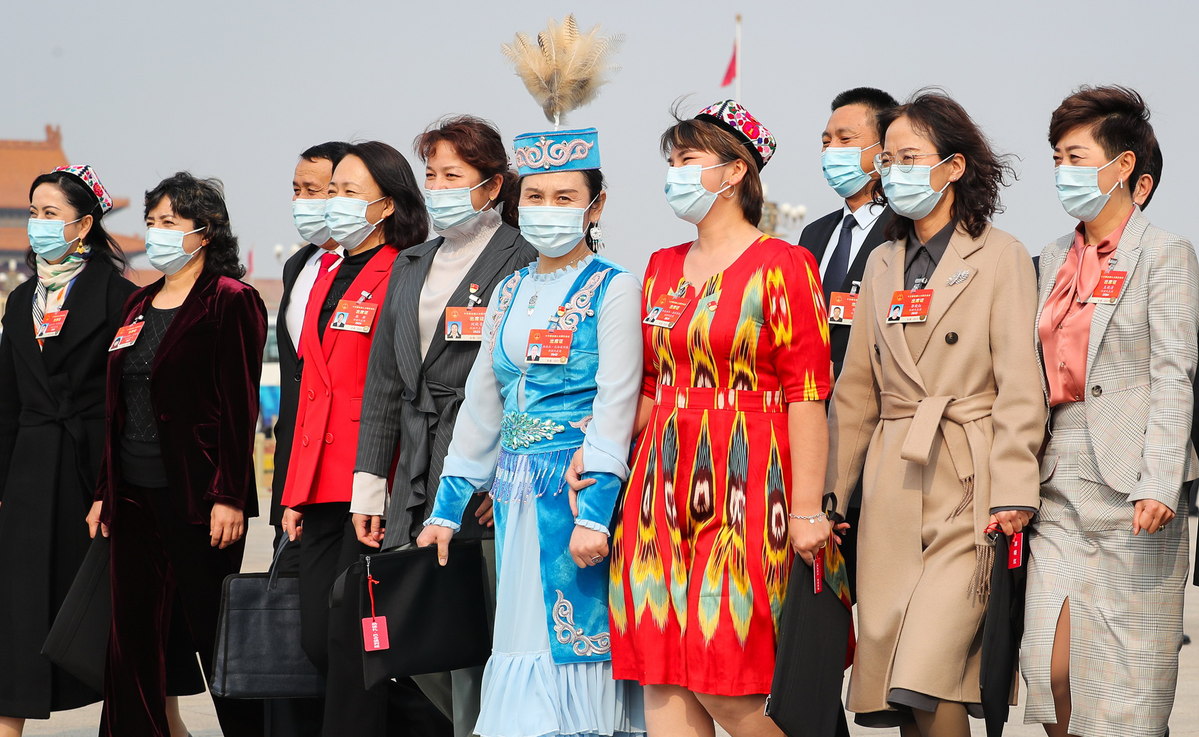
Tohutihan Roz, 36, has been working in a rose tea factory in Yutian county, Xinjiang Uygur autonomous region, since 2017. She was among the first group of women from her village to work in the factory near her home.
"I enjoyed working in the factory because the stable income has given me a sense of security. My income has improved the lives of my family and myself," said Tohutihan, who has been promoted to production technician. "I never knew I could be capable of so many things other than housework and farmwork."
Young women in rural areas of Xinjiang today have more opportunities to change their lives than ever. They know that their future is in their own hands, according to women who are deputies to the National People's Congress from the region.
"About 80 percent of young women from my village have found jobs in the past few years, and they are proud of being able to support their families. More importantly, they can make their own decisions about education and employment without being afraid to be rejected by others," said Rukyam Matisad, from Yutian, in southern Xinjiang's Hotan prefecture.
According to the Yutian Women's Federation, the employment rate of women in the county has increased to 95 percent in 2020 from just 31 percent in 2016.
Such change may seem insignificant to many, but in the eyes of the 25-year-old deputy, it's remarkable. Due to the lack of development and the influence of religious extremism in southern Xinjiang, women were once seen as the possessions of men. They had no choice but to stay at home because going to school or working was described as "immoral" by the extremists, according to Rukyam, an NPC deputy from the Xinjiang delegation.
"Many women told me that they will never forget the feeling of buying clothes with the money they earned for the first time because that's the moment that they know how great it is to be independent," said Rukyam, a member of the Uygur ethnic group.
Besides being forced to live by the rules of religious extremism in the past, lack of opportunities had also limited women's development paths in southern Xinjiang, Rukyam added.
"Now they can get all the support they need no matter if they decide to work in factories, run their own businesses or take care of farmland," she said. "The fact is that they have many options to choose from. If one thing doesn't work out, they can quit and try other things. No one can force them to do the things they don't want to do anymore."
In the past, a girl getting a junior high school diploma was considered to have received "enough "schooling in rural Xinjiang. Their families would then refuse to support any further education, even if they had great potential, because they believed education wasn't important for women, she said.
"Such views have also changed. The families all see having daughters who get into universities as an honor. Also, those who have returned to their villages after graduating from a university have brought back new ideas and become the backbones of rural development," Rukyam added.
Better education and more job opportunities also give women in Xinjiang more say in deciding how many children they want to have. "In the past, it was all up to their husbands," Rukyam said.
"As more and more women have learned about their reproductive rights and their family status has significantly improved, they can have a say on whether to have children, or how many children they want to have," she said.
Fatima, an NPC deputy from Xinjiang, said the region's family-planning policy is in line with the country's regulations. "The region offers women in rural areas free annual health checkups, which are extremely popular, because more and more women know the importance of taking care of themselves."
More life options
The changes young women are experiencing are the combined results of anti-extremism and poverty alleviation efforts, said Cui Jiuxiu, an official from Tuokezhake, in Shufu county, southern Xinjiang's Kashgar prefecture.
"Xinjiang's continuous efforts to boost social development have given young women opportunities after they were liberated from a life controlled by religious extremism," said Cui, also an NPC deputy from Xinjiang.
Social media has also opened the eyes of young women in Xinjiang, the 29-year-old said. "There are many women from Xinjiang sharing their stories of success on social media, which have encouraged young women from rural Xinjiang to think big and explore different life choices."
She said Western media reports on Xinjiang often left her "speechless", especially the accusations that the regional government has forced the locals, including young women, to work.
"They really don't understand Xinjiang at all. The regional government is simply creating job opportunities, many of which didn't exist in the past. It's up to the young women to decide if they want to apply or not," she said.
Cui came to Xinjiang to build her career after graduating from a university in Shandong province in 2014. She said she can perfectly understand the difficulties of making changes.
"For young women, many opportunities are like an unknown territory, such as working outside the region, so it's only natural for them to be baffled. But they are willing to try out those options so they can find what they love to do. I believe it's major progress," she said.
"I really want to ask Western media and politicians if seeing young women having no opportunities or education, but having to stay at home, is the ideal way of protecting human rights in their eyes?" Cui said. "Why can't they stand to see them being independent and ambitious like many Western women are?"
After seeing how others' lives are changed after getting a higher education and finding employment, more and more young women in rural Xinjiang are willing to follow in their footsteps, said Fatima, the NPC deputy.
"They don't want to miss the opportunities. They also know how to protect their rights in accordance with the law," said Fatima, also a lawyer from the Uzbek ethnic group.





