



High-level talks 'constructive'









Beijing and Washington gain deeper understanding of each other's concerns
The recently concluded two-day high-level strategic dialogue between Beijing and Washington was constructive, helped bolster mutual understanding and was a promising signal for a global recovery, with the long-awaited gathering touching on an expansive agenda and yielding fresh consensus, officials and Chinese scholars said.
Both sides agreed to maintain dialogue, roll out cooperation and avoid misjudgment and confrontation, and they "both expect this kind of high-level strategic communication to continue", according to a statement released by the Chinese delegation after the talks, held on Thursday and Friday in Anchorage, Alaska.
As a promising sign for keeping ties from worsening, the two sides discussed arranging COVID-19 vaccination for each other's diplomats, adjusting visa and travel policy based on the evolving pandemic and normalizing the exchange of visits.
In particular, the two countries said they are committed to increasing communication and cooperation in the field of climate change, deciding to "set up a joint working group on climate change", the release said.
They outlined topics for future discussions, including facilitating the operations of each other's diplomatic missions and media reporters, as well as multilateral events such as G20 and the Asia-Pacific Economic Cooperation forum.
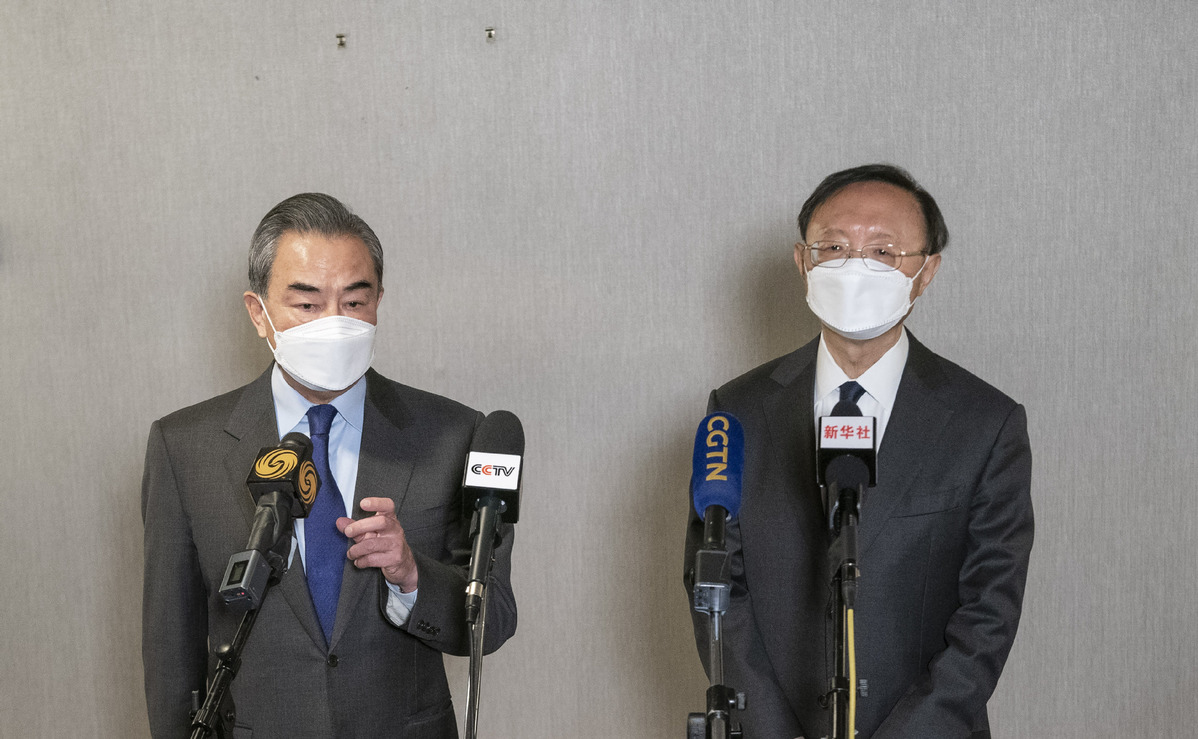
At the dialogue venue, the Chinese delegation was led by Yang Jiechi, a member of the Political Bureau of the Communist Party of China Central Committee and director of the Office of the Foreign Affairs Commission of the CPC Central Committee, and State Councilor and Foreign Minister Wang Yi.
United States Secretary of State Antony Blinken and National Security Advisor Jake Sullivan represented Washington at the dialogue.
Yang Jiechi told reporters upon the event's conclusion that the dialogue was "candid, constructive and helpful", though there are still some important differences between the two sides.
He said China will firmly safeguard its national sovereignty, security and development interests, and the two sides should handle relations in the spirit of nonconflict, non-confrontation, mutual respect and win-win cooperation, so as to move forward the bilateral relationship on a sound and stable track.
Wang, the state councilor, said "the door for China-US dialogue would be always open", if the US could work toward the same goal as China and respect each other's core interests and major concerns.
A dialogue must be based on mutual respect, and only one side of the two parties should not come up with a long list for bargaining, Wang added.
Ruan Zongze, vice-president of the China Institute of International Studies, said the latest dialogue was "timely, expansive in agenda and adequate in the length of time for talks," given the huge needs from both sides to communicate and to fix damage triggered by the previous US administration.
It is also a positive sign that both sides expressed their readiness to continue this kind of high-level strategic contact, Ruan said, noting that through the dialogue, the two sides have enhanced mutual understanding and identified areas for cooperation, such as establishing a joint working group on climate change.
Ruan noted that during the dialogue, the Chinese side actually "drew a red line for China-US relations, thus helping reduce strategic miscalculation", as it laid out its principles and positions clearly and firmly, particularly its firm opposition to US interference in China's internal affairs.
Wang Fan, vice-president of China Foreign Affairs University, said that the high-level strategic dialogue was a key step to realizing the consensus reached by the two heads of state during their phone call last month, noting that "the strategic guidance offered by the two heads of state is very important".
Despite the exchange of harsh words at the beginning of the dialogue, the officials' interactions behind closed doors were rational and smooth in general, and the communication proved effective, Wang noted.
"Dialogue is better than confrontation, and such a dialogue itself means a positive impact," Wang said.
The China-US ties are win-win in nature as "most US enterprises operating in China continued to make profits in the past few years "and some even increased their investment, Wang said.
The two sides share a great spectrum for cooperation, including in combating COVID-19, economic recovery and climate change, and of course, such cooperation must be two-way, win-win and should address the concerns of both sides in a balanced manner, Wang added.
During the dialogue, Beijing voiced its sincerity in accepting the US invitation for dialogue, explained its future plans for growth and the CPC's leading role, laid out views on multilateralism and highlighted the win-win nature of China-US ties.
The Chinese delegation also made clear that there will be no concession on the Taiwan question, that the US should stop interfering in China's domestic affairs, including those related to the Hong Kong Special Administrative Region, the Xinjiang Uygur autonomous region and the Tibet autonomous region.
Diao Daming, an associate professor of US studies at the School of International Studies of Renmin University of China, said such a dialogue is indispensable for two major countries that "have certain differences and must cooperate with one another".
China's serious response to unfounded accusations made by the US officials at the dialogue's opening served national interests and "helped bring the dialogue back to the right track". No dialogue can be a success without mutual respect and the spirit of seeking common ground while shelving differences, Diao said.
During the dialogue, the Chinese side elaborated on its way of rolling out governance and its determination to continue on its own development path, which "will help deepen the US side's understanding of its counterpart", Diao said.
Washington should realize that US values do not mean international values, and the rules formulated by the US and some other countries are not necessarily international rules, Diao added.
Wang Dong, a professor of US studies at the School of International Studies at Peking University, noted that at the dialogue's opening, the Chinese side named some prominent problems in the US, including racial discrimination against ethnic minorities. The US side also recognized its own problems.
"Through a fierce clash of views, a better understanding was underway. This is perfect for a case study in diplomacy," he said.
Promoting the healthy and stable development of China-US relations is the shared aspiration of the two peoples and the international community, and China and the US should join hands in advancing their relations and safeguarding peace and stability in the Asia-Pacific region, Wang said.










