



Tokyo must stop playing with nuclear waste lest it burns itself









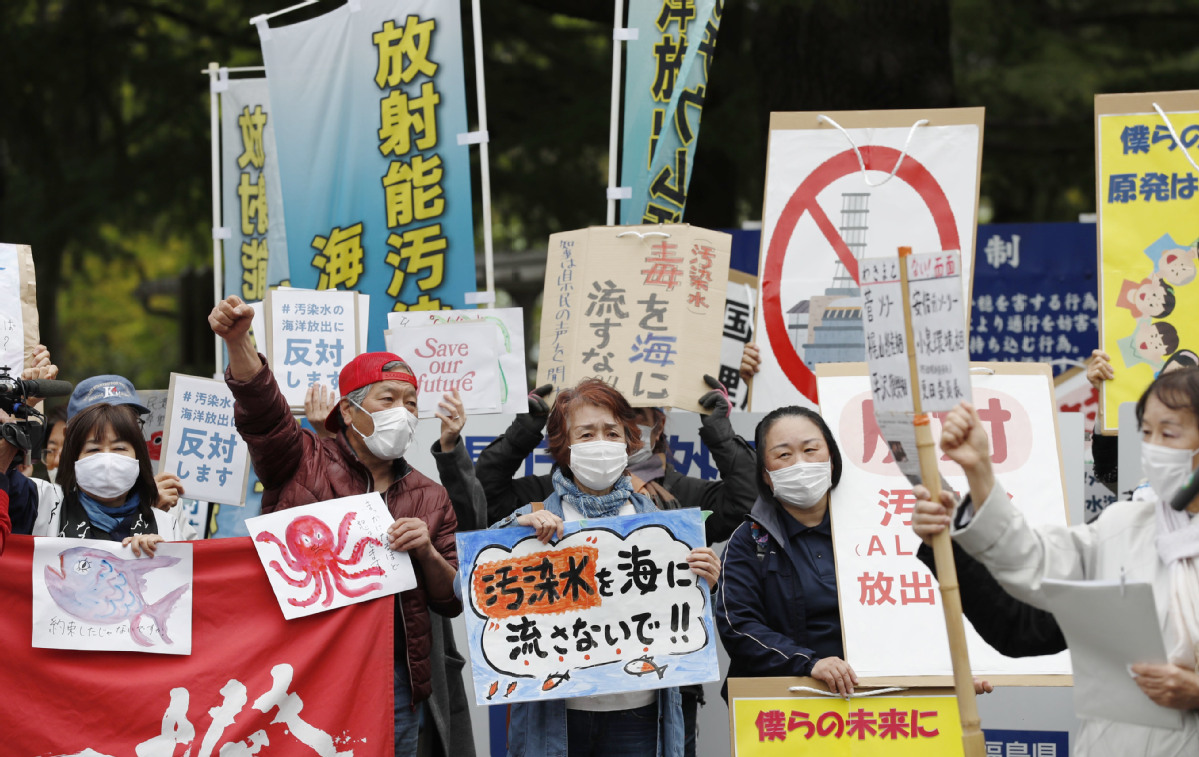
The damage caused to Japan's Fukushima Daiichi nuclear power plant by the tsunami triggered by the massive earthquake on March 11, 2011, was debilitating and tragic. The Tokyo Electric Power Company, which owns the Fukushima plant, has been, according to reports, trying to minimize the impact of the radiation from the now crippled facility on the environment.
Yet on Tuesday, the Japanese government decided to discharge radioactive water from the plant into the sea in two years. Japan's decision has rightly been opposed by China and other countries including the Republic of Korea, for the highly toxic water from Fukushima, if released into the Pacific Ocean, will pose a direct threat to the marine environment and public health in not only Japan but also other countries, and thus violate international environmental laws.
Studies suggest the tsunami-driven seawater that engulfed the Fukushima plant has long since receded. Despite that, plant officials have been struggling to cope with a different kind of flood, that is, huge volumes of radioactive water the disabled facility generates each day. More than 1.25 million cubic meters of radiation-laced water is currently stored in an expanding forest of tanks.
The tsunami that hammered Fukushima a decade ago triggered meltdowns in three of the plant's six nuclear reactors, which left an intrinsic mess of intensely radioactive fuel loose in the reactor buildings. And up to 150 tons of groundwater percolated into the reactors through cracks in their foundations every day and became contaminated with radioactive isotopes.
What TEPCO did to prevent the radioactive water from leaking into the ground or the Pacific Ocean is to pump it out through a massive filtering system housed in a hangar-sized building. There are rows of seven-foot tall stainless steel tubes, filled with sand grain-like particles that perform a process called ion exchange-they "catch" ions of cesium, strontium, and other dangerous isotopes in the water.
TEPCO stores the highly radioactive sludge created as a byproduct in thousands of sealed steel canisters kept elsewhere on the site.
Although by 2013, the company developed artificial particles-a form of titano silicate-that also grab strontium, the filters still didn't "catch" tritium, a radioactive isotope of hydrogen. The problem is that cesium and strontium atoms go into solution with water, but tritium can bond with oxygen just like regular hydrogen, which means the water molecules themselves will become radioactive.
Veolia Nuclear Solutions that acquired Kurion, a California-based company which installed the filtering system at Fukushima just weeks after the disaster, claims to have developed a method to "catch" tritium, but TEPCO refused to avail of its services because it would cost of billions of dollars.
Instead, TEPCO continued pumping the tritiated water into a growing number of tanks. And to prevent the groundwater from getting into the plant, the company built a network of pumps, and in 2016 it installed an underground "ice wall", a $300 million subterranean fence of 25-meter-long rods through which tons of sub-zero brine is pumped, freezing the surrounding soil.
But TEPCO says it can't store all of the tritiated water indefinitely. Hence, the Japanese government has decided to discharge the contaminated water into the sea.
Since 2011, TEPCO and the Japanese government have been trying to assure the Japanese public and the international community that they would not allow radioactive water from the plant to leak into the sea or contaminate the underground water table around the Fukushima plant.
But the little faith the Japanese public had in TEPCO suffered a severe blow in the first two to three years after the meltdowns in the reactors, when several investigations forced the company to accept that it had underreported the amount of radiation released into the environment during and after the disaster.
That TEPCO-and by extension the Japanese government-didn't accept Veolia's proposal to decontaminate Fukushima's wastewater of tritium because of the high cost involved shows they have not exhausted "all safe ways of disposal" and not consulted with neighboring countries and the international community before deciding to release the radioactive water into the sea, which is a "highly irresponsible" act.
As a signatory to the United Nations Convention on the Law of the Sea, Japan is obliged to protect the marine environment, because according to the convention, signatory states should not, directly or indirectly, dump substances into the ocean that could harm or are likely to harm the ocean's bio-system and thus pose a threat to human health.
As such, Japan should, as the Chinese Foreign Ministry said on Tuesday, "refrain from wantonly discharging the wastewater" before reaching a consensus with "all stakeholders and the International Atomic Energy Agency through full consultations".
So before actually releasing the contaminated water into the sea, Japan should submit all relevant information to the countries that could suffer damage, because discharge of radioactive water is not only an issue of Japan; it concerns the entire international community. If Japan ignores the global protests against its decision and releases the contaminated water into the sea, it would violate UNCLOS and international laws, as well as damage the marine environment.
The author is a senior editor with China Daily.
If you have a specific expertise and would like to contribute to China Daily, please contact us at opinion@chinadaily.com.cn, and comment@chinadaily.com.cn.





