



US must cut emissions by at least half









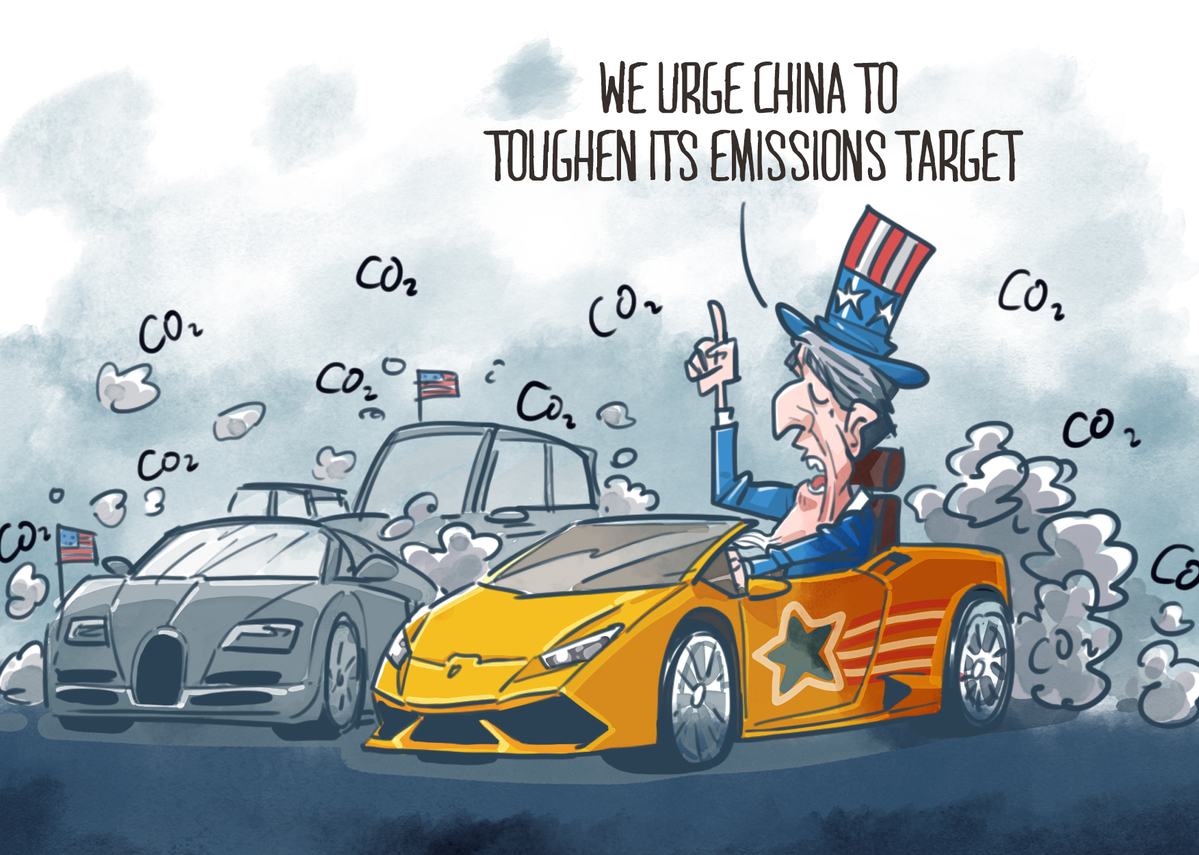
United Nations Secretary-General Antonio Guterres has said that "2021 is a make or break year" to confront the global climate emergency. After rejoining the Paris Agreement, the Joe Biden administration must now rise to the climate challenge and commit to an ambitious and achievable 2030 Nationally Determined Contribution of reducing the US' greenhouse gas (GHG) emissions at least 50 percent below 2005 levels by 2030 to set the stage for the forthcoming UN Climate Change Conference in Glasgow, Scotland, in November.
The Natural Resources Defense Council, a nonprofit international environmental group based in the US, has published an analysis, titled "The Biden Administration Must Swiftly Commit to Cutting Climate Pollution at least 50 percent by 2030", which shows that for a fraction of the United States' GDP, we can help avert a global climate crisis by building an energy system that creates jobs and drives economic growth, improves public health, supports equity priorities, and affords Americans and their communities a safer future.
We (at the NRDC) find that a minimum of 50 percent net GHG reductions target by 2030, below 2005 levels is technologically feasible, affordable and achievable — adding to the tally of recent studies reaching the same conclusion.
The analysis shows that a strong pledge to cut GHG pollution by the end of the decade, if coupled with strong federal policies, could have the following the outcomes.
It could put the US on a path to add no new carbon pollution to the atmosphere by 2050 — which scientists say is needed to limit global temperature rise to 1.5 degrees Celsius and avoid the worst devastations from climate change.
It could create millions of jobs from sustained construction activity in clean infrastructure like wind and solar technologies and electric transmission lines.
It could ensure new job opportunities for communities impacted by the transition from fossil fuel to clean energy and prioritize cutting pollution in vulnerable communities that have suffered a disproportionate air pollution burden for decades, which could make the country fairer and more equitable.
It could deliver more than $150 billion in economic and health benefits in 2030 — well above that year's investment of $100 billion.
It could help avoid tens of thousands of premature deaths because people would breathe cleaner air.
And it could bolster the administration's "Build Back Better" priorities and post-pandemic economic goals to pull the country out of recession.
In fact, our modeling shows that a 53 percent GHG reduction by 2030 is technologically feasible and would cost just 0.4 percent of projected US gross domestic product. The 53 percent goal can be achieved relying on familiar decarbonization pillars assuming reasonable and demonstrated levels of ambition.
The following measures constitute one pathway out of the many charted by recent studies towards the same goal by 2030.
Zero-carbon electricity: The share of zero-carbon electricity nearly doubles compared with today to make up about 80 percent by 2030, and emissions from coal power plants are nearly entirely eliminated. The power sector is the linchpin of decarbonization in this decade and the vehicle to cleaning up the other sectors as we electrify our vehicles, buildings and industries. This highlights the vital need for bold federal policies to accelerate the sector's transition to clean energy.
Energy efficiency: By reducing energy demand, efficiency remains a highly cost-effective decarbonization tool to reduce the size of investments needed over the next decade and beyond. By 2030, among other measures, aging appliances are replaced with best available commercial and efficient technology and more than 14 million US homes are weatherized.
Electrification: remarkable advancements in electric vehicles and high-efficiency heat pumps, together with bold corporate commitments and state policies are the basis for ambitious federal action. By 2030, more than 50 percent of vehicles sold are zero-emissions vehicles — across vehicle segments — and nearly 100 percent of building heating equipment sold is electric.
We also assume reductions in non-carbon dioxide emissions and investments in preserving and enhancing land carbon sinks through reforestation, afforestation and improved agricultural soil management.
Committing to an ambitious 2030 target is also critical to position the US on a cost-effective path to net-zero emission by 2050. Otherwise, new fossil-reliant and long-lived infrastructure such as pipelines and industrial plants would still be added in bulk during this decade, which would be expensive to replace or decarbonize as we move closer to 2050.
We can no longer afford any wavering on addressing the climate crisis. Climate change is already harming millions of Americans, from worsening asthma and public health to destructive and woefully costly extreme weather events.
Opportunity knocks: we must answer the call.
The author is a policy analyst of Climate and Clean Energy Program with the Natural Resources Defense Council. The views don't necessarily reflect those of China Daily.
If you have a specific expertise and would like to contribute to China Daily, please contact us at opinion@chinadaily.com.cn, and comment@chinadaily.com.cn.





