



Macro policies can mend structural imbalances









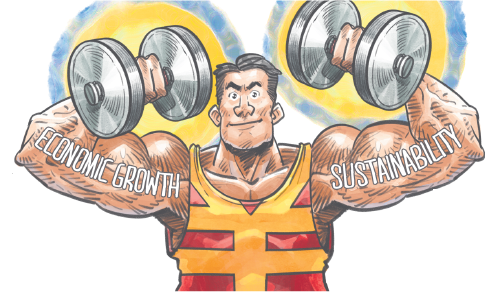
Economic rebalancing, structural recovery, development and transitions, rather than pursuit of a large size of economic aggregate, are the main goals of China's macroeconomic policies this year.
We should attach importance to both GDP growth and economic structural adjustment, which is a major direction of our country's macroeconomic policies.
Last year, governments around the world put emphasis on preventing economic recessions and promoting an economic rebound. Therefore, at that time, the main target of policies was to maintain fairly high GDP growth. That is why, we saw unprecedented fiscal and monetary stimulus.
The global economy contracted by 3.3 percent in 2020. After the recession, a new imbalance between economic structure and activities has emerged, as the COVID-19 pandemic has had different effects on different industries, residents and regions.
The new imbalance is reflected in various aspects, such as the imbalance between virtual economy and the real economy, which affected the employment of women and low-income, low-tech young people more seriously than the average labor force during the pandemic.
Policymakers should pay special attention to structural changes in the economy in different countries, as well as a series of changes in different domestic industries and different employed groups.
China posted 2.3 percent GDP growth in 2020 and became the only major economy that reported growth. But we also saw that the imbalance in the overall economic activities has further increased.
On the supply side of the economy, although the industrial sector rebounded strongly, the services sector rebounded weakly due to its feature of close person-to-person contact.
As China is making a transition from a manufacturing economy to a services-led economy, its manufacturing and industrial sectors have declined step by step since they peaked in 2012-13. The country is also gradually forming a big pattern of a consumption-led domestic market that boosts economic growth.
However, the pandemic brought reverse shock to the fundamental economic structure and the trend of economic activities, which means we need to think about the way forward.
While forcefully promoting economic rebound, we must attach greater importance to the economic structure and have our policies focus more on structural recovery. That is why, rebalancing will become extremely important.
At the start of this year, China entered a new transition of its economic structure, with three major structural changes.
The first change is aging. Its speed and size will far exceed our imagination. People aged 65 and over now account for 12 percent of China's population. In 2050, its net population increase is expected to be above the age of 60, while the country will see a net decline in the population under 60.
Aging and longevity will bring huge structural changes, which will fundamentally change supply and demand of the economy and also the financial sector.
If we look at Japan's experience, data since 1994 show that the manufacturing, construction and financial sectors accounted for a smaller portion of its GDP, whereas the healthcare, science and technology, and communications industries expanded.
Aging also caused a decrease in potential economic growth, low labor productivity and low inflation.
The second major structural change is related to China's commitment to achieve carbon neutrality by 2060. Last year, coal consumption accounted for about 57 percent of China's primary energy consumption.
To cut the portion to around 6 percent, the country must take the path of green development, which is a fundamental change in economic development mode, backed by a technological revolution.



















