Railway embodies the charm and pace of rural life









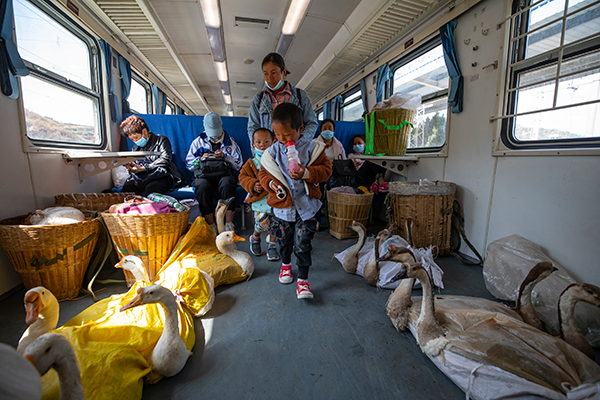
CHENGDU-In an age of ever-extending high-speed rail networks and a race for efficiency, slow trains with an average speed of less than 40 kilometers per hour still diligently chug through the mountains and across the deserts in remote corners of China.
The slow trains, carrying the hope of local people, move forward steadily and surely, with a unique rhythm that has not changed for more than 50 years.
Layi Axia, 75, a member of the Yi ethnic group from Mianshan township in Liangshan Yi autonomous prefecture, Sichuan province, remembers the day a train first rolled into her local railway station. She and her husband took their 1-year-old son and walked 7 km to see it.
"The train carriage was decorated with small red flags. We waved to the passengers, and they waved back," she recalls. "It was an unforgettable day in my life."
She was still a newlywed when the Chengdu-Kunming Railway, a major transportation artery linking Southwest China's Sichuan and Yunnan provinces, opened in 1970.
She and her husband, a former soldier, toiled in the fields, busy with farmwork to support their family. Later, her husband succumbed to illness and died, leaving her and their three young sons behind. She struggled for years until, when she was in her 50s, they married.
She runs a small shop in Mianshan, selling hairpins, binding strings, hats, socks and the like. She takes the slow train to replenish her stock at a wholesale market in Xichang, the capital city of the prefecture, and goes to Sunday fairs. Business is slow, but it kills time and she makes enough to cover her household spending.
Over the past half-century, trains running on the Chengdu-Kunming Railway have been speeding up with the development of the nation. The slow trains have also changed-coal is no longer burned for power and the seats are much more comfortable.
However, the 5633/5634 train running between Puxiong township and Panzhihua city still maintains its initial speed of, on average, less than 40 km per hour. The whole journey is 376 km, with 26 stops along the way and takes a trundling 11 hours and 4 minutes. However, the fares have remained unchanged for over three decades with the highest costing 25.5 yuan ($3.9), and the lowest being just 2 yuan.
Liu Wei, 46, has been working on the slow train for 28 years.
In 1968, his father, a retired army veteran and the only clinical doctor covering a vast area, was dispatched to Tiexi Station along the Chengdu-Kunming Railway. Liu Wei recalls that their time at the small station was lonely, but the slow train was a lifeline, bringing news from afar, as well as strangers to talk to. Every time the slow train would pull into the station, workers, the elderly, children and dogs all stood together on the platform. Although the train stayed for just two minutes, it washed away their boredom.
Liu, once a young student, went to school by train every day. In the carriage, he listened to passengers discuss current affairs, watched peddlers bargain and observed train attendants. In his eyes, the attendant uniform was the most handsome outfit. His mother always carried potatoes and apples to sell.
After graduation from middle school, he, too, became a train attendant. "When I see children, I see what I used to be. When I see the old selling things, I see my mother," he says.
To Liu, the train he's been working on is "a train of life".
Over the years, at least seven or eight children were born on Liu's train, and some Yi villagers even named their children Manche, meaning "slow train" in Chinese.
Once, a baby boy, upon birth, was abandoned in a toilet on the train. Luckily, however, he was adopted by a woman traveling on that same journey. While traveling on the train five years later, the woman spotted Liu and told him, while pointing to the child next to her: "This is the boy from the toilet."
It was also through the train that many young passengers learned about the "big, outside world".
Asu Ershi, 45, now a vice-principal at a high school in Xide county along the railway, had grown up counting the carriages of slow trains, and in the late 1980s, he and his childhood friends took the slow train to school. It was on the train that they first heard adults talk about Chengdu and Chongqing, big cities of the outside world.
At the boarding school where he works, every two weeks, more than 700 students take the 5633/5634 train home, and then again to return to the school. One big change, Asu Ershi says, compared to the days when he was a student, girls were rarely seen on the train, but today, girls make up two-thirds of students. Moreover, people are dressing more fashionably, fewer drink on trains and soon-to-be teenage brides, who would take the train to their husbands' hometowns to get married, are rarely seen.
Outside the carriage window, more changes have taken place: Buildings and greenhouses containing vegetables and fruit have "grown" from the once barren land; preschoolers are sent to kindergartens; and young people who left the mountains have returned with confidence and ambition.
Though home to the world's most developed high-speed railway network, China still regularly operates 81 slow train services, covering regions populated by 35 ethnic groups, transporting some 12 million people annually at an average cost of no more than 0.06 yuan per km.
In order to ensure that these slow trains arrive, come rain or shine, the Chinese government not only provides annual subsidies, but also makes investments in upgrading the stations and building roads along the railways.
"No matter how much the world changes and how fast high-speed trains are, the slow train is still some people's lifeline," Liu says.